4,068 posters, 219 videos, 101 topics, 69 sessions, 14,365 authors, 6,128 institutions
ePostersLive by SciGen Technologies S.A. All rights reserved.
Alzheimer's Association International Conference 2026
July 12-15, 2026 | London, United Kingdom, and Online

5719
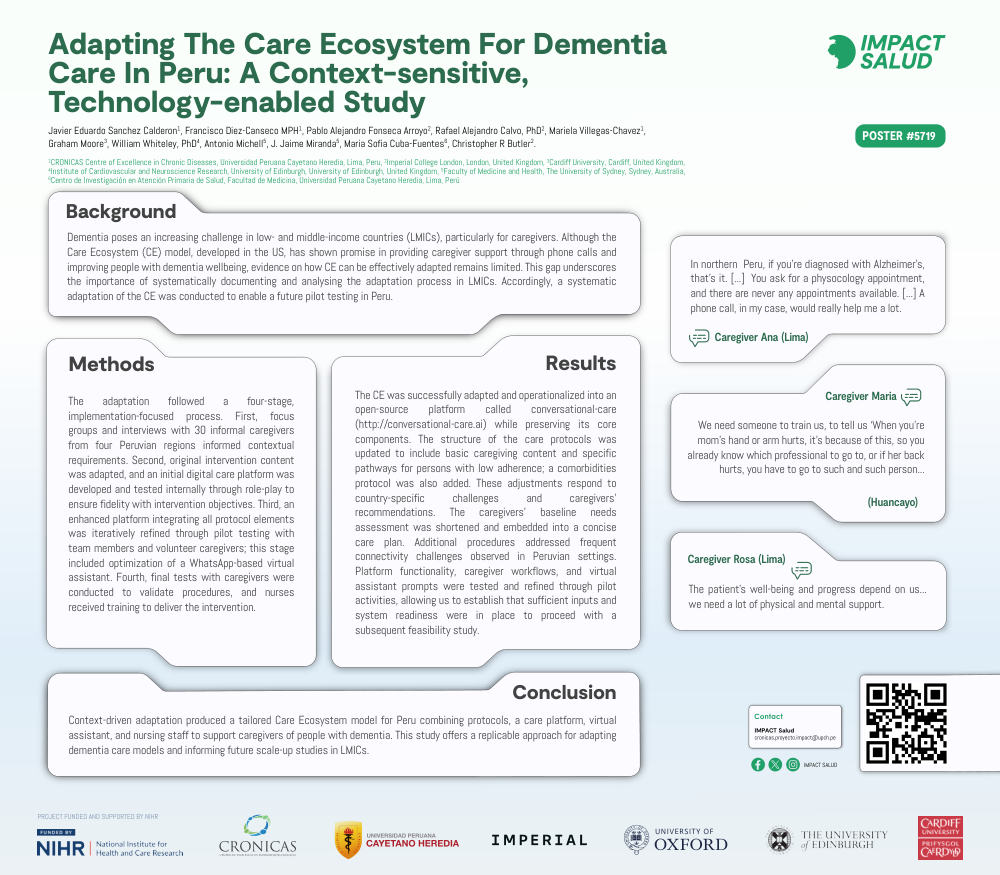
Adapting The Care Ecosystem For Dementia Care In Peru: A Context-sensitive, Technology-enabled Study
Poster Presenter
Authors
Javier Eduardo Sanchez Calderon, Francisco Diez-Canseco, Pablo Fonseca, Rafael A. Calvo, Mariela Villegas, Graham Moore, William Whiteley, Antonio Michell, Maria Sofia Cuba-Fuentes, Christopher R Butler
Affiliations
CRONICAS Center of Excellence in Chronic Diseases, Universidad Peruana Cayetano Heredia, Lima, Peru, Centro de Investigación en Atención Primaria de Salud, Facultad de Medicina, Universidad Peruana Cayetano Heredia, Lima, Perú, Imperial College London, London, United Kingdom., Dyson School of Design Engineering, Imperial College London, London, United Kingdom, Centre for Development, Evaluation, Complexity and Implementation in Public Health Improvement (DECIPHer), School of Social Sciences, Cardiff University, Cardiff, United Kingdom, Institute of Cardiovascular and Neuroscience Research, University of Edinburgh, University of Edinburgh, United Kingdom, Faculty of Medicine and Health, The University of Sydney, Sydney, Australia., Imperial College London, London, United Kingdom
Part of Topic
Background:
Dementia poses an increasing challenge in low- and middle-income countries (LMICs), particularly for caregivers. Although the Care Ecosystem (CE) model, developed in the US, has shown promise in providing caregiver support through phone calls and improving people with dementia wellbeing, evidence on how CE can be effectively adapted remains limited. This gap underscores the importance of systematically documenting and analysing the adaptation process in LMICs. Accordingly, a systematic adaptation of the CE was conducted to enable a future pilot testing in Peru.
Methods:
The adaptation followed a four-stage, implementation-focused process. First, focus groups
and interviews with 30 informal caregivers from four Peruvian regions informed contextual requirements. Second, original intervention content was adapted, and an initial digital care platform was developed and tested internally through role-play to ensure fidelity with intervention objectives. Third, an enhanced platform integrating all protocol elements was iteratively refined through pilot testing with team members and volunteer caregivers; this stage included optimization of a WhatsApp-based virtual assistant. Fourth, final tests with caregivers were conducted to validate procedures, and nurses received training to deliver the intervention.
Results:
The CE was successfully adapted and operationalized into an open-source platform called conversational-care (http://conversational-care.ai) while preserving its core components. The structure of the care protocols was updated to include basic caregiving content and specific pathways for persons with low adherence; a comorbidities protocol was also added. These adjustments respond to country-specific challenges and caregivers’ recommendations. The caregivers’ baseline needs assessment was shortened and embedded into a concise care plan. Additional procedures addressed frequent connectivity challenges observed in Peruvian settings. Platform functionality, caregiver workflows, and virtual assistant prompts were tested and refined through pilot activities, allowing us to establish that sufficient inputs and system readiness were in place to proceed with a subsequent feasibility study.
Conclusion:
Context-driven adaptation produced a tailored Care Ecosystem model for Peru combining protocols, a care platform, virtual assistant, and nursing staff to support caregivers of people with dementia. This study offers a replicable approach for adapting dementia care models and informing future scale-up studies in LMICs.
Comments
Email is required but is not shown publicly.
Loading comments...