4,068 posters, 219 videos, 101 topics, 69 sessions, 14,365 authors, 6,128 institutions
ePostersLive by SciGen Technologies S.A. All rights reserved.
Alzheimer's Association International Conference 2026
July 12-15, 2026 | London, United Kingdom, and Online

1742
Proactive Management Of Primary Progressive Aphasia In Arabic-speaking Patients: A Practical Framework
Poster Presenter
Authors
Affiliations
Part of Topic
Background: Despite advancements in diagnosing and treating primary progressive aphasia (PPA), there is a persistent need to adapt non-pharmacological interventions for speakers of underrepresented and minority languages, particularly those outside the Indo-European family. To address this gap, we developed a remote, culturally-adapted linguistic management protocol for Moroccan Arabic-speaking patients with PPA and their caregivers
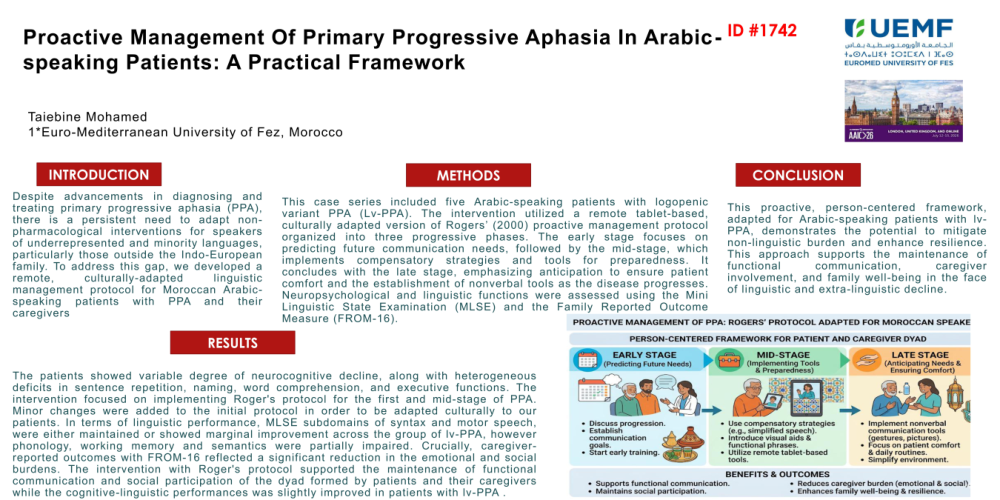
Methods: This case series included five Arabic-speaking patients with logopenic variant PPA (Lv-PPA). The intervention utilized a remote tablet-based, culturally adapted version of Rogers’ (2000) proactive management protocol organized into three progressive phases. The early stage focuses on predicting future communication needs, followed by the mid-stage, which implements compensatory strategies and tools for preparedness. It concludes with the late stage, emphasizing anticipation to ensure patient comfort and the establishment of nonverbal tools as the disease progresses. Neuropsychological and linguistic functions were assessed using the Mini Linguistic State Examination (MLSE) and the Family Reported Outcome Measure (FROM-16).
Results: The patients showed variable degree of neurocognitive decline, along with heterogeneous deficits in sentence repetition, naming, word comprehension, and executive functions. The intervention focused on implementing Roger's protocol for the first and mid-stage of PPA. Minor changes were added to the initial protocol in order to be adapted culturally to our patients. In terms of linguistic performance, MLSE subdomains of syntax and motor speech, were either maintained or showed marginal improvement across the group of lv-PPA, however phonology, working memory and semantics were partially impaired. Crucially, caregiver-reported outcomes with FROM-16 reflected a significant reduction in the emotional and social burdens. The intervention with Roger's protocol supported the maintenance of functional communication and social participation of the dyad formed by patients and their caregivers while the cognitive-linguistic performances was slightly improved in patients with lv-PPA .
Conclusion: This proactive, person-centered framework, adapted for Arabic-speaking patients with lv-PPA, demonstrates the potential to mitigate non-linguistic burden and enhance resilience. This approach supports the maintenance of functional communication, caregiver involvement, and family well-being in the face of linguistic and extra-linguistic decline.
Comments
Email is required but is not shown publicly.
Loading comments...