4,068 posters, 219 videos, 101 topics, 69 sessions, 14,365 authors, 6,128 institutions
ePostersLive by SciGen Technologies S.A. All rights reserved.
Alzheimer's Association International Conference 2026
July 12-15, 2026 | London, United Kingdom, and Online

2677
Initiation Of Advance Care Planning In Dementia: A Conversation Analytic Study Of GP Consultations
Poster Presenter
Part of Topic
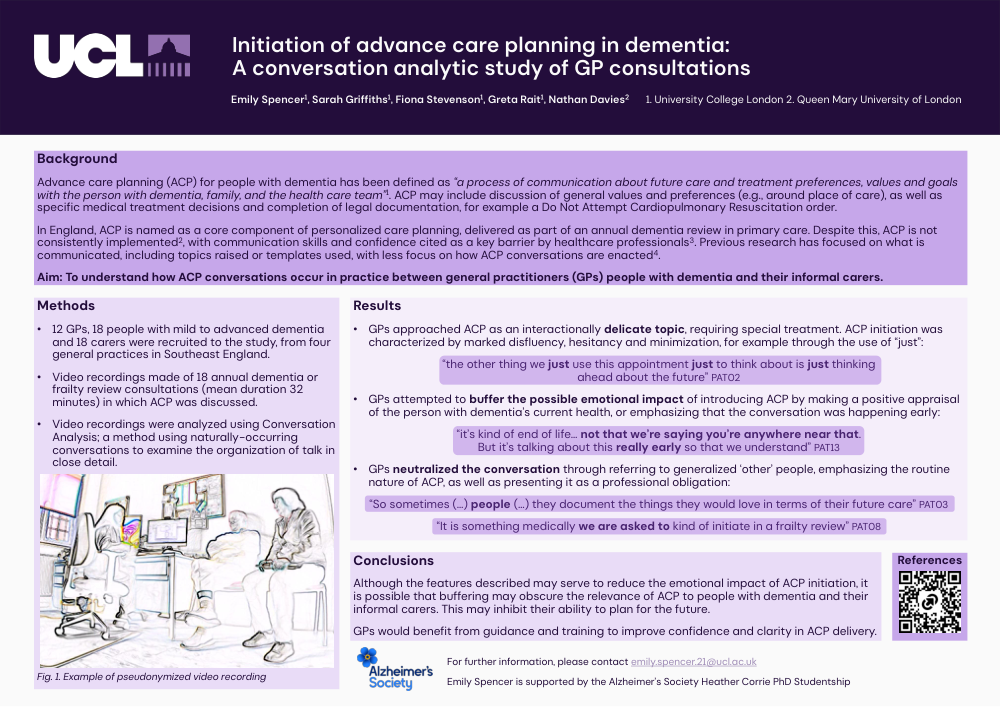
Initiation of advance care planning in dementia: A conversation analytic study of GP consultations
Background
Advance care planning (ACP) for people with dementia has been defined as “a process of communication about future care and treatment preferences, values and goals with the person with dementia, family, and the health care team”1. ACP may include discussion of general values and preferences (e.g., around place of care), as well as specific medical treatment decisions and completion of legal documentation, for example a Do Not Attempt Cardiopulmonary Resuscitation order.
In England, ACP is named as a core component of personalized care planning, delivered as part of an annual dementia review in primary care. Despite this, ACP is not consistently implemented2, with communication skills and confidence cited as a key barrier by healthcare professionals3. Previous research has focused on what is communicated, including topics raised or templates used, with less focus on how ACP conversations are enacted4.
Aim: To understand how ACP conversations occur in practice between general practitioners (GPs) people with dementia and their informal carers.
Methods
Results
“the other thing we just use this appointment just to think about is just thinking ahead about the future” PAT02
“it’s kind of end of life… not that we’re saying you’re anywhere near that. But it’s talking about this really early so that we understand” PAT13
“So sometimes (…) people (…) they document the things they would love in terms of their future care” PAT03
“It is something medically we are asked to kind of initiate in a frailty review” PAT08
Conclusions
Although the features described may serve to reduce the emotional impact of ACP initiation, it is possible that buffering may obscure the relevance of ACP to people with dementia and their informal carers. This may inhibit their ability to plan for the future.
GPs would benefit from guidance and training to improve confidence and clarity in ACP delivery.
Comments
Email is required but is not shown publicly.
Loading comments...