4,068 posters, 219 videos, 101 topics, 69 sessions, 14,365 authors, 6,128 institutions
ePostersLive by SciGen Technologies S.A. All rights reserved.
Alzheimer's Association International Conference 2026
July 12-15, 2026 | London, United Kingdom, and Online

10722
Decentralized Outreach Model For Alzheimer’S Disease And Related Dementia Research And Community Engagement In Peru
Poster Presenter
Authors
Pilar Giron-Davila, Pedro Mena, Maryenela Illanes-Manrique, Elison Sarapura-Castro, Andrea Rivera-Valdivia, Ismael Araujo-Aliaga, Carla Manrique-Enciso, Ana Saldarriaga-Mayo, Ines Caceres-Aranda, Vcitoria Marca-Ysabel, Angel Medina-Colque, Julia Rios-Pinto, Sheila Castro-Suarez, Henry Palomino-Lescano, Ivan Cornejo-Herrera, Edward Ochoa-Valle, Koni Mejia-Rojas, Claudia Mejia-Rojas, Aldo Vences-Balta, Larry Benavides-Vasquez, Jose Villafane-Alva, Jeffery M Vance, Giuseppe Tosto, Margaret Pericak-Vance, Mario Cornejo-Olivas
Affiliations
Columbia University, New York, NY, USA, Neurogenetics Research Center, Instituto Nacional de Ciencias Neurológicas, Lima, Peru, Dr. John T. Macdonald Foundation Department of Human Genetics, University of Miami Miller School of Medicine, Miami, FL, USA, Direccion Regional de Salud de Puno, Puno, Peru, Universidad Peruana Los Andes, Huancayo, Peru;, CBI en Demencias y Enfermedades Desmielinizantes del Sistema Nervioso, Instituto Nacional de Ciencias Neurológicas, Lima, Peru, Hospital Hipolito Unanue de Tacna, Tacna, Peru, Hospital Regional de Cusco, Cusco, Peru, Hospital Daniel Alcides Carrion, Callao, Peru, EDMECON, Educacion Medica Continua, Lima, Peru, Centro Medico Regional Piura, Piura, Perú, .Hospital II-2 Tarapoto, San Martin, Peru, Hospital Hospital II Tarapoto – EsSalud, San Martin, Peru
Part of Topic
Decentralized outreach model for Alzheimer’s Disease and Related Dementia research and community engagement in Peru
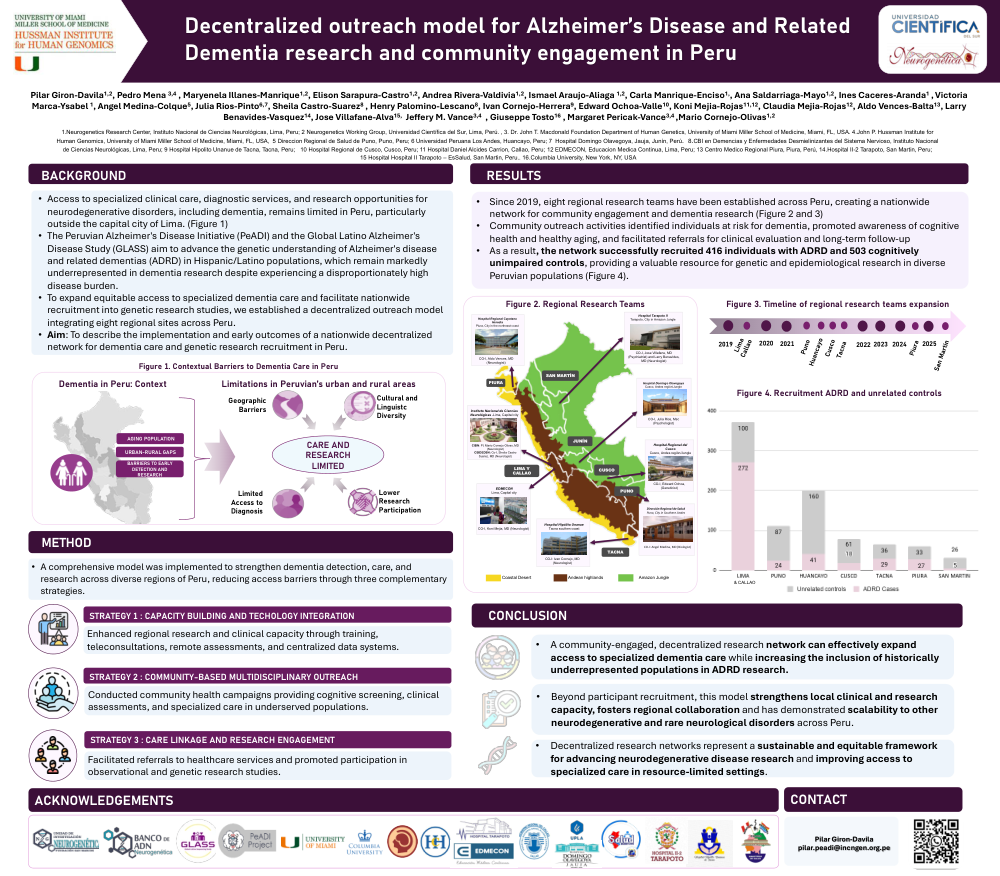
Background: In Peru, access to diagnostic services and specialized care for neurodegenerative disorders, including dementia, remains limited, particularly outside the capital city of Lima where most clinical care and research activities are concentrated. Geographic barriers, along with sociocultural and linguistic diversity, prevent timely dementia diagnosis and research participation, Ongoing genetic initiatives, including PeADI and GLASS, aim to address the underrepresentation of Hispanic/Latino populations in ADRD research, despite their disproportionately high disease burden .To overcome these challenges, we implemented a decentralized, interdisciplinary, and culturally adapted model to improve access to healthcare and enable systematic recruitment across diverse urban and rural settings.
Methods: The model integrated geographically and socioculturally diverse regions of Peru and was structured around three core strategies: (1) capacity building and integration of health technologies, including clinical and administrative training, regionally adapted educational modules, remote cognitive assessments, teleconsultation, and centralized data management systems; (2) community-based outreach multidisciplinary healthcare campaigns, delivering specialized medical care, cognitive screening, and standardized clinical evaluations in coordination with local stakeholders and community advocacy organizations; and (3) care linkage and research engagement, involving the referral of individuals with suspected or confirmed neurodegenerative diseases to appropriate healthcare providers and their invitation to participate in ongoing observational and genetic research studies.
Results: Since 2019, eight regional research teams have been established across Peru, encompassing the Lima–Callao metropolitan area, the Andean highlands, the north and south coastal regions, and the Amazonian jungle. Outreach activities facilitated the active identification of individuals at risk for dementia, who were informed of their cognitive status and referred to local healthcare services for clinical evaluation and longitudinal follow-up. From a research perspective, the model enabled the recruitment of 416 individuals with ADRD and 503 non-related cognitively unimpaired individuals . Despite these advances, key barriers to participation remain, primarily related to geographic dispersion, limited access to specialized services, and sociocultural and linguistic diversity .
Conclusions: Decentralized, community-engaged research models are feasible and effective for advancing ADRD genetic research in underrepresented populations. This approach strengthens local capacity, improves equity in access, and provides a sustainable and scalable framework for public health and dementia care initiatives in limited-resource settings.
Comments
Email is required but is not shown publicly.
Loading comments...