4,068 posters, 219 videos, 101 topics, 69 sessions, 14,365 authors, 6,128 institutions
ePostersLive by SciGen Technologies S.A. All rights reserved.
Alzheimer's Association International Conference 2026
July 12-15, 2026 | London, United Kingdom, and Online

1653
Treating Hearing Loss With Hearing Aids For The Prevention Of Cognitive Decline And Dementia
Poster Presenter
Authors
Lachlan Cribb, Margarita Moreno-Betancur, Matthew Pase, Rory Wolfe, Carlene Britt, Zhen Zhou, Raj Shah, Gary Rance, Kerry Sheets, Trevor Chong, Robyn Woods, Anne Murray, Alice Owen, Joanne Ryan
Affiliations
null,
Part of Topic
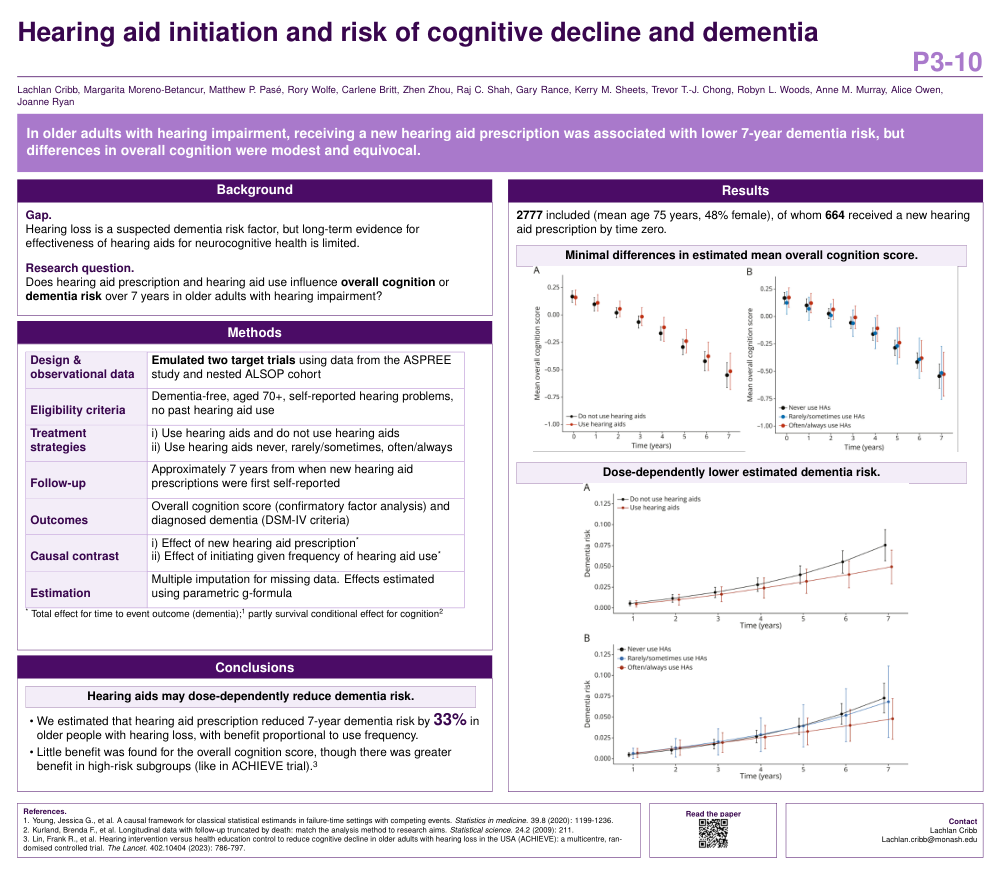
Hearing aid initiation and risk of cognitive decline and dementia
In older adults with hearing impairment, receiving a new hearing aid prescription was associated with lower 7-year dementia risk, but
differences in overall cognition were modest and equivocal.
Gap.
Hearing loss is a suspected dementia risk factor, but long-term evidence for
effectiveness of hearing aids for neurocognitive health is limited.
Research question.
Does hearing aid prescription and hearing aid use influence overall cognition or
dementia risk over 7 years in older adults with hearing impairment?
Design &
observational data
Emulated two target trials using data from the ASPREE
study and nested ALSOP cohort
Eligibility criteria
Dementia-free, aged 70+, self-reported hearing problems,
no past hearing aid use
Treatment
strategies
i) Use hearing aids and do not use hearing aids
ii) Use hearing aids never, rarely/sometimes, often/always
Follow-up
Approximately 7 years from when new hearing aid
prescriptions were first self-reported
Outcomes
Overall cognition score (confirmatory factor analysis) and
diagnosed dementia (DSM-IV criteria)
Causal contrast
i) Effect of new hearing aid prescription*
ii) Effect of initiating given frequency of hearing aid use*
Estimation
Multiple imputation for missing data. Effects estimated
using parametric g-formula
* Total effect for time to event outcome (dementia);1 partly survival conditional effect for cognition2
2777 included (mean age 75 years, 48% female), of whom 664 received a new hearing
aid prescription by time zero.
Minimal differences in estimated mean overall cognition score.
Dose-dependently lower estimated dementia risk.
Hearing aids may dose-dependently reduce dementia risk.
We estimated that hearing aid prescription reduced 7-year dementia risk by 33% in
older people with hearing loss, with benefit proportional to use frequency.
Little benefit was found for the overall cognition score, though there was greater
benefit in high-risk subgroups (like in ACHIEVE trial).3
Comments
Email is required but is not shown publicly.
Loading comments...