4,068 posters, 219 videos, 101 topics, 69 sessions, 14,365 authors, 6,128 institutions
ePostersLive by SciGen Technologies S.A. All rights reserved.
Alzheimer's Association International Conference 2026
July 12-15, 2026 | London, United Kingdom, and Online

3219
Diagnostic Validity Of A Video-adapted Version Of The NACC UDSv3 Cognitive Battery In Older Adults With And Without Cognitive Impairment
Poster Presenter
Authors
Part of Topic
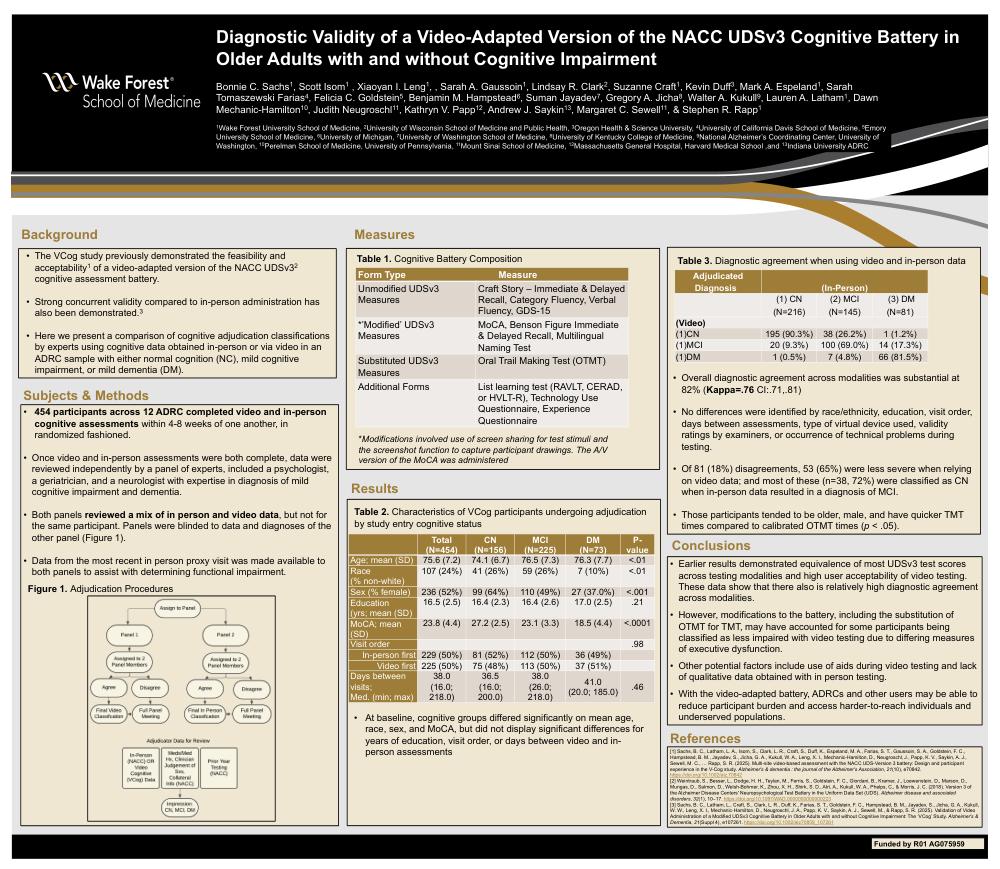
Background: The VCog study previously demonstrated the feasibility and acceptability of a video-adapted version of the NACC UDSv3 cognitive assessment battery and the strong concurrent validity compared to in-person administration. Here we present a comparison of adjudication classifications by experts using cognitive data obtained in-person or via video.
Methods: 463 participants from 12 geographically diverse ADRCs, previously diagnosed as cognitively normal (CN; N = 156), mild cognitive impairment (MCI; N= 230) or dementia (DM; N= 77), were administered the video-adapted and in-person UDSv3 batteries in counterbalanced order over a 4-8 week interval by trained and certified examiners at each site. Two independent adjudication panels, each consisting of a psychologist, neurologist, and geriatrician, reviewed either participant’s in-person data or video data and additional information (Clinical Dementia Rating scale; Neuropsychiatric Inventory; Functional Activities Questionnaire; Geriatric Depression Scale-15; medication list; brief medical history and cognitive test data from their past annual ADRC visit).
Within panels, each case was reviewed independently by two adjudicators with agreement establishing final classification; disagreements were discussed in full panel until consensus was reached. Cases were assigned to adjudicators to achieve balance in the number of in-person and video assessments within and across panels. Cohen’s kappa coefficient of agreement (Cohen; 1960) was used to determine concordance.
Results: Characteristics of cases reviewed by panels are presented in Table 1. Overall diagnostic agreement across modalities was substantial at 82% (Kappa = 0.76 CI: 0.71; 0.81). There was high agreement on cases adjudicated: CN (90.5%) and DM (81.5%), and good agreement for MCI (69%) (Table 2). Of 81 disagreements, most (n=38; 72%) were classified as CN when in-person data yielded a diagnosis of MCI. Similarly, 14 cases classified as DM were concurrently classified as MCI when using video data.
Conclusion: Earlier results demonstrated equivalence of most UDSv3 test scores across testing modalities and high user acceptability of video testing. These data show that there also is high diagnostic agreement across modalities. With the video-adapted battery, ADRCs and other users may be able to reduce participant burden and access harder-to-reach individuals and underserved populations.
Funded by R01 AG075959
Comments
Email is required but is not shown publicly.
Loading comments...