4,068 posters, 219 videos, 101 topics, 69 sessions, 14,365 authors, 6,128 institutions
ePostersLive by SciGen Technologies S.A. All rights reserved.
Alzheimer's Association International Conference 2026
July 12-15, 2026 | London, United Kingdom, and Online

3209
Digital Cognitive Testing Assessment Associates with Expedited Care in Older Adults
Poster Presenter
Part of Topic
Introduction
Early diagnosis of cognitive decline is important to facilitate lifestyle interventions, initiate disease modifying therapies, and develop comprehensive care plans that align with patient needs and preferences.
Advocate Health implemented a quality improvement initiative that sought to reduce barriers to a cognitive impairment diagnosis due to limitations in Primary Care Provider (PCP) time, expertise and operational resources.
The main objective of the grant was to increase the rate of cognitive screening in patients 65 years and older. For this study we examined whether early cognitive testing influenced the frequency of making a cognitive impairment diagnosis or the associated tests that were ordered.
Methods
PCPs were offered multiple diagnostic and treatment supports as previously reported1.
This retrospective cohort study focused on the effects of clinic-based BrainCheck2 digital cognitive testing and compared the time to diagnosis and treatment between patients screened using BrainCheck (BrainCheck cohort, n=1,349) and those traditionally screened (e.g., Minicog, MoCA, etc.) (Control Cohort, n=5,635).
Digital cognitive testing is attractive for use in primary care as it can reduce the burden of test administration and provide more immediate, consistent, and automated scoring for busy primary care practices3.
Two BrainCheck tests were used during the study period. BrainCheck Screen took less than 5 min and the results were provided as (“Further Testing Recommended / Not Recommended”). BrainCheck Standard Battery took 10-15 min and the results were (“Unlikely,” “Possible,” and Likely”).
Cohorts included patients 65 years and older who attended at least one Annual Wellness Visit (AWV) between August 1, 2022, and July 31, 2024. Data were retrospectively extracted from the electronic medical record (Epic) and the BrainCheck database.
Inverse Probability Treatment Weighting (IPTW) was used to balance observed confounds between the cohorts4. Time to event for each diagnostic or treatment outcome was assessed using Cox Proportional Hazards Regression. Differences in time to event were visualized using Kaplan-Meier curves. Final time to event models included fixed effect predictors of cohort (BrainCheck or Control), existing lab data (y/n), and existing imaging data (y/n; omitted from MRI model) and were further adjusted by normalized IPTW weights and using provider name as a random effect (shared frailty term).
Post hoc Bonferroni corrected significance thresholds were used to account for multiple testing within each group of analyses. All statistical tests were run in R v4.5.15.
Results
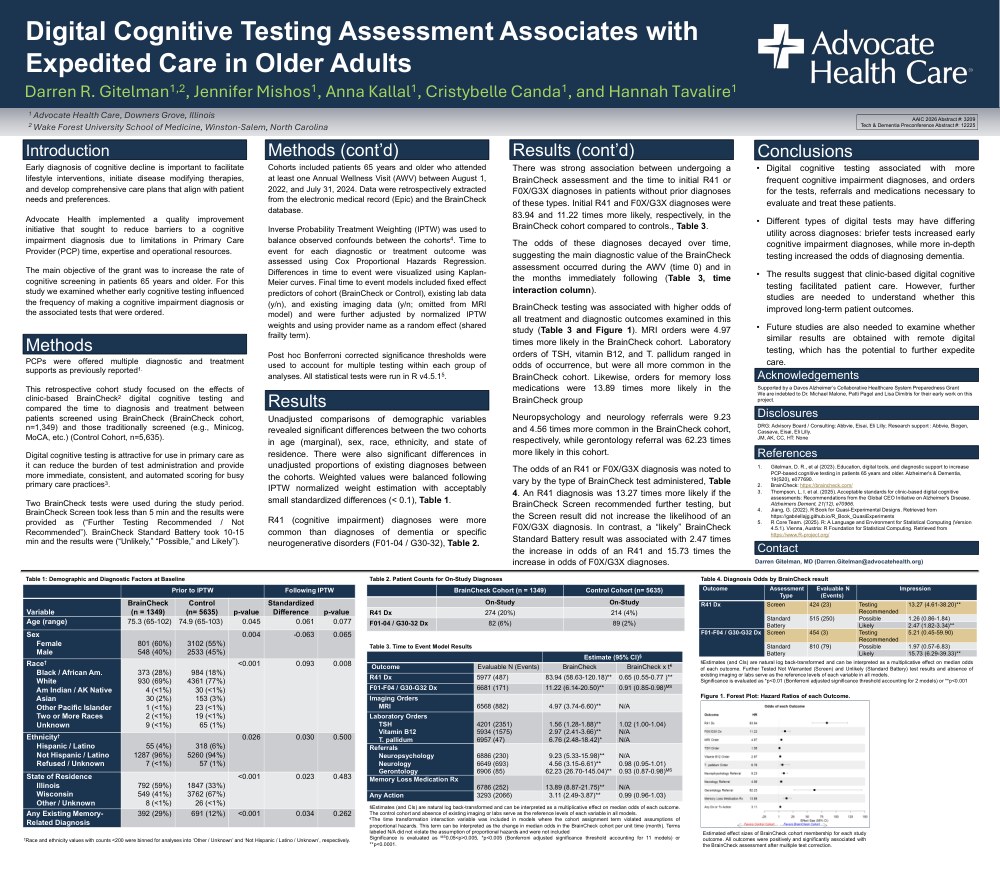
Unadjusted comparisons of demographic variables revealed significant differences between the two cohorts in age (marginal), sex, race, ethnicity, and state of residence. There were also significant differences in unadjusted proportions of existing diagnoses between the cohorts. Weighted values were balanced following IPTW normalized weight estimation with acceptably small standardized differences (< 0.1), Table 1.
R41 (cognitive impairment) diagnoses were more common than diagnoses of dementia or specific neurogenerative disorders (F01-04 / G30-32), Table 2.
There was strong association between undergoing a BrainCheck assessment and the time to initial R41 or F0X/G3X diagnoses in patients without prior diagnoses of these types. Initial R41 and F0X/G3X diagnoses were 83.94 and 11.22 times more likely, respectively, in the BrainCheck cohort compared to controls., Table 3.
The odds of these diagnoses decayed over time, suggesting the main diagnostic value of the BrainCheck assessment occurred during the AWV (time 0) and in the months immediately following (Table 3, time interaction column).
BrainCheck testing was associated with higher odds of all treatment and diagnostic outcomes examined in this study (Table 3 and Figure 1). MRI orders were 4.97 times more likely in the BrainCheck cohort. Laboratory orders of TSH, vitamin B12, and T. pallidum ranged in odds of occurrence, but were all more common in the BrainCheck cohort. Likewise, orders for memory loss medications were 13.89 times more likely in the BrainCheck group
Neuropsychology and neurology referrals were 9.23 and 4.56 times more common in the BrainCheck cohort, respectively, while gerontology referral was 62.23 times more likely in this cohort.
The odds of an R41 or F0X/G3X diagnosis was noted to vary by the type of BrainCheck test administered, Table 4. An R41 diagnosis was 13.27 times more likely if the BrainCheck Screen recommended further testing, but the Screen result did not increase the likelihood of an F0X/G3X diagnosis. In contrast, a “likely” BrainCheck Standard Battery result was associated with 2.47 times the increase in odds of an R41 and 15.73 times the increase in odds of F0X/G3X diagnoses.
Conclusions
•Digital cognitive testing associated with more frequent cognitive impairment diagnoses, and orders for the tests, referrals and medications necessary to evaluate and treat these patients.
•Different types of digital tests may have differing utility across diagnoses: briefer tests increased early cognitive impairment diagnoses, while more in-depth testing increased the odds of diagnosing dementia.
•The results suggest that clinic-based digital cognitive testing facilitated patient care. However, further studies are needed to understand whether this improved long-term patient outcomes.
•Future studies are also needed to examine whether similar results are obtained with remote digital testing, which has the potential to further expedite care.
Acknowledgements
Supported by a Davos Alzheimer’s Collaborative Healthcare System Preparedness Grant
We are indebted to Dr. Michael Malone, Patti Pagel and Lisa Dimitris for their early work on this project.
Disclosures
DRG: Advisory Board / Consulting: Abbvie, Eisai, Eli Lilly; Research support : Abbvie, Biogen, Cassava, Eisai, Eli Lilly.
JM, AK, CC, HT: None
References
1.Gitelman, D. R., et al (2023). Education, digital tools, and diagnostic support to increase PCP-based cognitive testing in patients 65 years and older. Alzheimer's & Dementia, 19(S20), e077690.
2.BrainCheck: https://braincheck.com/
3.Thompson, L. I. et al. (2025). Acceptable standards for clinic-based digital cognitive assessments: Recommendations from the Global CEO Initiative on Alzheimer's Disease. Alzheimers Dement, 21(12), e70966.
4.Jiang, G. (2022). R Book for Quasi-Experimental Designs. Retrieved from https://gabriellajg.github.io/R_Book_QuasiExperiments
5.R Core Team. (2025). R: A Language and Environment for Statistical Computing (Version 4.5.1). Vienna, Austria: R Foundation for Statistical Computing. Retrieved from https://www.R-project.org/
Contact
Darren Gitelman, MD (Darren.Gitelman@advocatehealth.org)
Comments
Email is required but is not shown publicly.
Loading comments...