4,068 posters, 219 videos, 101 topics, 69 sessions, 14,365 authors, 6,128 institutions
ePostersLive by SciGen Technologies S.A. All rights reserved.
Alzheimer's Association International Conference 2026
July 12-15, 2026 | London, United Kingdom, and Online

2878
Development Of Tiered Machine Learning Models To Estimate Risk Of Dementia In Home And Hospital Settings
Poster Presenter
Authors
Xinyi Xia, Qi Qin, Lingxi Xie, Yifan Wang, Peiyang Gao, Yanjun Ma, Chengbei Hou, Chang Su, Qi Tian, Yi Tang
Affiliations
Xuanwu Hospital Capital Medical University, Beijing, China, Independent researcher, Beijing, China, Miracle (Shenzhen) Biotechnology Co., Ltd, Shenzhen, China, Guangming Laboratory, Shenzhen, China
Part of Topic
Development Of Tiered Machine Learning Models To Estimate Risk Of Dementia In Home And Hospital Settings
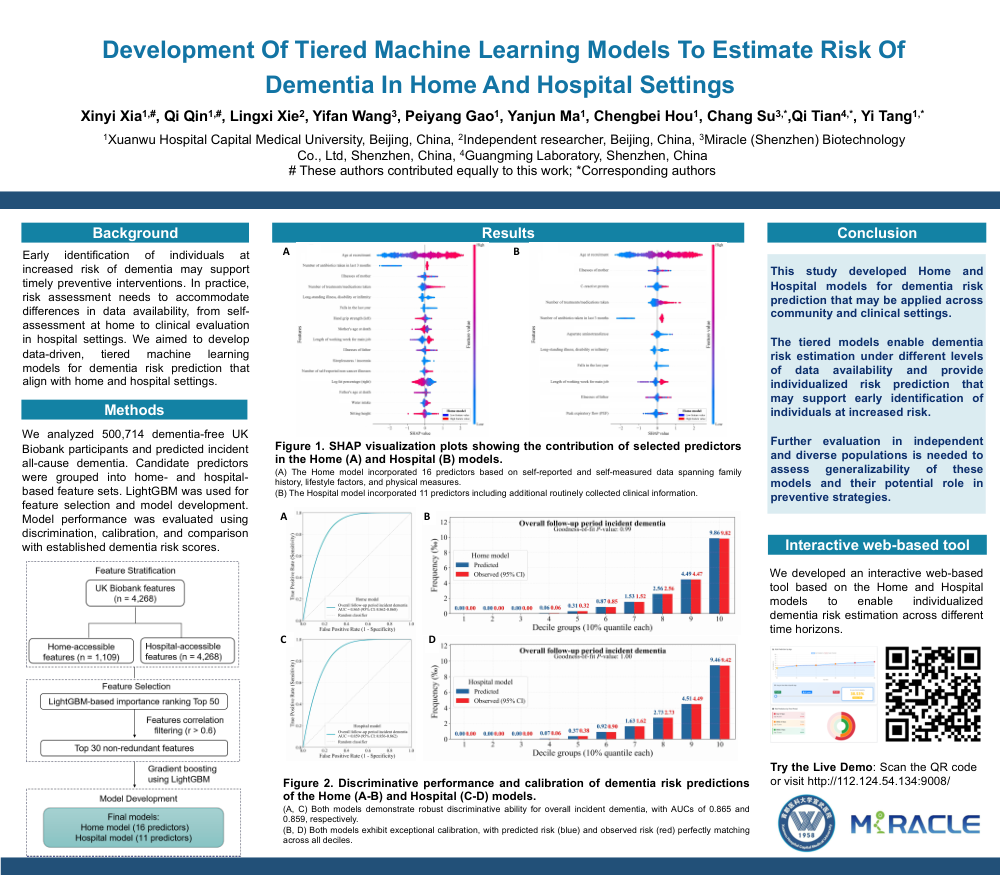
Background: Early identification of individuals at increased risk of dementia may support timely preventive interventions. In practice, risk assessment needs to accommodate differences in data availability, from self-assessment at home to clinical evaluation in hospital settings. We aimed to develop data-driven, tiered machine learning models for dementia risk prediction that align with home and hospital settings.
Methods: We included 500,714 participants without dementia at baseline from the UK Biobank, with incident all-cause dementia as the outcome. Candidate features were categorized into two sets: self-reported and self-measured variables for home use, with additional routinely collected clinical variables for hospital settings. Features were ranked using Light Gradient Boosting Machine (LightGBM), followed by redundancy removal through Pearson correlation analysis. Final predictors were selected based on their incremental contribution to model performance. Separate models were developed for home and hospital settings. Model calibration was assessed using the Hosmer-Lemeshow test, and performance was compared with established dementia risk scores.
Results: During a median follow-up of 10.8 years, 9,815 participants developed dementia. The Home model included 16 predictors and demonstrated good discrimination for incident dementia, with an area under the curve (AUC) of 0.865. The Hospital model, which included 11 predictors, showed comparable performance, with an AUC of 0.859 (P = 0.210). Both models showed consistent discrimination for 5- and 10-year dementia risk prediction, with good calibration between predicted and observed risks. The models outperformed the Cardiovascular Risk Factors, Aging, and Dementia (CAIDE) score and Australian National University Alzheimer’s Disease Risk Index (ANU-ADRI) across all prediction horizons (P < 0.001). We also developed an interactive web-based tool to allow individualized risk estimation.
Conclusions: We developed and internally validated tiered machine learning models for dementia risk prediction under different levels of data availability. These models may support earlier identification of individuals at increased risk of dementia and may help inform targeted preventive strategies. Further validation in independent populations will help clarify their practical utility.
Keywords: Dementia; Machine learning; Risk stratification; UK Biobank
Comments
Email is required but is not shown publicly.
Loading comments...