4,068 posters, 219 videos, 101 topics, 69 sessions, 14,365 authors, 6,128 institutions
ePostersLive by SciGen Technologies S.A. All rights reserved.
Alzheimer's Association International Conference 2026
July 12-15, 2026 | London, United Kingdom, and Online

5056
Enhance: Feasibility And Acceptability Trial Of A Coach Supported App To Reduce Cognitive Decline And Prevent Dementia
Poster Presenter
Authors
Sergi Costafreda, James Jamison, Tsz Kiu Clare Yu, Louise Allan, Richard Boczko, Sue Boex, Cho Youngjun, Andrea Hilton, Rachael Hunter, Fahima Katun, Teresa Lee, Monica Manela, Louise Marston, Vrushti Mehta, Naaheed Mukadam, Hee Kyung Park, Greta Rait, Penny Rapaport, Joanne Reeve, Anne Schilder, Aneesha Singh, Andrew Sommerlad, Elizabeth Steed, Jing Yi Weng, Gill Livingston
Affiliations
, University College London, University of Exeter, Queen Mary University of London, University College London; North London NHS Foundation Trust, University of Hull
Part of Topic
ENHANCE: Feasibility and acceptability trial of a coach-supported app to prevent dementia
Sergi Costafreda1,2, James Jamison1, Tsz Kiu Clare Yu1, Louise Allan3, Richard Boczko4, Sue Boex, Youngjun Cho1, Andrea Hilton4, Rachael Hunter1, Fahima Khatun1, Teresa Lee1, Monica Manela1, Louise Marston1
,
Vrushti Mehta1, Naaheed Mukadam1, Hee Kyung Park1, Greta Rait1, Penny Rapaport1,2, Joanne Reeve4, Anne Schilder1, Aneesha Singh1, Andrew Sommerlad1,2, Elizabeth Steed5, Jing Yi Weng1, Gill Livingston1,2
1 University College London; 2 North London NHS Foundation Trust; 3 University of Exeter; 4 University of Hull; 5 Queen Mary University of London
Background
• Dementia risk may be reduced by addressing modifiable risk factors.
• These risks cluster in people with less education, lower socio-economic status and
ethnic minority background. These groups are under-represented in prevention
research.
The ENHANCE Intervention
• A blended eHealth intervention with coach plus app, delivering a personalised 3-
month programme across risk factors assessed at baseline.
• Face-to-face onboarding; participants choose up to 3 risk factors, 6 weeks each.
• Weekly app content: brain-training games, videos and self-monitoring questionnaires
• Fortnightly meetings with a trained non-specialist coach
Risk Factors Targeted
High Blood Pressure (SYS/DIAS>140/90) Obesity (BMI>30) Smoking (≥ 7 cigarettes in past week) Depression (PHQ-9 ≥ 9) Social isolation (LSNS-6 < 6) High Blood sugar (HbA1c ≥ 48 mmol/mol)
Physical inactivity (< 150 min/week)
Alcohol (> 14 units/week)
Hearing loss (HearWHO screen + no hearing aid)
Low Education (Left school ≤ 16 or no qualifications)
The ENHANCE App
Methods
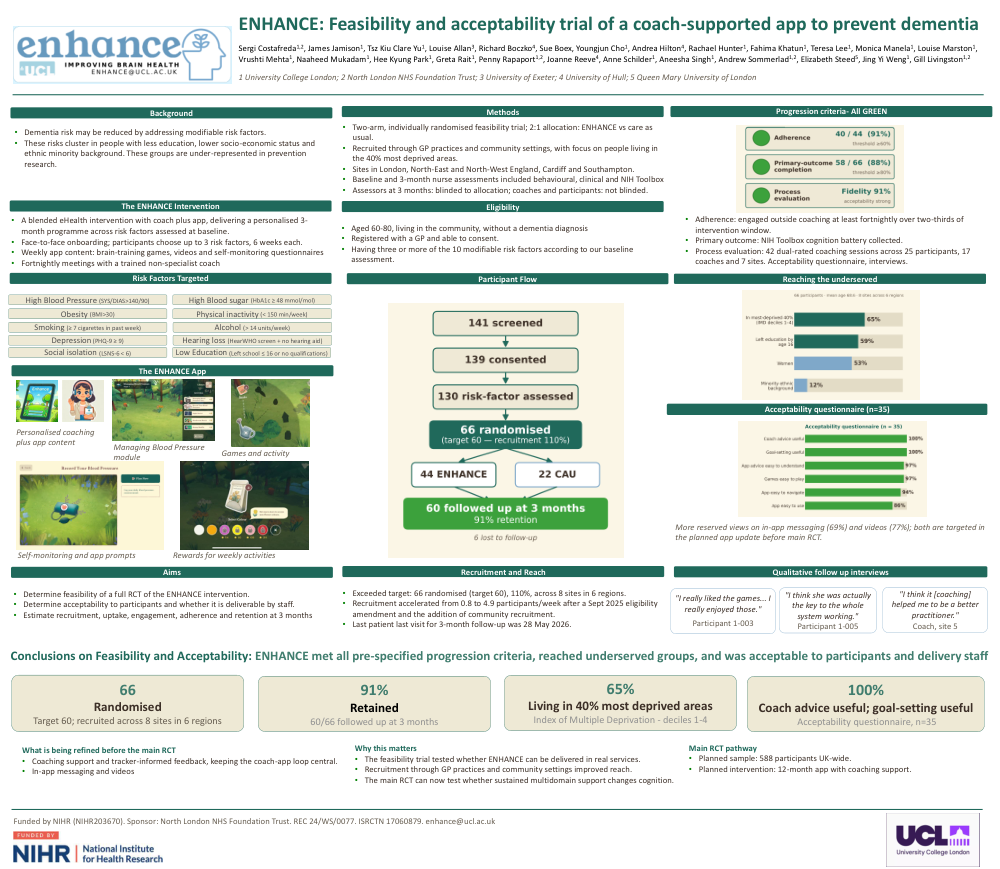
• Two-arm, individually randomised feasibility trial; 2:1 allocation: ENHANCE vs care as
usual.
• Recruited through GP practices and community settings, with focus on people living in
the 40% most deprived areas.
• Sites in London, North-East and North-West England, Cardiff and Southampton.
• Baseline and 3-month nurse assessments included behavioural, clinical and NIH Toolbox
• Assessors at 3 months: blinded to allocation; coaches and participants: not blinded.
Eligibility
• Aged 60-80, living in the community, without a dementia diagnosis
• Registered with a GP and able to consent.
• Having three or more of the 10 modifiable risk factors according to our baseline
assessment.
Participant Flow
Progression criteria- All GREEN
• Adherence: engaged outside coaching at least fortnightly over two-thirds of
intervention window.
• Primary outcome: NIH Toolbox cognition battery collected.
• Process evaluation: 42 dual-rated coaching sessions across 25 participants, 17
coaches and 7 sites. Acceptability questionnaire, interviews.
Reaching the underserved
Acceptability questionnaire (n=35)
Personalised coaching
plus app content Managing Blood Pressure
module Games and activity
rewards
More reserved views on in-app messaging (69%) and videos (77%); both are targeted in
the planned app update before main RCT.
Self-monitoring and app prompts Rewards for weekly activities
Aims
Recruitment and Reach
Qualitative follow up interviews
• Determine feasibility of a full RCT of the ENHANCE intervention.
• Determine acceptability to participants and whether it is deliverable by staff.
• Estimate recruitment, uptake, engagement, adherence and retention at 3 months
• Exceeded target: 66 randomised (target 60), 110%, across 8 sites in 6 regions.
• Recruitment accelerated from 0.8 to 4.9 participants/week after a Sept 2025 eligibility
amendment and the addition of community recruitment.
• Last patient last visit for 3-month follow-up was 28 May 2026.
"I really liked the games... I
really enjoyed those."
Participant 1-003
"I think she was actually
the key to the whole
system working."
Participant 1-005
"I think it [coaching]
helped me to be a better
practitioner."
Coach, site 5
Conclusions on Feasibility and Acceptability: ENHANCE met all pre-specified progression criteria, reached underserved groups, and was acceptable to participants and delivery staff
66
91%
65%
100%
Randomised
Target 60; recruited across 8 sites in 6 regions
Retained
60/66 followed up at 3 months
Living in 40% most deprived areas
Index of Multiple Deprivation - deciles 1-4
Coach advice useful; goal-setting useful
Acceptability questionnaire, n=35
What is being refined before the main RCT
• Coaching support and tracker-informed feedback, keeping the coach-app loop central.
• In-app messaging and videos
Why this matters
• The feasibility trial tested whether ENHANCE can be delivered in real services.
• Recruitment through GP practices and community settings improved reach.
• The main RCT can now test whether sustained multidomain support changes cognition.
Main RCT pathway
• Planned sample: 588 participants UK-wide.
• Planned intervention: 12-month app with coaching support.
Comments
Email is required but is not shown publicly.
Loading comments...