4,068 posters, 219 videos, 101 topics, 69 sessions, 14,365 authors, 6,128 institutions
ePostersLive by SciGen Technologies S.A. All rights reserved.
Alzheimer's Association International Conference 2026
July 12-15, 2026 | London, United Kingdom, and Online

5795
Agetech Insights: Mobilizing Data To Drive Healthy Aging & Brain Health Innovation
Poster Presenter
Authors
Part of Topic
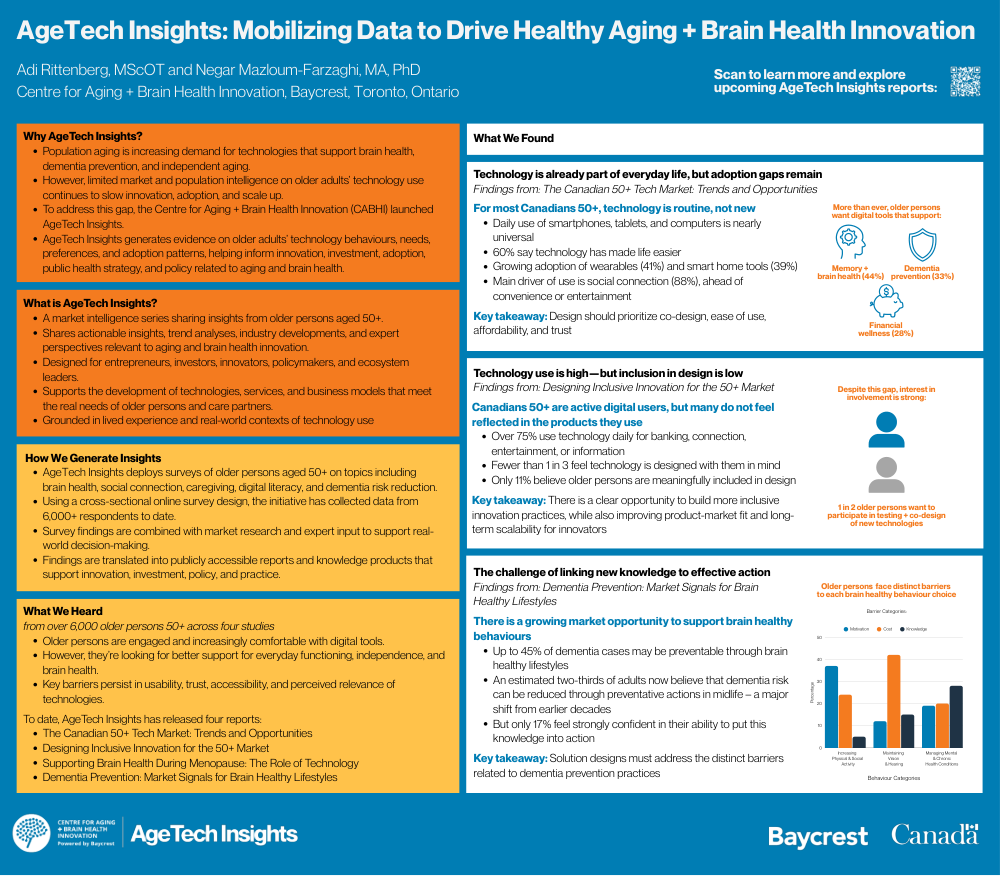
AgeTech Insights: Mobilizing Data to Drive Healthy Aging + Brain Health Innovation
Adi Rittenberg, MScOT and Negar Mazloum-Farzaghi, MA, PhD
Centre for Aging + Brain Health Innovation, Baycrest, Toronto, Ontario
Why AgeTech Insights?
- Population aging is increasing demand for technologies that support brain health, dementia prevention, and independent aging.
- However, limited market and population intelligence on older adults’ technology use continues to slow innovation, adoption, and scale up.
- To address this gap, the Centre for Aging + Brain Health Innovation (CABHI) launched AgeTech Insights.
- AgeTech Insights generates evidence on older adults’ technology behaviours, needs, preferences, and adoption patterns, helping inform innovation, investment, adoption, public health strategy, and policy related to aging and brain health
What is AgeTech Insights?
- A market intelligence series sharing insights from older persons aged 50+.
- Shares actionable insights, trend analyses, industry developments, and expert perspectives relevant to aging and brain health innovation.
- Designed for entrepreneurs, investors, innovators, policymakers, and ecosystem leaders.
- Supports the development of technologies, services, and business models that meet the real needs of older persons and care partners.
- Grounded in lived experience and real-world contexts of technology use
How We Generate Insights
- AgeTech Insights deploys surveys of older persons aged 50+ on topics including brain health, social connection, caregiving, digital literacy, and dementia risk reduction.
- Using a cross-sectional online survey design, the initiative has collected data from 6,000+ respondents to date.
- Survey findings are combined with market research and expert input to support real-world decision-making.
- Findings are translated into publicly accessible reports and knowledge products that support innovation, investment, policy, and practice.
What We Heard
from over 6,000 older persons 50+ across four studies
- Older persons are engaged and increasingly comfortable with digital tools.
- However, they’re looking for better support for everyday functioning, independence, and brain health.
- Key barriers persist in usability, trust, accessibility, and perceived relevance of technologies.
To date, AgeTech Insights has released four reports:
- The Canadian 50+ Tech Market: Trends and Opportunities
- Designing Inclusive Innovation for the 50+ Market
- Supporting Brain Health During Menopause: The Role of Technology
- Dementia Prevention: Market Signals for Brain Healthy Lifestyles
Technology is already part of everyday life, but adoption gaps remain
Findings from: The Canadian 50+ Tech Market: Trends and Opportunities
For most Canadians 50+, technology is routine, not new
- Daily use of smartphones, tablets, and computers is nearly universal
- 60% say technology has made life easier
- Growing adoption of wearables (41%) and smart home tools (39%)
- Main driver of use is social connection (88%), ahead of convenience or entertainment
Memory + brain health (44%)
Dementia prevention (33%)
Financial wellness (28%)
Key takeaway: Design should prioritize co-design, ease of use, affordability, and trust
Technology use is high—but inclusion in design is low
Findings from: Designing Inclusive Innovation for the 50+ Market
Canadians 50+ are active digital users, but many do not feel reflected in the products they use
- Over 75% use technology daily for banking, connection, entertainment, or information
- Fewer than 1 in 3 feel technology is designed with them in mind
- Only 11% believe older persons are meaningfully included in design
Despite this gap, interest in involvement is strong:
1 in 2 older persons want to participate in testing + co-design of new technologiesKey takeaway: There is a clear opportunity to build more inclusive innovation practices, while also improving product-market fit and long-term scalability for innovators
The challenge of linking new knowledge to effective action
Findings from: Dementia Prevention: Market Signals for Brain Healthy Lifestyles
There is a growing market opportunity to support brain healthy behaviours
- Up to 45% of dementia cases may be preventable through brain healthy lifestyles
- An estimated two-thirds of adults now believe that dementia risk can be reduced through preventative actions in midlife – a major shift from earlier decades
- But only 17% feel strongly confident in their ability to put this knowledge into action
Older persons face distinct barriers
to each brain healthy behaviour choice
Key takeaway: Solution designs must address the distinct barriers related to dementia prevention practices
Comments
Email is required but is not shown publicly.
Loading comments...