4,068 posters, 219 videos, 101 topics, 69 sessions, 14,365 authors, 6,128 institutions
ePostersLive by SciGen Technologies S.A. All rights reserved.
Alzheimer's Association International Conference 2026
July 12-15, 2026 | London, United Kingdom, and Online

3244
Taking A Patient Centred Approach To Information Delivery Of Risk Factor Management In Vascular Dementia
Part of Topic
Taking a patient centred approach to information delivery of risk factor management in Vascular Dementia
P0885
- Co-design provides an effective way to tailor patient information to its target audience
- Dementia patients prefer positive, simple messages with graphics that represent their communities
- Patient information resources should encourage active participation
Introduction
Dementia affects memory, language comprehension, orientation, and judgement.
Prevention is crucial, and in 2017, The Lancet identified 12 modifiable risk factors for developing dementia.
These risk factors are of particular importance in vascular dementia (VD).
Healthcare services must communicate information about these risk factors effectively to patients and carers.
This study used co-design principles to develop a dementia-friendly, accessible information resource for patients and carers.
Methods
Rapid literature reviews were undertaken to identify best practices in easy-read information and design for patients with cognitive impairment.
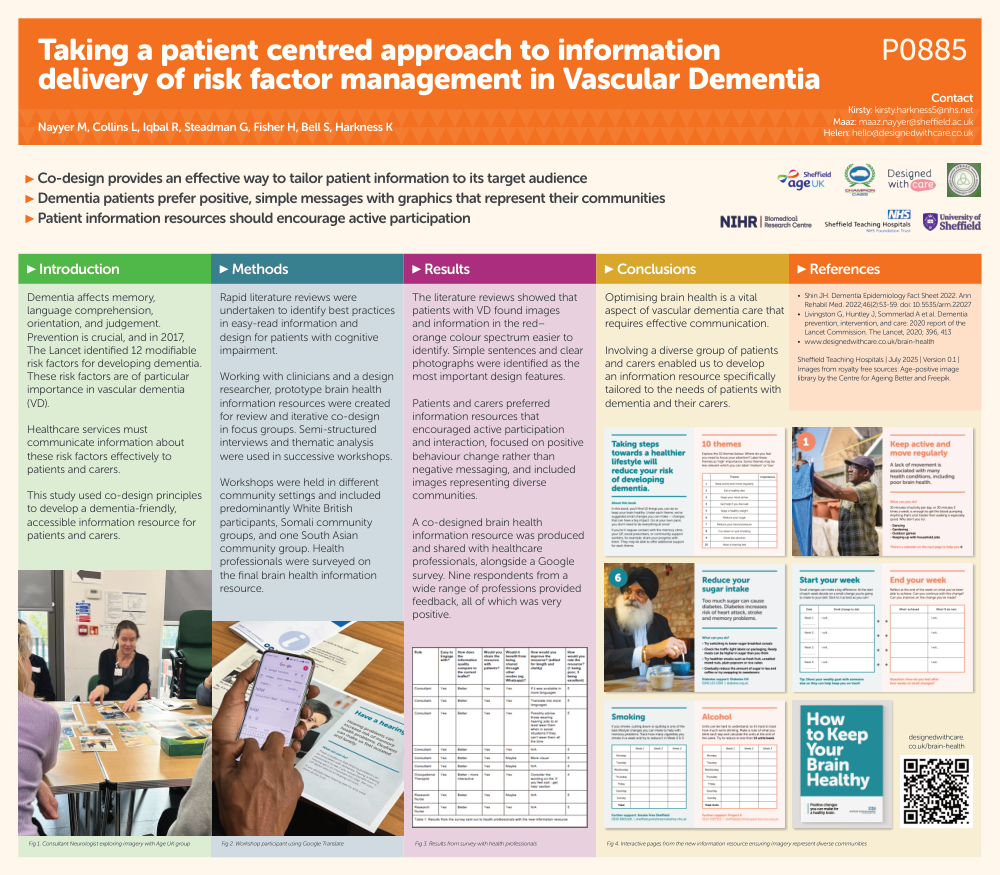
Working with clinicians and a design researcher, prototype brain health information resources were created for review and iterative co-design in focus groups. Semi-structured interviews and thematic analysis were used in successive workshops.
Workshops were held in different community settings and included predominantly White British participants, Somali community groups, and one South Asian community group. Health professionals were surveyed on the final brain health information resource.
Results
The literature reviews showed that patients with VD found images and information in the red– orange colour spectrum easier to identify.Simple sentences and clear photographs were identified as the most important design features. Patients and carers preferred information resources that encouraged active participation and interaction, focused on positive behaviour change rather than negative messaging, and included images representing diverse communities. A co-designed brain health information resource was produced and shared with healthcare professionals, alongside a Google survey. Nine respondents from a wide range of professions provided feedback, all of which was very positive.
Conclusions
Optimising brain health is a vital aspect of vascular dementia care that requires effective communication.
Involving a diverse group of patients and carers enabled us to develop an information resource specifically tailored to the needs of patients with dementia and their carers.
References
• Shin JH. Dementia Epidemiology Fact Sheet 2022. Ann
Rehabil Med. 2022;46(2):53-59. doi: 10.5535/arm.22027
• Livingston G, Huntley J, Sommerlad A et al. Dementia
prevention, intervention, and care: 2020 report of the
Lancet Commission. The Lancet, 2020; 396, 413
• www.designedwithcare.co.uk/brain-health
Sheffield Teaching Hospitals | July 2025 | Version 0.1 |
Images from royalty free sources: Age-positive image
library by the Centre for Ageing Better and Freepik.
Comments
Email is required but is not shown publicly.
Loading comments...