4,068 posters, 219 videos, 101 topics, 69 sessions, 14,365 authors, 6,128 institutions
ePostersLive by SciGen Technologies S.A. All rights reserved.
Alzheimer's Association International Conference 2026
July 12-15, 2026 | London, United Kingdom, and Online

7318
Beyond Accuracy: Evaluating An AI Clinical Decision Support System For Dementia In Ghana
Poster Presenter
Authors
Affiliations
Part of Topic
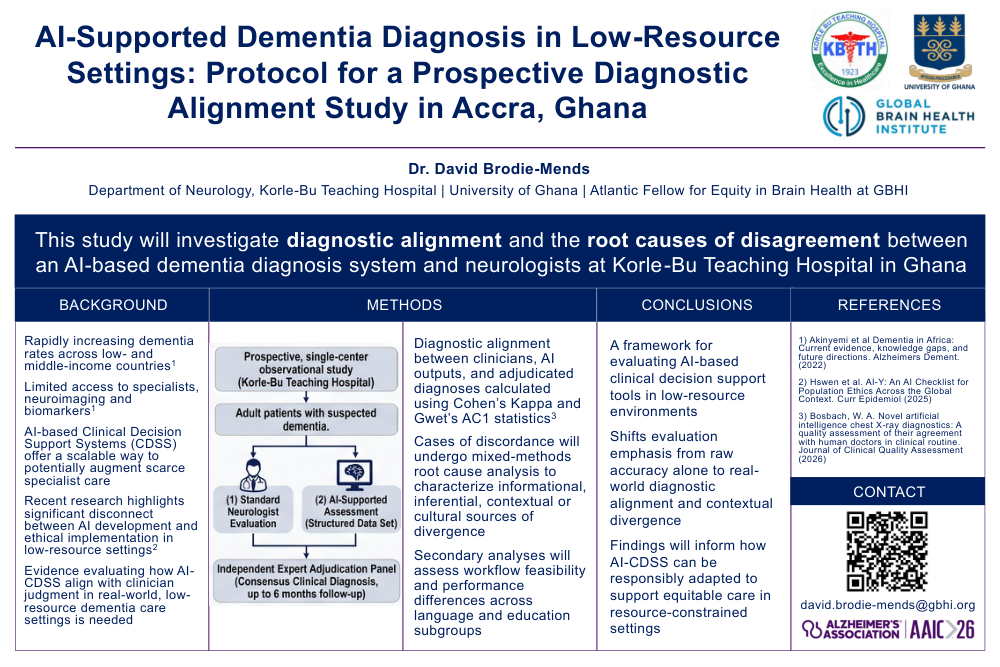
AI-Supported Dementia Diagnosis in Low-Resource Settings: Protocol for a Prospective Diagnostic Alignment Study in Accra, Ghana
Dr. David Brodie-Mends
Department of Neurology, Korle-Bu Teaching Hospital | University of Ghana | Atlantic Fellow for Equity in Brain Health at GBHI
david.brodie-mends@gbhi.org
Background
Neurodegenerative disorders, including dementia, are increasing rapidly in low- and middle-income countries (LMICs), where access to specialist diagnostics and disease biomarkers remains limited. In Ghana, diagnosis of these conditions relies primarily on clinical phenomenology due to constrained neuroimaging and laboratory resources. Artificial intelligence (AI)–based clinical decision support systems, developed largely in high-resource settings, have the potential to augment specialist care but may perform unpredictably when deployed in culturally and infrastructurally distinct environments. Evidence evaluating how these AI systems align with clinician judgment in real-world, low-resource dementia care settings is limited.
Methods
We will conduct a prospective, single-center observational study at the Adult Neurology Clinic of Korle-Bu Teaching Hospital, Accra, Ghana. Adult patients presenting with suspected dementia syndromes will undergo parallel assessments: (1) a standard neurologist-led evaluation and (2) an AI-supported assessment using a structured minimum data set. An independent expert adjudication panel will establish a consensus clinical diagnosis using baseline data and up to six months of follow-up, serving as a pragmatic reference standard in the absence of universal biomarkers. Diagnostic alignment between clinicians, AI outputs, and adjudicated diagnoses will be quantified using Cohen’s Kappa and Gwet’s AC1 statistics. Cases of discordance will undergo mixed-methods root cause analysis to characterize informational, inferential, and contextual or cultural sources of divergence. Secondary analyses will assess workflow feasibility and performance differences across language and education subgroups.
Results
This study will generate quantitative estimates of diagnostic alignment between AI-supported assessments, clinician judgment, and expert consensus diagnoses under resource-constrained conditions. Qualitative analyses will characterize recurrent patterns of divergence, including the impact of missing data, contextual symptom interpretation, and population differences from the AI training domain. Subgroup analyses will explore whether alignment varies by language, education (as a proxy for literacy), or access to biomarkers.
Conclusions
By shifting emphasis from accuracy alone to diagnostic alignment and contextual divergence, this study provides a framework for evaluating AI-based clinical decision support in real-world dementia care in LMIC settings. Findings will inform whether and under what conditions AI systems developed in high-resource environments can be responsibly adapted to support equitable neurological care in resource-constrained contexts.
Comments
Email is required but is not shown publicly.
Loading comments...