4,068 posters, 219 videos, 101 topics, 69 sessions, 14,365 authors, 6,128 institutions
ePostersLive by SciGen Technologies S.A. All rights reserved.
Alzheimer's Association International Conference 2026
July 12-15, 2026 | London, United Kingdom, and Online

3599
Embedding New Technology In Primary Care To Improve Outcomes For Patients With Dementia - The UKDRI Minder Study In West London
Poster Presenter
Authors
Affiliations
Hammersmith and Fulham Partnership, London, United Kingdom; School of Public Health, Imperial College London, London, United Kingdom, Dept of Brain Sciences, Imperial College London, London, United Kingdom; UK Dementia Research Institute, London, United Kingdom, Dept of Brain Sciences, Imperial College London, London, United Kingdom; Hammersmith and Fulham Partnership, London, United Kingdom; UK Dementia Research Institute, London, United Kingdom
Part of Topic
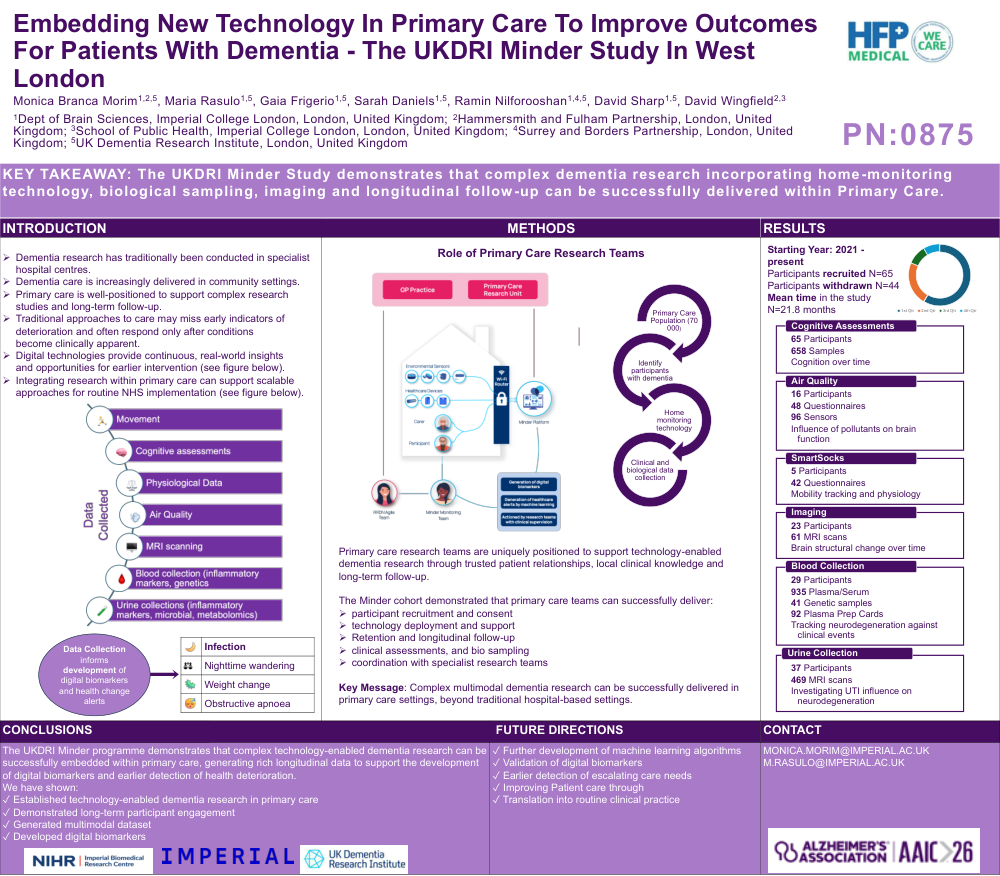
KEY TAKEAWAY: The UKDRI Minder Study demonstrates that complex dementia research incorporating home-monitoring technology, biological sampling, imaging and longitudinal follow-up can be successfully delivered within Primary Care.
INTRODUCTION
Role of Primary Care Research Teams:
Primary care research teams are uniquely positioned to support technology-enabled dementia research through trusted patient relationships, local clinical knowledge and long-term follow-up.
The Minder cohort demonstrated that primary care teams can successfully deliver:
Key Message: Complex multimodal dementia research can be successfully delivered in primary care settings, beyond traditional hospital-based settings.
Starting Year: 2021 - present
Participants recruited N=65
Participants withdrawn N=44
Mean time in the study N=21.8 months
CONCLUSIONS
The UKDRI Minder programme demonstrates that complex technology-enabled dementia research can be successfully embedded within primary care, generating rich longitudinal data to support the development of digital biomarkers and earlier detection of health deterioration.
We have shown:
✓ Established technology-enabled dementia research in primary care
✓ Demonstrated long-term participant engagement
✓ Generated multimodal dataset
✓ Developed digital biomarkers
FUTURE DIRECTIONS
✓ Further development of machine learning algorithms
✓ Validation of digital biomarkers
✓ Earlier detection of escalating care needs
✓ Improving Patient care through ✓ Translation into routine clinical practice
CONTACTS:
MONICA.MORIM@IMPERIAL.AC.UK
M.RASULO@IMPERIAL.AC.UK
Comments
Email is required but is not shown publicly.
Loading comments...