4,068 posters, 219 videos, 101 topics, 69 sessions, 14,365 authors, 6,128 institutions
ePostersLive by SciGen Technologies S.A. All rights reserved.
Alzheimer's Association International Conference 2026
July 12-15, 2026 | London, United Kingdom, and Online

2441
Penn State Emergency Medicine Cares: The Relationship Between Dementia Care-partner Stress And Return Visits To The Emergency Department
Poster Presenter
Authors
Affiliations
Part of Topic
Video
Penn State Emergency Medicine Cares: The Relationship Between Dementia Care-partner Stress And Return Visits To The Emergency Department:
1Emergency Department, Penn State Health/Penn State College of Medicine, Hershey, PA, USA, 2Internal Medicine/Geriatrics, Penn State Health/Penn State College of Medicine, Hershey, PA, USA, 3Geriatric Medicine, Penn State Health/Penn State College of Medicine, Hershey, PA, USA.
Abstract:
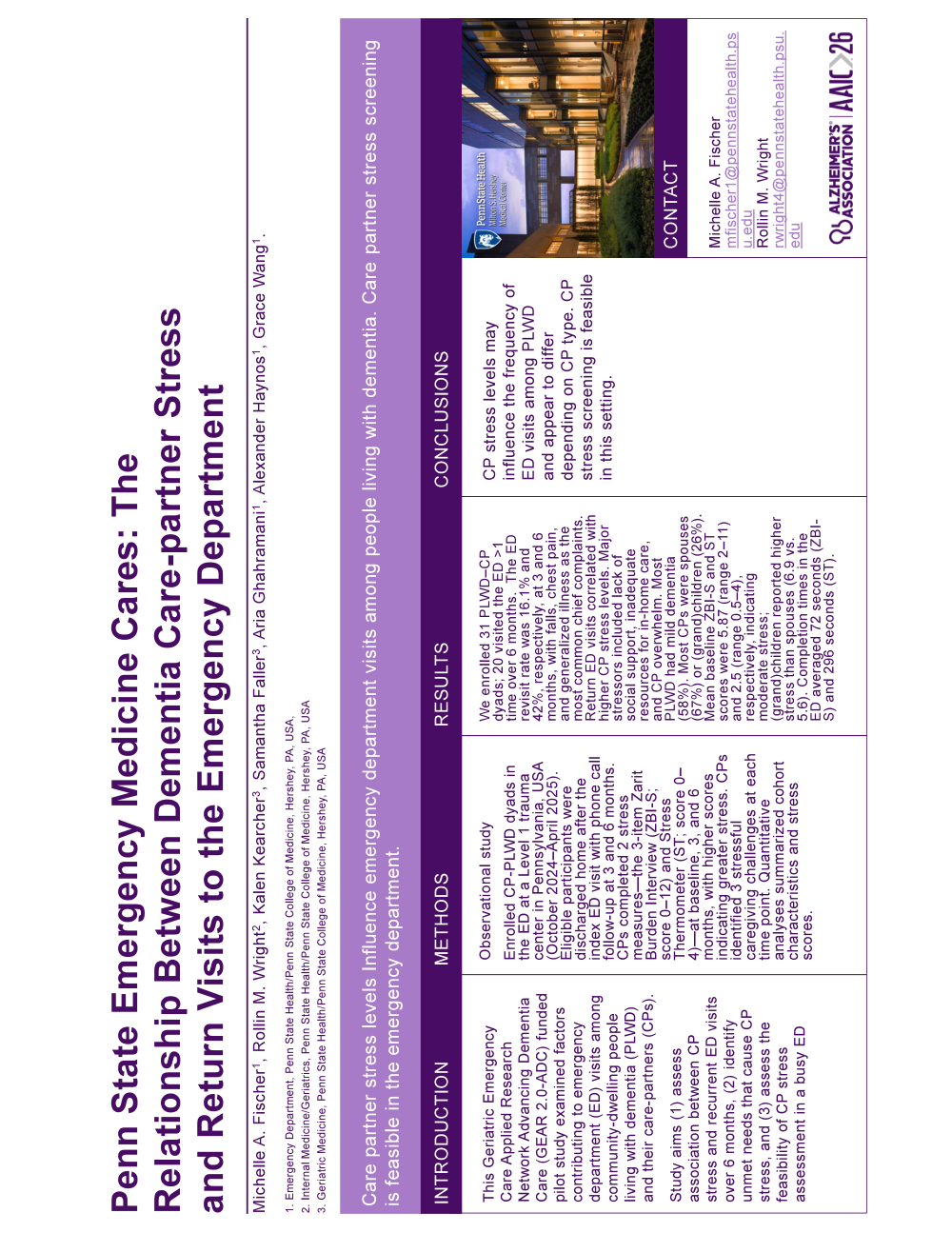
Background: This Geriatric Emergency Care Applied Research Network Advancing Dementia Care (GEAR 2.0-ADC) funded pilot study examined factors contributing to emergency department (ED) visits among community-dwelling people living with dementia (PLWD) and their care-partners (CPs). Study aims included: (1) assessing the association between CP stress and recurrent ED visits, (2) identifying unmet needs that cause CP stress, and (3) assessing the feasibility of CP stress assessment in the ED.
Methods: This observational study enrolled CP-PLWD dyads in the ED at a large trauma center in south-central Pennsylvania, USA (October 2024-April 2025). Eligible participants were discharged home after the index ED visit, with follow-up phone calls at 3 and 6 months. CPs completed 2 stress measures—the 3-item Zarit Burden Interview (ZBI-S; score 0-12) and Stress Thermometer (ST; score 0-4)—with higher scores indicating greater stress. CPs identified 3 stressful caregiving challenges. Quantitative analyses summarized cohort characteristics and stress scores.
Results: We enrolled 31 dyads PLWD and their CPs with an ED revisit rate of 16.1% at 3 months and 41.9% at 6 months. Most common chief complaints were falls, chest pain, and generalized illness. Major stressors were limited social support, insufficient funding for in-home care, and CP overwhelm. CPs were predominantly spouses (67.7%) or (grand)children (25.8%). Mean baseline ZBI-S and ST scores were 6.06 and 2.49, respectively, consistent with moderate stress; (grand)children reported higher stress than spouses (6.9 vs. 5.6). The 6-month average ZBI-S and ST scores for readmitted vs. non-readmitted dyads were 6.07 vs. 2.55 and 6.03 vs. 2.48, respectively, with no statistically significant differences (p=0.2133 and p=0.2577). ED Feasibility was high for the ZBI-S and ST, with median completion times of 72 seconds and 296 respectively.
Conclusion: A substantial 6-month ED revisit rate among PLWD-CP dyads highlight significant short-term utilization in this vulnerable population. Although CP stress levels showed a non-significant trend toward higher revisit frequency, this may reflect the limited sample size. Dementia severity and CP relationship warrant further study as potential contributors to ED use. Screening for CP stress in the ED proved feasible and may support targeted care navigation and case management strategies to reduce avoidable revisit
Comments
Email is required but is not shown publicly.
Loading comments...