4,068 posters, 219 videos, 101 topics, 69 sessions, 14,365 authors, 6,128 institutions
ePostersLive by SciGen Technologies S.A. All rights reserved.
Alzheimer's Association International Conference 2026
July 12-15, 2026 | London, United Kingdom, and Online

9715
Wearables-and Blood-based Biomarkers-incorporated Care For Circadian Rhythm Disrruption In Alzheimer’S Dementia-A Protocol
Part of Topic
Taiwan became a super-aged society in 2025, with more than 20% of its population aged over 65 years, leading to a growing prevalence of dementia and increasing caregiving demands. Behavioural and psychological symptoms of dementia (BPSD), particularly sleep disturbances and circadian rhythm disruption, are major contributors to caregiver burden and healthcare utilisation. Current assessment relies on caregiver-reported questionnaires, which are subjective and often cross-sectional. Treatments are also limited, often relying on sedative-hypnotics or antipsychotics that carry significant safety risks. Wearable technologies offer a promising alternative by enabling objective, continuous monitoring of sleep, activity, and environmental factors, while generating novel digital phenotypes. Emerging non-pharmacological interventions, such as wearable transcranial photobiomodulation (tPBM), may improve circadian regulation and sleep. By integrating wearable-device data, blood-based Alzheimer’s disease (AD) biomarkers, and clinical assessments, this study aims to develop more precise, personalised, and safer approaches to dementia care.
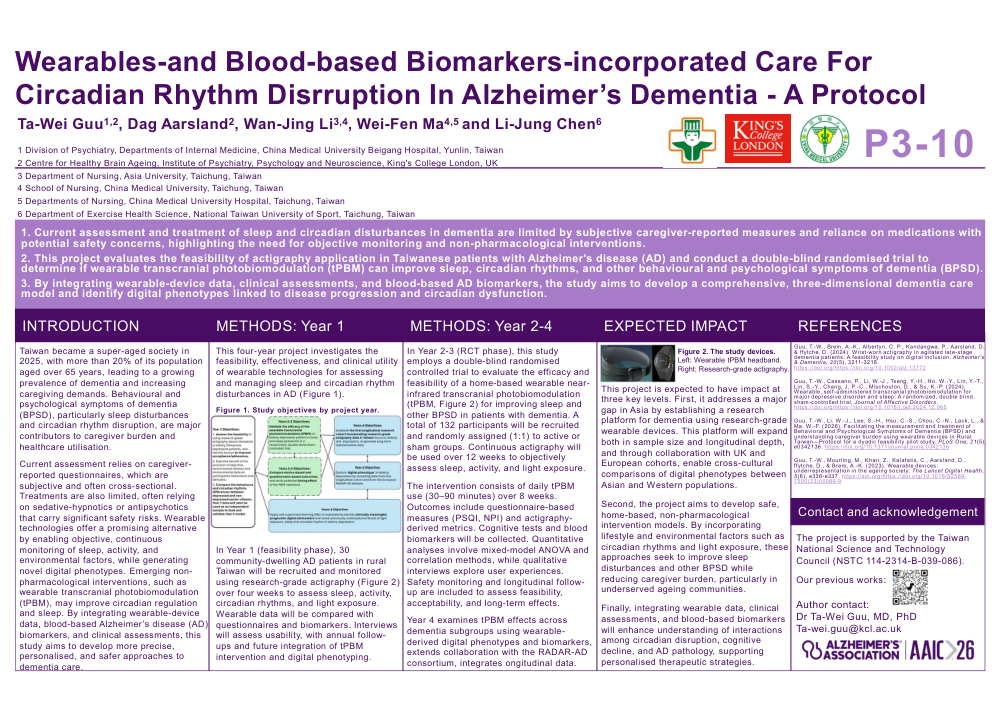
This four-year project investigates the feasibility, effectiveness, and clinical utility of wearable technologies for assessing and managing sleep and circadian rhythm disturbances in AD (Figure 1). In Year 1 (feasibility phase), 30 community-dwelling AD patients in rural Taiwan will be recruited and monitored using research-grade actigraphy (Figure 2) over four weeks to assess sleep, activity, circadian rhythms, and light exposure. Wearable data will be compared with questionnaires and biomarkers. Interviews will assess usability, with annual follow-ups and future integration of tPBM intervention and digital phenotyping.
In Year 2-3 (RCT phase), this study employs a double-blind randomised controlled trial to evaluate the efficacy and feasibility of a home-based wearable near-infrared transcranial photobiomodulation (tPBM, Figure 2) for improving sleep and other BPSD in patients with dementia. A total of 132 participants will be recruited and randomly assigned (1:1) to active or sham groups. Continuous actigraphy will be used over 12 weeks to objectively assess sleep, activity, and light exposure. The intervention consists of daily tPBM use (30–90 minutes) over 8 weeks. Outcomes include questionnaire-based measures (PSQI, NPI) and actigraphy-derived metrics. Cognitive tests and blood biomarkers will be collected. Quantitative analyses involve mixed-model ANOVA and correlation methods, while qualitative interviews explore user experiences. Safety monitoring and longitudinal follow-up are included to assess feasibility, acceptability, and long-term effects. Year 4 examines tPBM effects across dementia subgroups using wearable-derived digital phenotypes and biomarkers, extends collaboration with the RADAR-AD consortium, integrates ongitudinal data.
This project is expected to have impact at three key levels. First, it addresses a major gap in Asia by establishing a research platform for dementia using research-grade wearable devices. This platform will expand both in sample size and longitudinal depth, and through collaboration with UK and European cohorts, enable cross-cultural comparisons of digital phenotypes between Asian and Western populations. Second, the project aims to develop safe, home-based, non-pharmacological intervention models. By incorporating lifestyle and environmental factors such as circadian rhythms and light exposure, these approaches seek to improve sleep disturbances and other BPSD while reducing caregiver burden, particularly in underserved ageing communities. Finally, integrating wearable data, clinical assessments, and blood-based biomarkers will enhance understanding of interactions among circadian disruption, cognitive decline, and AD pathology, supporting personalised therapeutic strategies.
References:
Guu, T.-W., Brem, A.-K., Albertyn, C. P., Kandangwa, P., Aarsland, D., & ffytche, D. (2024). Wrist-worn actigraphy in agitated late-stage dementia patients: A feasibility study on digital inclusion. Alzheimer's & Dementia, 20(5), 3211-3218. https://doi.org/https://doi.org/10.1002/alz.13772
Guu, T.-W., Cassano, P., Li, W.-J., Tseng, Y.-H., Ho, W.-Y., Lin, Y.-T., Lin, S.-Y., Chang, J. P.-C., Mischoulon, D., & Su, K.-P. (2024). Wearable, self-administered transcranial photobiomodulation for major depressive disorder and sleep: A randomized, double blind, sham-controlled trial. Journal of Affective Disorders. https://doi.org/https://doi.org/10.1016/j.jad.2024.12.065
Guu, T.-W., Li, W.-J., Lee, S.-H., Hsu, C.-S., Chou, C.-N., Lack, L., & Ma, W.-F. (2026). Facilitating the measurement and treatment of Behavioral and Psychological Symptoms of Dementia (BPSD) and understanding caregiver burden using wearable devices in Rural Taiwan—Protocol for a dyadic feasibility pilot study. PLoS One, 21(5), e0342136. https://doi.org/10.1371/journal.pone.0342136
Guu, T.-W., Muurling, M., Khan, Z., Kalafatis, C., Aarsland, D., ffytche, D., & Brem, A.-K. (2023). Wearable devices: underrepresentation in the ageing society. The Lancet Digital Health, 5(6), e336-e337. https://doi.org/https://doi.org/10.1016/S2589-7500(23)00069-9
Comments
Email is required but is not shown publicly.
Loading comments...