4,068 posters, 219 videos, 101 topics, 69 sessions, 14,365 authors, 6,128 institutions
ePostersLive by SciGen Technologies S.A. All rights reserved.
Alzheimer's Association International Conference 2026
July 12-15, 2026 | London, United Kingdom, and Online

929
Modifiable Factors In The Effect Of Menopause Age On Dementia Outcomes: A Uk Biobank Study
Part of Topic
Abstract text
Modifiable Factors In The Effect Of Menopause Age On Dementia Outcomes: A Uk Biobank Study
Author Block: Eve Douglas1, Emma J. Kidd2, Arron Lacey3, Kate Bache1, Robin Andrews2.
1Health & Her, Cardiff, United Kingdom, 2Cardiff University, Cardiff, United Kingdom, 3Swansea University, Swansea, United Kingdom.
Abstract:
Background: Earlier menopause is associated with increased dementia risk, whereas late menopause appears protective. This study examined whether modifiable psychosocial and lifestyle factors influence dementia risk across menopausal age groups.
Methods: Postmenopausal UK Biobank participants (N=166,736) were analysed using Cox proportional hazards models across menopausal age groups: premature (<40 years), early (40-44), average (45-55), and late (≥55). Five progressive models were fitted: Model 1 adjusted for menopause age; Model 2 added demographic, reproductive, and genetic factors; Model 3 added psychosocial factors; Model 4 added lifestyle factors; Model 5 added clinical mediators. Interaction analyses examined whether modifiable factors influenced dementia risk within menopausal groups. These included HRT use, dietary supplement use, smoking, alcohol, exercise, diet, sleep, hearing loss, isolation, loneliness, mental health seeking, and anxiousness. These analyses adjusted for confounders outside the causal pathway identified via a directed acyclic graph: deprivation, education, ethnicity, APOE4, menarche age, parity, oral contraceptive use, hysterectomy, bilateral oophorectomy.
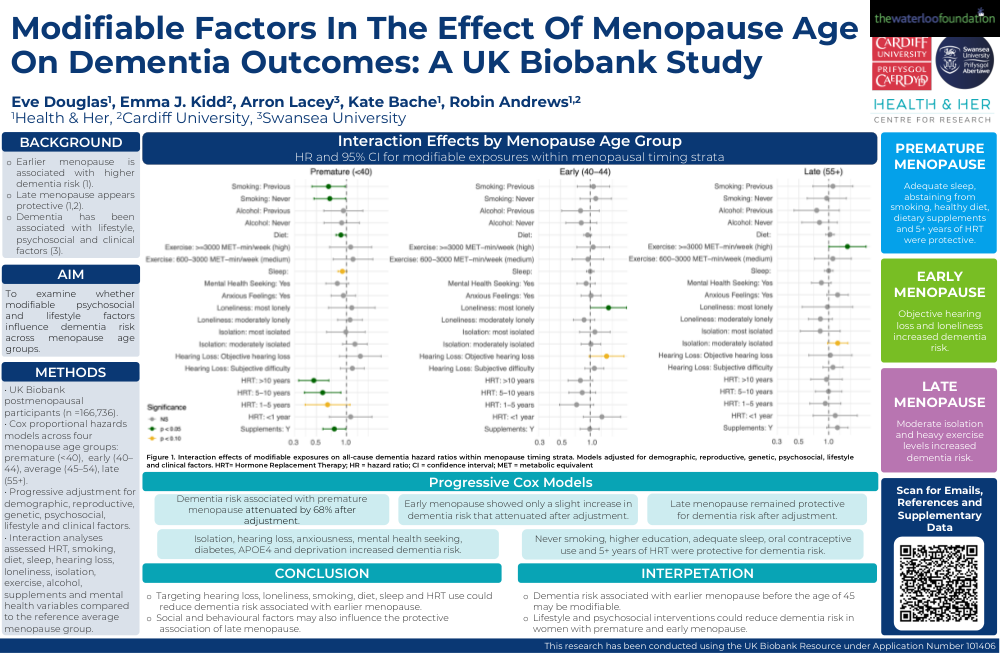
Results: Premature menopause was associated with higher dementia risk in all models, attenuating by 68% from HR 1.60 (p<0.001) in Model 1 to HR 1.19 (p=0.07) in Model 5. Early menopause showed slight increased risk, HR 1.13 (p=0.01) in Model 1 which fully attenuated after adjustment: HR 1.02 (p=0.8). Late menopause remained consistently protective HR 0.85 (p=0.006) in Model 1 to HR 0.78 (p=0.002) in Model 5. Key predictors of increased dementia risk included isolation, hearing loss, mental health seeking, anxiousness, diabetes, APOE4 and socioeconomic deprivation. Protective factors included never smoking, higher education, ≥5-year HRT use, oral contraceptive use, and adequate sleep. Interaction analysis showed smoking, poor diet, and poor sleep increased dementia risk in premature menopause, while dietary supplements and ≥5-year HRT use were protective. For early menopause, hearing loss and loneliness increased risk. In late menopause, the protective association was attenuated by isolation and high exercise levels.
Conclusion: Earlier menopause increases dementia risk, but this could be modified by psychosocial and lifestyle factors. Interventions targeting hearing loss, loneliness, smoking, diet, sleep and HRT use may reduce dementia risk associated with earlier menopause. The protective association of late menopause may be influenced by social and behavioural factors.
Comments
Email is required but is not shown publicly.
Loading comments...