4,068 posters, 219 videos, 101 topics, 69 sessions, 14,365 authors, 6,128 institutions
ePostersLive by SciGen Technologies S.A. All rights reserved.
Alzheimer's Association International Conference 2026
July 12-15, 2026 | London, United Kingdom, and Online

3630
Stroke-grid Writing And Semantic Feature Drawing For Chinese Dysgraphia In Logopenic Ppa: A Pilot Crossover Case Series
Poster Presenter
Part of Topic
Video
Stroke-grid Writing And Semantic Feature Drawing For Chinese Dysgraphia In Logopenic Primary Progressive Aphasia
Lorinda Kwan-Chen, PhD 1 , Amy HH Chung, MScESLPLD 1 , Joshua Tsoh, MD 2 , Lung-Tat Andrew Chan, MD 3 , Fangda Leng, MD 4 , Boon Lead Tee, MD 4
1The Education University of Hong Kong, Tai Po, Hong Kong, 2Prince Of Wales Hospital and Shatin Hospital, Shatin, Hong Kong, 3Queen Elizabeth Hospital, Kowloon, Hong Kong, 4University of California San Francisco, San Francisco, CA, USA.
BACKGROUND Written-language rehabilitation in logopenic variant primary progressive aphasia (lvPPA) remains understudied in Chinese langauges, despite well-documented impairments in orthographic processing. We investigated two complementary interventions targeting lvPPA-related dysgraphia: Stroke-Grid Writing (SGW), which provides visuospatial–orthographic scaffolding to support stroke sequencing, and Semantic Feature Drawing (SFD) which leverages semantically guided drawing to facilitate Chinese character retrieval.
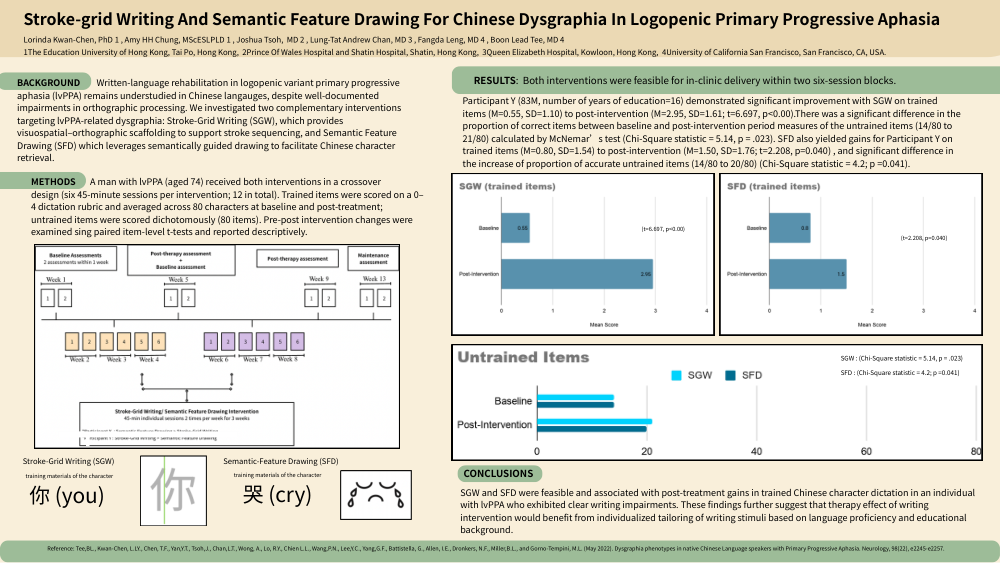
METHODS A man with lvPPA (aged 74) received both interventions in a cross-over esign (six 45-minute sessions per intervention; 12 in total). Trained items were scored on a 0– 4 dictation rubric and averaged across 80 characters at baseline and post-treatment; untrained items were scored dichotomously (80 items). Pre-post intervention changes were examined sing paired item-level t-tests and reported descriptively.
RESULTS: Both interventions were feasible for in-clinic delivery within two six-session blocks.
Participant Y (83M, number of years of education=16) demonstrated significant improvement with SGW on trained items (M=0.55, SD=1.10) to post-intervention (M=2.95, SD=1.61; t=6.697, p<0.00).There was a significant difference in the proportion of correct items between baseline and post-intervention period measures of the untrained items (14/80 to 21/80) calculated by McNemar’s test (Chi-Square statistic = 5.14, p = .023). SFD also yielded gains for Participant Y on trained items (M=0.80, SD=1.54) to post-intervention (M=1.50, SD=1.76; t=2.208, p=0.040) , and significant difference in the increase of proportion of accurate untrained items (14/80 to 20/80) (Chi-Square statistic = 4.2; p =0.041).
Stroke-Grid Writing (SGW) training materials of the character
你 (you)
Semantic-Feature Drawing (SFD) training materials of the character
哭 (cry)
CONCLUSIONS
SGW and SFD were feasible and associated with post-treatment gains in trained Chinese character dictation in an individual with lvPPA who exhibited clear writing impairments. These findings further suggest that therapy effect of writing intervention would benefit from individualized tailoring of writing stimuli based on language proficiency and educational background.
Reference: Tee,BL., Kwan-Chen, L.LY., Chen, T.F., Yan,Y.T., Tsoh,J., Chan,L.T., Wong, A., Lo, R.Y., Chien L.L., Wang,P.N., Lee,Y.C., Yang,G.F., Battistella, G., Allen, I.E., Dronkers, N.F., Miller,B.L., and Gorno-Tempini, M.L. (May 2022). Dysgraphia phenotypes in native Chinese Language speakers with Primary Progressive Aphasia. Neurology, 98(22), e2245-e2257.
Comments
Email is required but is not shown publicly.
Loading comments...