4,068 posters, 219 videos, 101 topics, 69 sessions, 14,365 authors, 6,128 institutions
ePostersLive by SciGen Technologies S.A. All rights reserved.
Alzheimer's Association International Conference 2026
July 12-15, 2026 | London, United Kingdom, and Online

3688
Bpsd Clusters In Early-onset Vs Late-onset Alzheimer’S Disease In The Peruvian Population: Cognitive And Functional Associations
Poster Presenter
Part of Topic
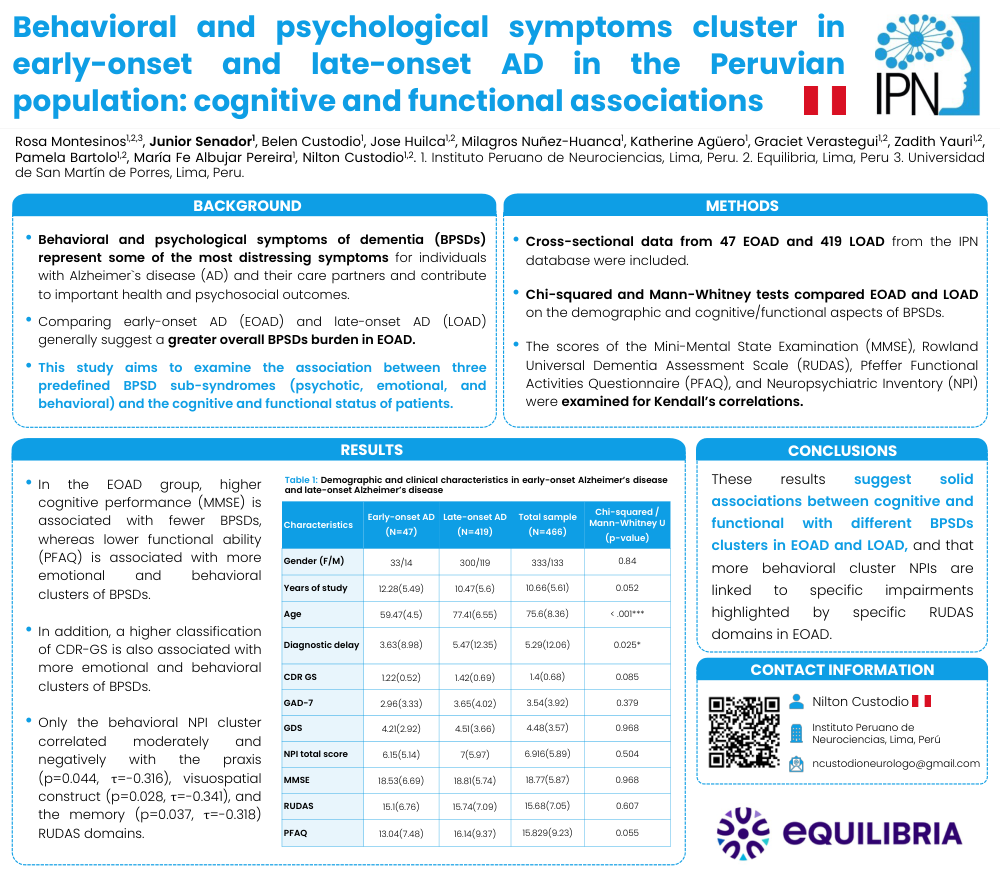
Background: Behavioral and psychological symptoms of dementia (BPSDs) represent some of the most distressing symptoms for individuals with Alzheimer`s disease (AD) and their care partners and contribute to important health and psychosocial outcomes. Comparing early-onset AD (EOAD) and late-onset AD (LOAD) generally suggest a greater overall BPSDs burden in EOAD. This study aims to examine the association between three predefined BPSD sub-syndromes (psychotic, emotional, and behavioral) and the cognitive and functional status of patients.
Methods: Cross-sectional data from 47 EOAD and 419 LOAD from the IPN database were included. Chi-squared and Mann-Whitney tests compared EOAD and LOAD on the demographic and cognitive/functional of BPSDs. The scores of the Mini-Mental State Examination (MMSE), Rowland Universal Dementia Assessment Scale (RUDAS), Pfeffer Functional Activities Questionnaire (PFAQ), and Neuropsychiatric Inventory (NPI) were examined for Kendall’s correlations.
Results: In the EOAD group, higher cognitive performance (MMSE) is associated with fewer BPSDs, whereas lower functional ability (PFAQ) is associated with more emotional and behavioral clusters of BPSDs. In addition, a higher classification of CDR-GS is also associated with more emotional and behavioral clusters of BPSDs. Only the behavioral NPI cluster correlated moderately and negatively with the praxis (p=0.044, τ=-0.316), visuospatial construct (p=0.028, τ=-0.341), and the memory (p=0.037, τ=-0.318) RUDAS domains.
Conclusion: These results suggest solid associations between cognitive and functional with different BPSDs clusters in EOAD and LOAD; and that more behavioral cluster NPI are linked to specific impairments highlighted by specific RUDAS domains in EOAD.
Comments
Email is required but is not shown publicly.
Loading comments...