4,068 posters, 219 videos, 101 topics, 69 sessions, 14,365 authors, 6,128 institutions
ePostersLive by SciGen Technologies S.A. All rights reserved.
Alzheimer's Association International Conference 2026
July 12-15, 2026 | London, United Kingdom, and Online

8877
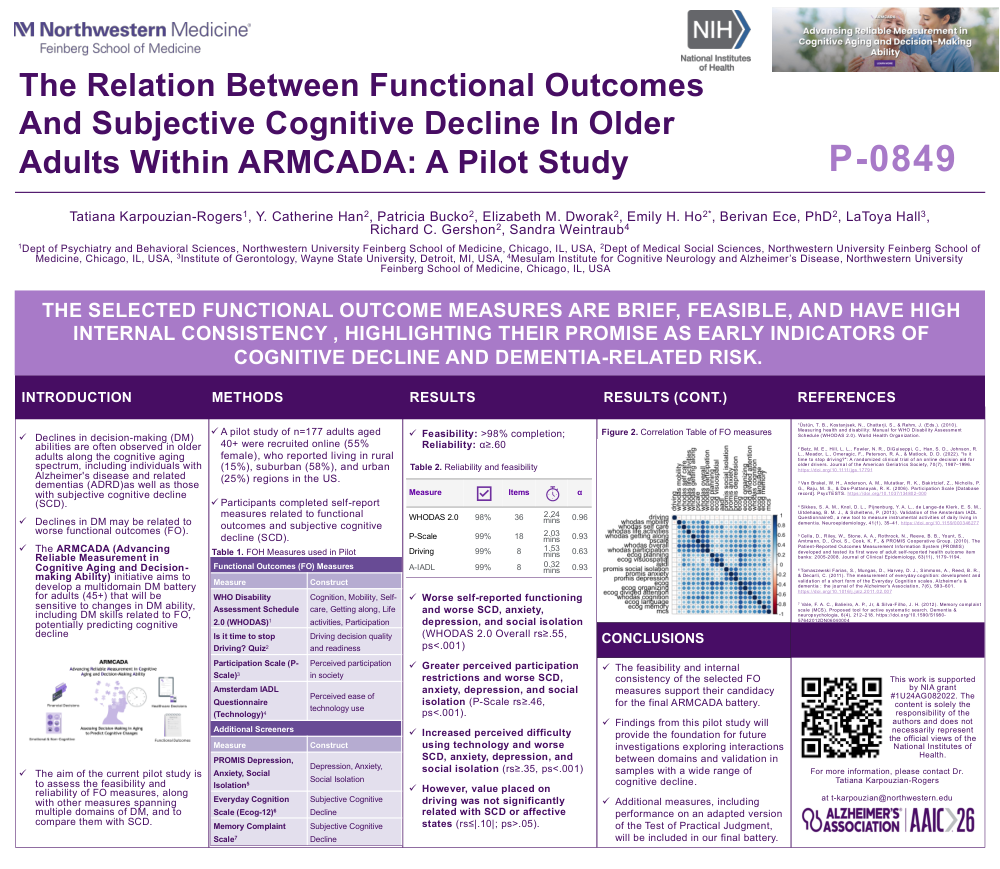
The Relation Between Functional Outcomes And Subjective Cognitive Decline In In Older Adults Within Armcada: A Pilot Study
Poster Presenter
Authors
Tatiana Karpouzian-Rogers, Y. Catherine Han, Patricia Bucko, Elizabeth M. Dworak, Emily H. Ho, Berivan Ece, LaToya Hall, Richard C. Gershon, Sandra Weintraub
Affiliations
Department of Medical Social Sciences, Northwestern University Feinberg School of Medicine, Department of Psychiatry and Behavioral Sciences, Northwestern University Feinberg School of Medicine, Institute of Gerontology, Wayne State University, Mesulam Institute for Cognitive Neurology and Alzheimer’s Disease, Northwestern University Feinberg School of Medicine
Part of Topic
The Relation Between Functional Outcomes And Subjective Cognitive Decline In Older Adults Within ARMCADA: A Pilot Study
P-0849
Tatiana Karpouzian-Rogers1, Y. Catherine Han2, Patricia Bucko2, Elizabeth M. Dworak2, Emily H. Ho2*, Berivan Ece, PhD2, LaToya Hall3,
Richard C. Gershon2, Sandra Weintraub4
1Dept of Psychiatry and Behavioral Sciences, Northwestern University Feinberg School of Medicine, Chicago, IL, USA, 2Dept of Medical Social Sciences, Northwestern University Feinberg School of Medicine, Chicago, IL, USA, 3Institute of Gerontology, Wayne State University, Detroit, MI, USA, 4Mesulam Institute for Cognitive Neurology and Alzheimer’s Disease, Northwestern University Feinberg School of Medicine, Chicago, IL, USA
THE SELECTED FUNCTIONAL OUTCOME MEASURES ARE BRIEF, FEASIBLE, AND HAVE HIGH INTERNAL CONSISTENCY , HIGHLIGHTING THEIR PROMISE AS EARLY INDICATORS OF COGNITIVE DECLINE AND DEMENTIA-RELATED RISK.
Participants completed self-report measures related to functional outcomes and subjective cognitive decline (SCD).
1Üstün, T. B., Kostanjsek, N., Chatterji, S., & Rehm, J. (Eds.). (2010). Measuring health and disability: Manual for WHO Disability Assessment Schedule (WHODAS 2.0). World Health Organization.
2 Betz, M. E., Hill, L. L., Fowler, N. R., DiGuiseppi, C., Han, S. D., Johnson, R. L., Meador, L., Omeragic, F., Peterson, R. A., & Matlock, D. D. (2022). "Is it time to stop driving?": A randomized clinical trial of an online decision aid for older drivers. Journal of the American Geriatrics Society, 70(7), 1987–1996. https://doi.org/10.1111/jgs.17791
3 Van Brakel, W. H., Anderson, A. M., Mutatkar, R. K., Bakirtzief, Z., Nicholls, P. G., Raju, M. S., & Das-Pattanayak, R. K. (2006). Participation Scale [Database record]. PsycTESTS. https://doi.org/10.1037/t34802-000
4 Sikkes, S. A. M., Knol, D. L., Pijnenburg, Y. A. L., de Lange-de Klerk, E. S. M., Uitdehaag, B. M. J., & Scheltens, P. (2013). Validation of the Amsterdam IADL Questionnaire©, a new tool to measure instrumental activities of daily living in dementia. Neuroepidemiology, 41(1), 35–41. https://doi.org/10.1159/000346277
5 Cella, D., Riley, W., Stone, A. A., Rothrock, N., Reeve, B. B., Yount, S., Amtmann, D., Choi, S., Cook, K. F., & PROMIS Cooperative Group. (2010). The Patient-Reported Outcomes Measurement Information System (PROMIS) developed and tested its first wave of adult self-reported health outcome item banks: 2005-2008. Journal of Clinical Epidemiology, 63(11), 1179-1194.
6 Tomaszewski Farias, S., Mungas, D., Harvey, D. J., Simmons, A., Reed, B. R., & Decarli, C. (2011). The measurement of everyday cognition: development and validation of a short form of the Everyday Cognition scales. Alzheimer's & dementia : the journal of the Alzheimer's Association, 7(6), 593–601. https://doi.org/10.1016/j.jalz.2011.02.007
7 Vale, F. A. C., Balieiro, A. P., Jr, & Silva-Filho, J. H. (2012). Memory complaint scale (MCS). Proposed tool for active systematic search. Dementia & neuropsychologia, 6(4), 212–218. https://doi.org/10.1590/S1980-57642012DN06040004
This work is supported by NIA grant #1U24AG082022. The content is solely the responsibility of the authors and does not necessarily represent the official views of the National Institutes of Health.
Comments
Email is required but is not shown publicly.
Loading comments...