4,068 posters, 219 videos, 101 topics, 69 sessions, 14,365 authors, 6,128 institutions
ePostersLive by SciGen Technologies S.A. All rights reserved.
Alzheimer's Association International Conference 2026
July 12-15, 2026 | London, United Kingdom, and Online

6803
Communication between cerebellum and memory circuits supporting social and non-social feedback learning
Poster Presenter
Authors
Yu Chen, Corby Dale, Kamalini Ranasinghe, Kuan-Hua Chen, Faatimah Syed, Bailey McEachen, Gil Rabinovici, Howard Rosen, Joel Kramer, Bruce Miller, Srikantan Nagarajan, Katherine Rankin
Affiliations
Department of Neurology, Weill Institute for Neurosciences, Edward and Pearl Fein Memory and Aging Center, University of California San Francisco, San Francisco San Francisco, California, USA., Department of Radiology and Biomedical Imaging, University of California San Francisco, San Francisco, California, USA., Department of Human Ecology, University of California, Davis, Davis, California, USA.
Part of Topic
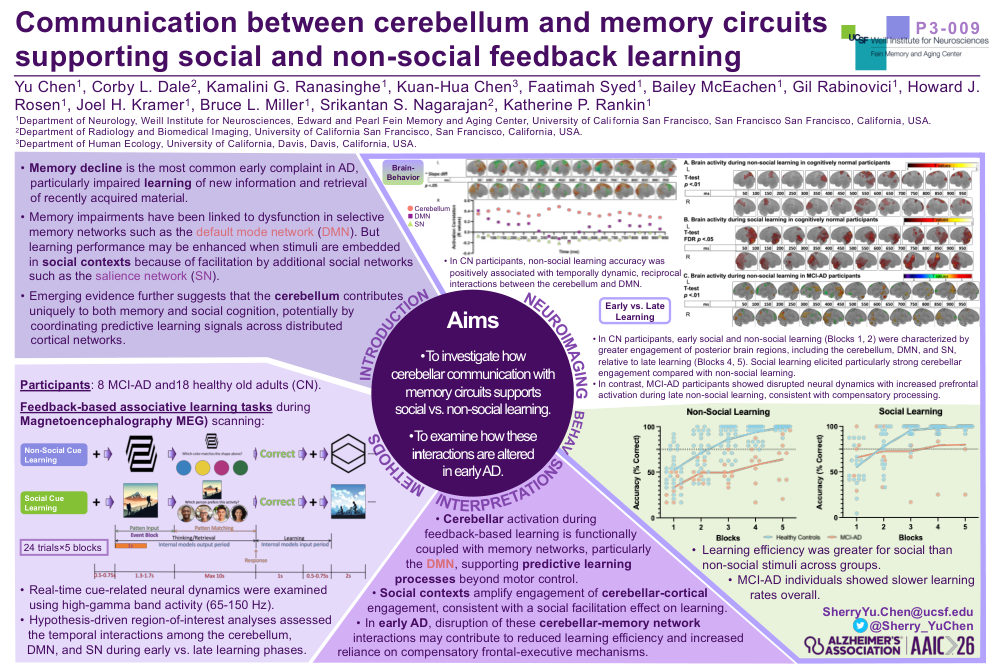
BACKGROUND. Memory decline is the most common early complaint in Alzheimer’s disease (AD), particularly impaired learning of new information and retrieval of recently acquired material. Learning performance, however, can be enhanced when stimuli are embedded in social contexts compared with non-social contexts. Prior work has linked memory impairments to dysfunction in selective memory networks such as the default mode network (DMN), and socioemotional deficits to disruptions in social networks such as the salience network (SN). Emerging evidence further suggests that the cerebellum contributes uniquely to both memory and social cognition, potentially by coordinating predictive learning signals across distributed cortical networks. However, how cerebellar communication with memory circuits supports social versus non-social learning, and how these interactions are altered in early AD, remain poorly understood.
METHODS. Eighteen cognitively normal (CN) participants and six individuals with mild cognitive impairment due to AD (MCI-AD) completed two feedback-based associative learning tasks during magnetoencephalography (MEG) scanning: a non-social shape-color matching task and a social face-activity matching task. Real-time cue-related neural dynamics were examined using high-gamma band activity (65-150 Hz). Hypothesis-driven region-of-interest analyses assessed the temporal interactions among the cerebellum, DMN, and SN during early versus late learning phases.
RESULTS. Learning efficiency was greater for social than non-social stimuli across groups, while MCI-AD individuals showed slower learning rates overall. In CN participants, early learning was characterized by greater engagement of posterior brain regions, including the cerebellum, DMN, and SN, relative to late learning. Social learning elicited particularly strong cerebellar engagement compared with non-social learning. In contrast, MCI-AD participants showed disrupted neural dynamics with increased prefrontal activation during late learning, consistent with compensatory processing. In CN participants, non-social learning accuracy was positively associated with temporally dynamic, reciprocal interactions between the cerebellum and DMN.
CONCLUSIONS. Cerebellar activation during feedback-based learning is functionally coupled with memory networks, particularly the DMN, supporting predictive learning processes beyond motor control. Social contexts amplify engagement of cerebellar-cortical engagement, consistent with a social facilitation effect on learning. In early AD, disruption of these cerebellar-memory network interactions may contribute to reduced learning efficiency and increased reliance on compensatory frontal mechanisms.
Comments
Email is required but is not shown publicly.
Loading comments...