4,068 posters, 219 videos, 101 topics, 69 sessions, 14,365 authors, 6,128 institutions
ePostersLive by SciGen Technologies S.A. All rights reserved.
Alzheimer's Association International Conference 2026
July 12-15, 2026 | London, United Kingdom, and Online

9690
Crosswalking MMSE And TICS: Performance Across Sociodemographic Groups
Poster Presenter
Authors
Rachel Maina, Wenjie Cai, Cliff Whetung, Alison M. Luckey, L. Grisell Diaz-Ramirez, Kelvin Pengyuan Zhang, Yuxuan Wang, Jason R. Gantenberg, Emma Nichols, Alden L. Gross, M. Maria Glymour, Jingxuan Wang, Ruijia Chen
Affiliations
Brain and Mind Institute, Aga Khan University, Nairobi, Kenya.; Global Brain Health Institute, Trinity College Institute of Neuroscience, The University of Dublin, Dublin, Ireland., Department of Epidemiology, Johns Hopkins University Bloomberg School of Public Health, Baltimore, MD, USA., Memory Keepers Medical Discovery Team, University of Minnesota Duluth Medical School, Duluth, Minnesota, USA., Glenn Biggs Institute for Alzheimer's & Neurodegenerative Diseases, University of Texas Health San Antonio, San Antonio, Texas, USA., Division of Geriatrics, University of California, San Francisco, CA, USA., Department of Epidemiology, University of Michigan, Ann Arbor, MI, USA., Center for Economic and Social Research, University of Southern California, Los Angeles, CA, USA., Department of Health Services, Policy & Practice, Brown University School of Public Health, Providence, RI, USA.; Department of Epidemiology, Brown University School of Public Health, Providence, RI, USA., Center for Economic and Social Research, University of Southern California, Los Angeles, CA, USA.; Leonard Davis School of Gerontology, University of Southern California, Los Angeles, CA, USA., Department of Community Health Sciences, UCLA Fielding School of Public Health, Los Angeles, CA, USA., Department of Epidemiology, Harvard T.H. Chan School of Public Health, Boston, MA, USA., Department of Community Health Sciences, UCLA Fielding School of Public Health, Los Angeles, CA, USA.
Part of Topic
Abstract:
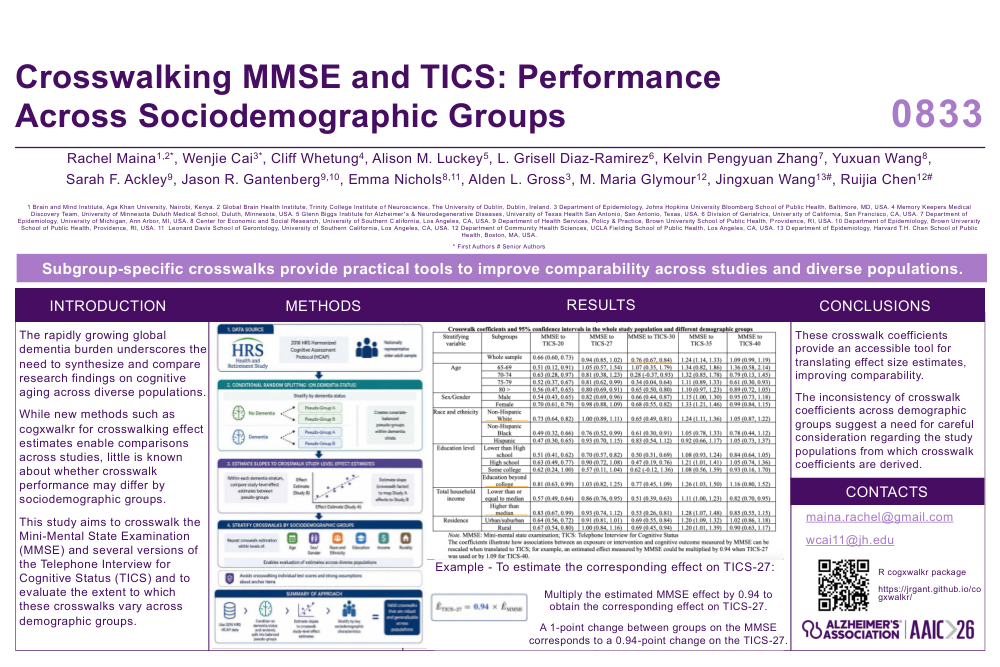
Background: The rapidly growing global dementia burden underscores the need to synthesize and compare research findings on cognitive aging across diverse populations. The Mini-Mental State Examination (MMSE) and the Telephone Interview for Cognitive Status (TICS) have been widely used to measure cognitive performance in cognitive aging studies, but effects from studies using the MMSE are not directly comparable to those using the TICS, and vice versa. While new methods for crosswalking effect estimates enable appropriate comparisons across studies, little is known about whether crosswalk performance may differ by sociodemographic groups. This study aims to crosswalk the MMSE and several versions of the TICS and to evaluate the extent to which these crosswalks vary across demographic groups.
Methods: Data were drawn from the 2016 Health and Retirement Study’s (HRS) Harmonized Cognitive Assessment Protocol (HCAP). We used a conditional, on dementia status, random-splitting approach to create covariate-balanced pseudo-groups and estimated slopes to crosswalk study-level effect estimates, avoiding the need to crosswalk individual test scores or make strong assumptions about anchor items. To evaluate estimates across sociodemographic groups, we stratified the crosswalks by age, sex/gender, race and ethnicity, education, income, and rurality.
Results: In the HRS-HCAP (n=3,236), crosswalk coefficients between the MMSE and TICS-20, TICS-27, TICS-30, TICS-35, and TICS-40 were 0.66 (95% CI:0.60, 0.730), 0.94 (95% CI: 0.85, 1.02), 0.76 (95% CI:0.67, 0.84), 1.24 (95% CI: 1.14, 1.33), and 1.09 (95% CI: 0.99, 1.19), respectively. Estimated coefficients were higher among non-Hispanic White participants and those with higher levels of education and income. TICS-30 yielded the largest variability in the crosswalk coefficients across sociodemographic groups.
Conclusion: The inconsistency of crosswalk coefficients across demographic groups suggest a need for careful consideration regarding the study populations from which crosswalk coefficients are derived. These subgroup-specific crosswalks provide practical tools to improve comparability across studies and diverse populations.
Comments
Email is required but is not shown publicly.
Loading comments...