4,068 posters, 219 videos, 101 topics, 69 sessions, 14,365 authors, 6,128 institutions
ePostersLive by SciGen Technologies S.A. All rights reserved.
Alzheimer's Association International Conference 2026
July 12-15, 2026 | London, United Kingdom, and Online

8573
Cerebrovascular Burden And Risk In Midlife: Evidence From The Singaporean CHARM Cohort
Poster Presenter
Part of Topic
Background: Cerebrovascular disease (CVD) is a known contributor of the Asian dementia phenomenon and overall adverse health outcomes. The prevalence of CVD and vascular risk factors (VRF) is increasing in midlife, however, their impact on midlife health and functioning remains scarce. Using data from the unique Singaporean Cerebrovascular Health, Adult Learning, Resilience and Mechanisms (CHARM) cohort of employed adults aged 30 to 59 years, this study examined age-related patterns and associations of CVD and VRF burden with neuropsychological, lifestyle, socio-behavioral and biomarker outcomes.
Methods: Multidomain baseline data were collected from 607 participants (67.5% female; mean age:49.97±6.50yrs; mean education:16.24±2.66yrs). CVD burden was defined using modified Fazekas score ≥5 while presence of VRF was defined as self-reported hyperlipidemia, hypertension, or diabetes; total cholesterol ≥5.1mmol/L; systolic blood pressure ≥140mmHg; and/or HbA1c≥7.1%. Analyses were performed separately for CVD burden and VRF presence. LOESS smoothing visualised age-related patterns of cognitive domains, stratified by CVD/VRF burden status. Appropriate parametric/non-parametric tests were utilised for descriptive statistics and group comparisons. Associations were tested using analysis of covariance adjusted for age (centred at 50 years), sex and education. Age-related interactions were tested using Type III sums of squares. Logistic regression estimated odds ratios. Statistical significance was set at p<0.05. Analyses were performed using R.
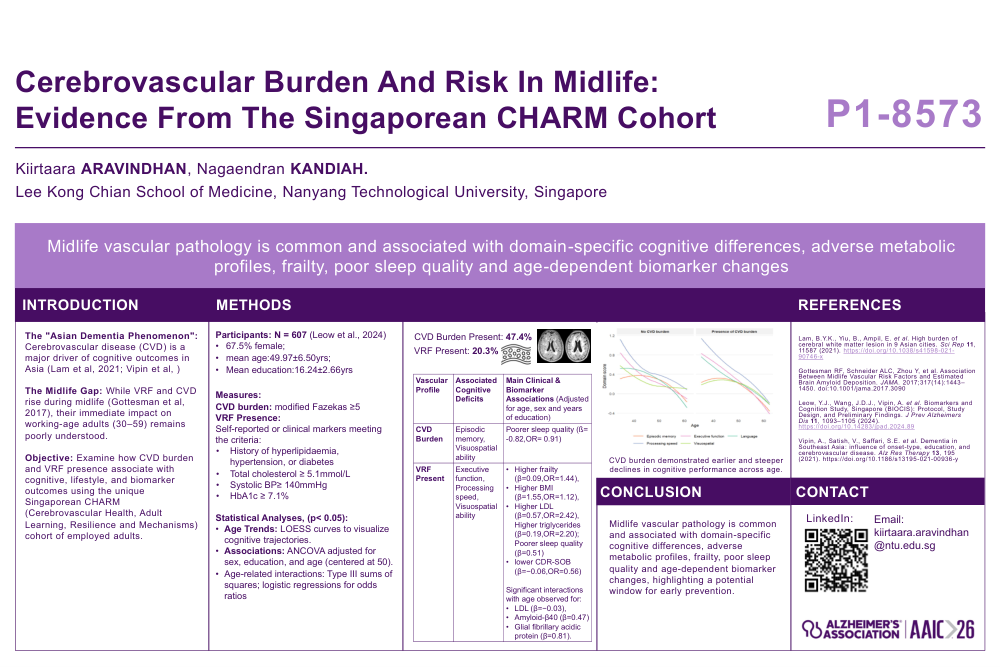
Results: CVD burden and VRF were present in 47.4% and 20.3% individuals, respectively. LOESS curves demonstrated earlier and steeper reductions among individuals with VRF or CVD. Significant differences were observed in episodic memory and visuospatial ability by CVD status, and in executive function, processing speed, and visuospatial ability by VRF status. VRF presence was associated with higher frailty (β=0.09,OR=1.44), higher body mass index (β=1.55,OR=1.12), elevated low-density lipoprotein (LDL) (β=0.57,OR=2.42), elevated triglycerides (β=0.19,OR=2.20), poorer sleep quality (β=0.51), and lower clinical dementia rating sum-of-boxes (β=−0.06,OR=0.56) after adjustments. Significant interactions with age were observed for LDL (β=−0.03), amyloid-β40 (β=0.47), and glial fibrillary acidic protein (β=0.81). CVD burden was associated with poorer sleep quality (β=−0.82,OR=0.91).
Conclusion: Midlife vascular pathology is common and associated with domain-specific cognitive differences, adverse metabolic profiles, frailty, poor sleep quality and age-dependent biomarker changes, highlighting a potential window for early prevention.
Comments
Email is required but is not shown publicly.
Loading comments...