4,068 posters, 219 videos, 101 topics, 69 sessions, 14,365 authors, 6,128 institutions
ePostersLive by SciGen Technologies S.A. All rights reserved.
Alzheimer's Association International Conference 2026
July 12-15, 2026 | London, United Kingdom, and Online

10481
Plasma P-tau 217 Associations With Verbal Learning And Memory Performance In A Community-Based Asian American Cohort
Poster Presenter
Authors
Affiliations
Part of Topic
Plasma p-tau 217 Associations with Verbal Learning and Memory Performance in A Community-Based Asian American Cohort
Author: Yirou Jiang, Marcelle Dougan, Annie Ching, Bora Nam, Daren Huang, Gabriel Fara-on, Marian Tzuang, Oanh Meyer, Sarah Tomaszewski Farias, Haeok Lee, Quyen Q. Tiet, Boon Lead Tee, Bharat Thyagarajan, Alka Kanaya, Gilbert Gee, Thu T. Nguyen, Junaid S. Merchant, Joshua Grill, Michele Tobias, Van Ta Park
Background
Alzheimer’s disease (AD) is characterized by amyloid-β and tau pathology, with p-tau emerging as a sensitive indicator of early neurodegeneration. Despite the substantial global AD burden among individuals of Asian descent, the relationship between plasma p-tau and cognitive performance in Asian populations remains largely unexplored. We examined the relationship between plasma p-tau and memory performance in a community-dwelling Asian population.
Methods
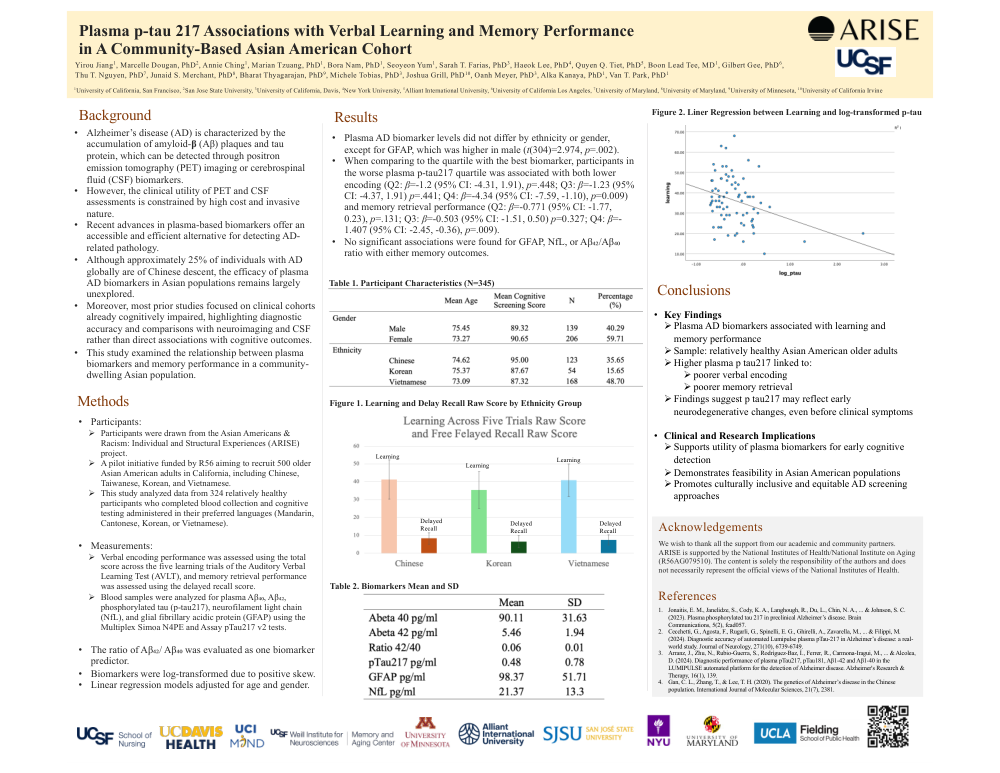
Participants were drawn from the Asian Americans and Racism: Individual and Structural Experiences (ARISE) pilot study. The analytic sample included 324 relatively healthy participants who completed blood collection and cognitive testing in their preferred languages (Mandarin, Cantonese, Korean, or Vietnamese); 17 participants were excluded due to impaired cognitive screening scores. Verbal encoding was assessed using the total score across the five learning trials of the Auditory Verbal Learning Test (AVLT), and memory retrieval was assessed using the delayed recall. Blood samples were analyzed for plasma Aβ₄₀, Aβ₄₂, p-tau217, neurofilament light chain (NfL), and glial fibrillary acidic protein (GFAP) using the Multiplex Simoa N4PE and Assay pTau217 v2 tests. The ratio of Aβ₄₂/ Aβ₄₀ was evaluated as one biomarker predictor. Biomarkers were log-transformed due to positive skew. Linear regression models adjusted for age and gender.
Results
Plasma AD biomarker levels did not differ by ethnicity or gender, except for GFAP, which was higher in male (t(304)=2.974, p=.002). When comparing to the quartile with the best biomarker, participants in the worse plasma p-tau217 quartile was associated with both lower encoding (Q2: β=-1.2 (95% CI: -4.31, 1.91), p=.448; Q3: β=-1.23 (95% CI: -4.37, 1.91) p=.441; Q4: β=-4.34 (95% CI: -7.59, -1.10), p=0.009) and memory retrieval performance (Q2: β=-0.771 (95% CI: -1.77, 0.23), p=.131; Q3: β=-0.503 (95% CI: -1.51, 0.50) p=0.327; Q4: β=-1.407 (95% CI: -2.45, -0.36), p=.009). No significant associations were found for GFAP, NfL, or Aβ₄₂/Aβ₄₀ ratio with either memory outcomes.
Conclusions
Elevated p-tau217 levels were associated with poorer verbal encoding and memory retrieval, suggesting that plasma p-tau217 may indicate early neurodegenerative changes even prior to clinical symptoms. These findings highlight the potential of plasma p-tau217 for equitable, community-based approaches to early AD detection in underrepresented Asian populations.
Comments
Email is required but is not shown publicly.
Loading comments...