4,068 posters, 219 videos, 101 topics, 69 sessions, 14,365 authors, 6,128 institutions
ePostersLive by SciGen Technologies S.A. All rights reserved.
Alzheimer's Association International Conference 2026
July 12-15, 2026 | London, United Kingdom, and Online

9385
Neuropsychological Test Performance And MRI Outcomes Among Black/African American Females From The NACC Data Set
Poster Presenter
Authors
Jacob Labonte, Annalise E. Miner, Yorghos Tripodis, Hugo Aparicio, Rachel Nosheny, Sarah Banks, Arlener Turner, Lola Baird, Ann McKee, Jesse Mez, Michael Alosco
Affiliations
University of California San Francisco, San Francisco, CA, USA, Boston University Alzheimer’s Disease Research and CTE Centers, Boston University Chobanian & Avedisian School of Medicine, Boston, MA, USA, The Framingham Heart Study, Framingham, MA, USA, University of California, San Diego, La Jolla, CA, USA, Miami Dade College, Miami, Florida, USA
Part of Topic
Background
• AD disproportionately impacts female
sex and Black/African Americans. Black
females are thus at greater risk for
developing AD.
• However, Black females are are
consistently underrepresented in aging
research.
• Objective: Describe neuropsychological
test performance and volumetric MRI
outcomes in large cohort of
Black/African American females from
the NACC data sets.
Methods
Sample: 6,120 Black/African American females from NACC
Assessment:
• Participants completed at least one UDS visit (2.0/3.0) with
neuropsychological testing.
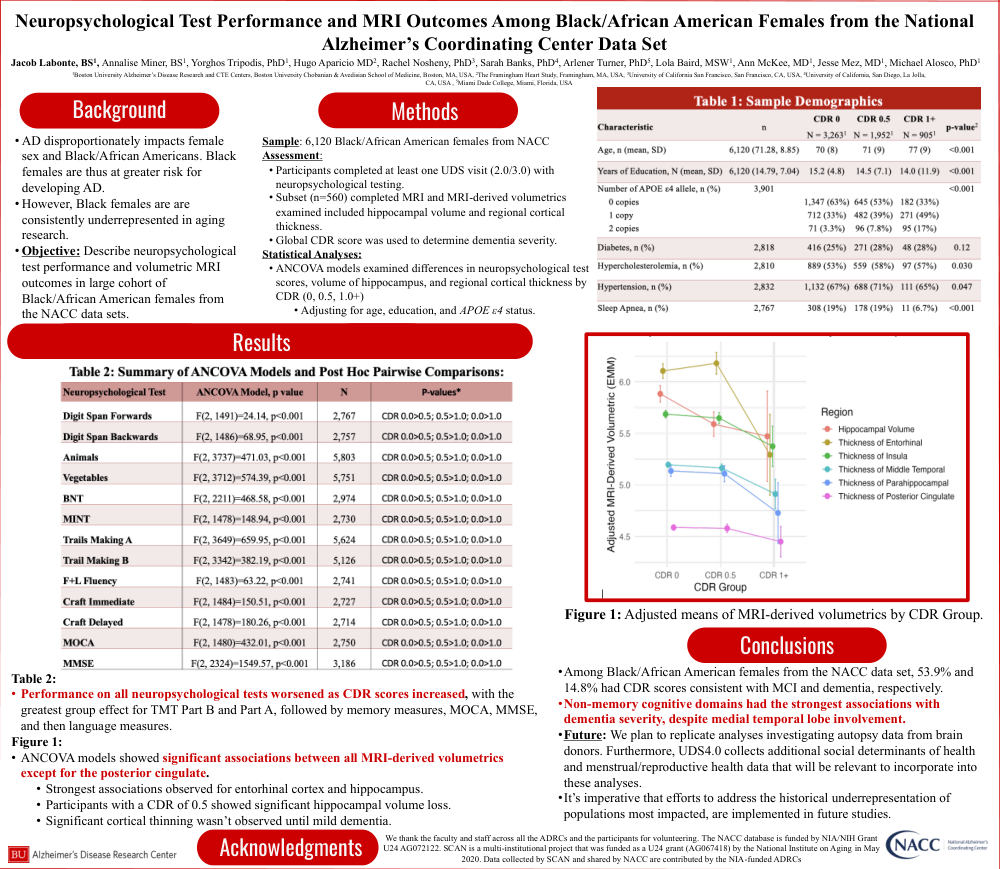
• Subset (n=560) completed MRI and MRI-derived volumetrics
examined included hippocampal volume and regional cortical
thickness.
• Global CDR score was used to determine dementia severity.
Statistical Analyses:
• ANCOVA models examined differences in neuropsychological test
scores, volume of hippocampus, and regional cortical thickness by
CDR (0, 0.5, 1.0+)
• Adjusting for age, education, and APOE ε4 status.
Results:
Table 2:
• Performance on all neuropsychological tests worsened as CDR scores increased, with the
greatest group effect for TMT Part B and Part A, followed by memory measures, MOCA, MMSE,
and then language measures.
Figure 1:
• ANCOVA models showed significant associations between all MRI-derived volumetrics
except for the posterior cingulate.
• Strongest associations observed for entorhinal cortex and hippocampus.
• Participants with a CDR of 0.5 showed significant hippocampal volume loss.
• Significant cortical thinning wasn’t observed until mild dementia.
Conclusions:
•Among Black/African American females from the NACC data set, 53.9% and
14.8% had CDR scores consistent with MCI and dementia, respectively.
•Non-memory cognitive domains had the strongest associations with
dementia severity, despite medial temporal lobe involvement.
•Future: We plan to replicate analyses investigating autopsy data from brain
donors. Furthermore, UDS4.0 collects additional social determinants of health
and menstrual/reproductive health data that will be relevant to incorporate into
these analyses.
•It’s imperative that efforts to address the historical underrepresentation of
populations most impacted, are implemented in future studies.
Comments
Email is required but is not shown publicly.
Loading comments...