4,068 posters, 219 videos, 101 topics, 69 sessions, 14,365 authors, 6,128 institutions
ePostersLive by SciGen Technologies S.A. All rights reserved.
Alzheimer's Association International Conference 2026
July 12-15, 2026 | London, United Kingdom, and Online

1436
Narrative Discourse Microparameters In Brazilians With Mild Alzheimer’s Disease: A Correlational And Factorial Analysis
Poster Presenter
Authors
Affiliations
Part of Topic
Background
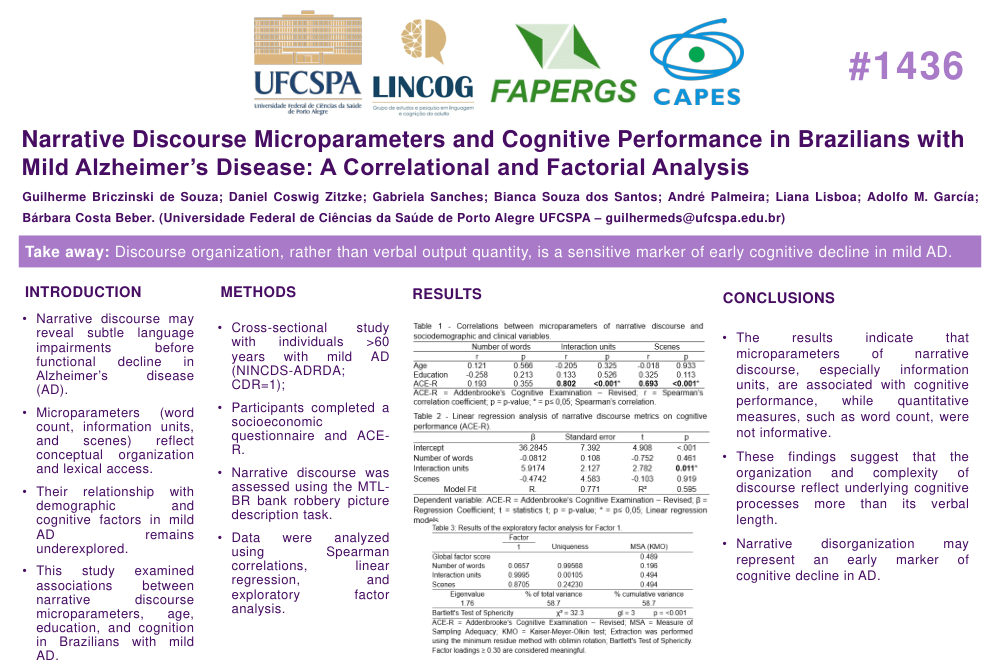
Narrative discourse can reveal subtle flaws in conceptual organization and lexical access before measurable functional decline. However, the literature lacks integrated models combining narrative microparameters (number of words, interaction units, and scenes) in Alzheimer disease (AD). Thus, this study aimed to correlate microparameters of narrative discourse and age, education and cognition in Brazilians with mild AD.
Method
Individuals over 60 years, diagnosed with AD according to NINCDS-ADRDA criteria and rated CDR 1, were invited to participate in the study. During data collection, participants completed a socioeconomic questionnaire and the Addenbrooke’s Cognitive Examination Revised (ACE-R). The narrative discourse was collected using the oral narrative task from the Brazilian version of the Montreal–Toulouse Language Assessment Battery (MTL-BR), in which participants described the bank robbery picture. Spearman’s correlation, linear regression models and exploratory factor analysis were performed.
Result
The sample comprised 25 individuals with mild AD (mean age 75.8 ± 8.29 years; education 10.9 ± 6.9 years). Mean time since diagnosis was 2.20 ± 1.91 years, and the average ACE-R score was 54.4 ± 18.5. The sample was mostly female (52%), white (84%) and right-handed (95%). Significant correlations (Table 1) were observed between ACE-R, interaction units (r = 0.802, p < 0.001) and scenes (r = 0.693, p < 0.001). The linear regression model (Table 2) shows that only interaction units (β = 5,917, p = 0.011) have a significant impact on ACE-R, with a moderate relation between the variations (R² = 0.595). Factor analysis (Table 3) revealed a single factor (eigenvalue = 1.76), responsible for 58.7% of the total variance, with adequate intervariate correlations (Bartlett's test of sphericity: χ² = 32.3; p < 0.001) with overall bounded sampling adequacy measure (SAM = 0.489).
Conclusion
The results indicate that microparameters of narrative discourse, especially interaction units, are associated with cognitive performance, while quantitative measures, such as word count, were not informative. These findings suggest that the organization and complexity of discourse reflect underlying cognitive processes more than its verbal length. Narrative disorganization may represent an early marker of cognitive decline in AD.
Comments
Email is required but is not shown publicly.
Loading comments...