4,068 posters, 219 videos, 101 topics, 69 sessions, 14,365 authors, 6,128 institutions
ePostersLive by SciGen Technologies S.A. All rights reserved.
Alzheimer's Association International Conference 2026
July 12-15, 2026 | London, United Kingdom, and Online

5594
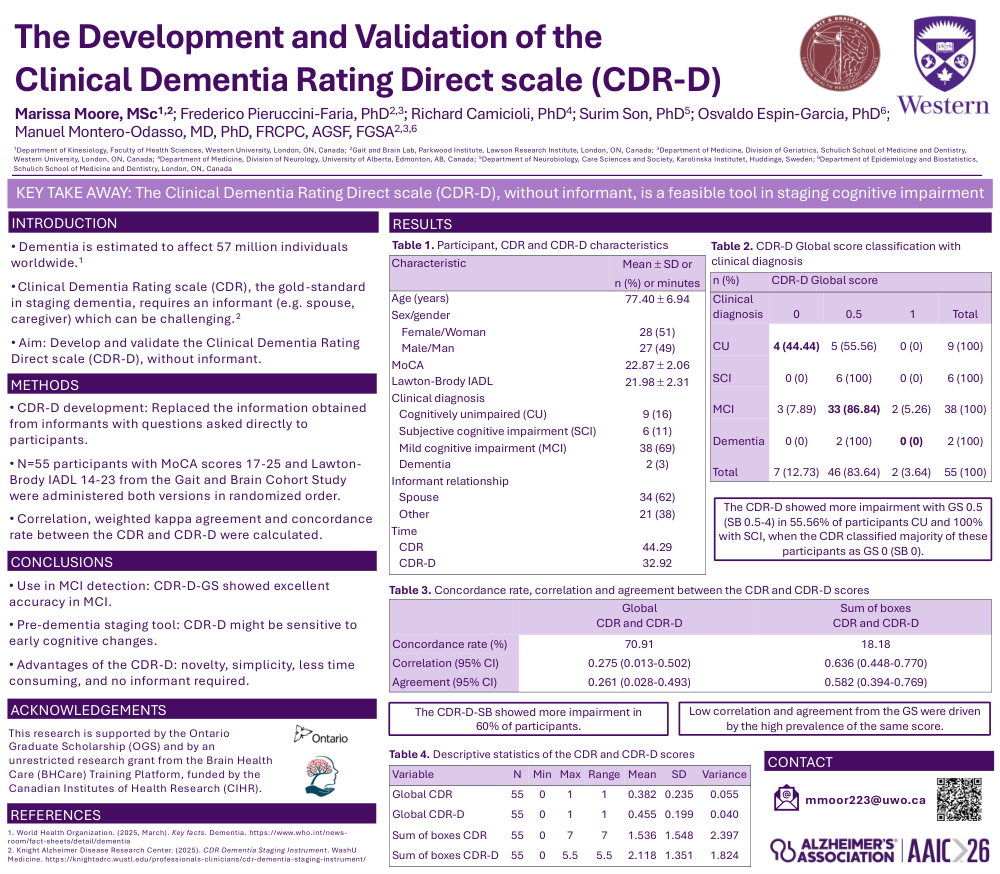
The Development And Validation Of The Clinical Dementia Rating Direct Scale (CDR-D)
Poster Presenter
Authors
Marissa Moore, Frederico Pieruccini-Faria, Richard Camicioli, Surim Son, Osvaldo Espin-Garcia, Manuel Montero-Odasso
Affiliations
Department of Kinesiology, Faculty of Health Sciences, Western University, London, ON, Canada; Gait and Brain Lab, Parkwood Institute, Lawson Research Institute, London, ON, Canada, Gait and Brain Lab, Parkwood Institute, Lawson Research Institute, London, ON, Canada; Department of Medicine, Division of Geriatrics, Schulich School of Medicine and Dentistry, Western University, London, ON, Canada, Department of Medicine, Division of Neurology, University of Alberta, Edmonton, AB, Canada, Department of Neurobiology, Care Sciences and Society, Karolinska Institutet, Huddinge, Sweden, Department of Epidemiology and Biostatistics, Schulich School of Medicine and Dentistry, London, ON, Canada, Gait and Brain Lab, Parkwood Institute, Lawson Research Institute, London, ON, Canada; Department of Medicine, Division of Geriatrics, Schulich School of Medicine and Dentistry, Western University, London, ON, Canada; Department of Epidemiology and Biostatistics, Schulich School of Medicine and Dentistry, London, ON, Canada
Part of Topic
KEY TAKE AWAY: The Clinical Dementia Rating Direct scale (CDR-D), without informant, is a feasible tool in staging cognitive impairment.
INTRODUCTION
• Dementia is estimated to affect 57 million individuals worldwide.1
• Clinical Dementia Rating scale (CDR), the gold-standard in staging dementia, requires an informant (e.g. spouse, caregiver) which can be challenging.2
• Aim: Develop and validate the Clinical Dementia Rating Direct scale (CDR-D), without informant.
METHODS
• CDR-D development: Replaced the information obtained from informants with questions asked directly to participants.
• N=55 participants with MoCA scores 17-25 and Lawton- Brody IADL 14-23 from the Gait and Brain Cohort Study were administered both versions in randomized order.
• Correlation, weighted kappa agreement and concordance rate between the CDR and CDR-D were calculated.
CONCLUSIONS
• Use in MCI detection: CDR-D-GS showed excellent accuracy in MCI.
• Pre-dementia staging tool: CDR-D might be sensitive to early cognitive changes.
• Advantages of the CDR-D: novelty, simplicity, less time consuming, and no informant required.
RESULTS
See poster
ACKNOWLEDGEMENTS
This research is supported by the Ontario Graduate Scholarship (OGS) and by an unrestricted research grant from the Brain Health Care (BHCare) Training Platform, funded by the Canadian Institutes of Health Research (CIHR).
REFERENCES
1. World Health Organization. (2025, March). Key facts. Dementia. https://www.who.int/news- room/fact-sheets/detail/dementia
2. Knight Alzheimer Disease Research Center. (2025). CDR Dementia Staging Instrument. WashU Medicine. https://knightadrc.wustl.edu/professionals-clinicians/cdr-dementia-staging-instrument/
CONTACT
Email: mmoor223@uwo.ca
Comments
Email is required but is not shown publicly.
Loading comments...