4,068 posters, 219 videos, 101 topics, 69 sessions, 14,365 authors, 6,128 institutions
ePostersLive by SciGen Technologies S.A. All rights reserved.
Alzheimer's Association International Conference 2026
July 12-15, 2026 | London, United Kingdom, and Online

6906
Speech-in-noise Processing In Alzheimer's Disease And Primary Progressive Aphasia
Poster Presenter
Authors
Sophie A Froud, Benjamin A Levett, Lucy B Core, Jess Jiang, Charles R Marshall, Jason D Warren, Chris JD Hardy
Affiliations
Dementia Research Centre, UCL Queen Square Institute of Neurology, University College London, London, UK., Centre for Preventive Neurology, Queen Mary University of London, UK.
Part of Topic
Background:
In daily life, understanding spoken messages generally requires the decoding of speech signals within variably noisy acoustic backgrounds.
This presents the brain with a difficult computational challenge that is likely to be vulnerable to neurodegenerative pathologies.
Here, we studied speech-in-noise processing alongside peripheral hearing function measured using pure tone audiometry (PTA) in Alzheimer’s disease (AD) and language-led dementias (primary progressive aphasia, PPA), and identified behavioural phenotypes and structural neuroanatomical associations to speech-in-noise processing in these canonical dementias.
Methods:
Participants: 23 AD, 12 logopenic variant PPA (LV), 16 semantic variant PPA (SV), 8 nonfluent variant PPA (NFV), and 24 age-matched healthy controls. Patients met diagnostic consensus criteria [1-2]
Design: An adapted version of the digit triplet test [3] was administered. 3-digit numbers were spoken in competition with speech-weighted white noise; adjusted from trial to trial following a performance-based adaptive staircase protocol. Participants reported the digits heard in each trial. PTA was measured using the standard protocol, and a better ear average (BEA) was taken for each ear.
Speech reception threshold (SRT): A 50% SRT was calculated for each participant to quantify the speech-to-noise ratio at which small changes in noise level most affected accurate speech intelligibility.
Voxel based morphometry (VBM): Patient structural MRI scans were pre-processed and analysed for regional grey matter correlates of PTA and SRT scores in prespecified auditory brain regions [4-6].
Discussion:
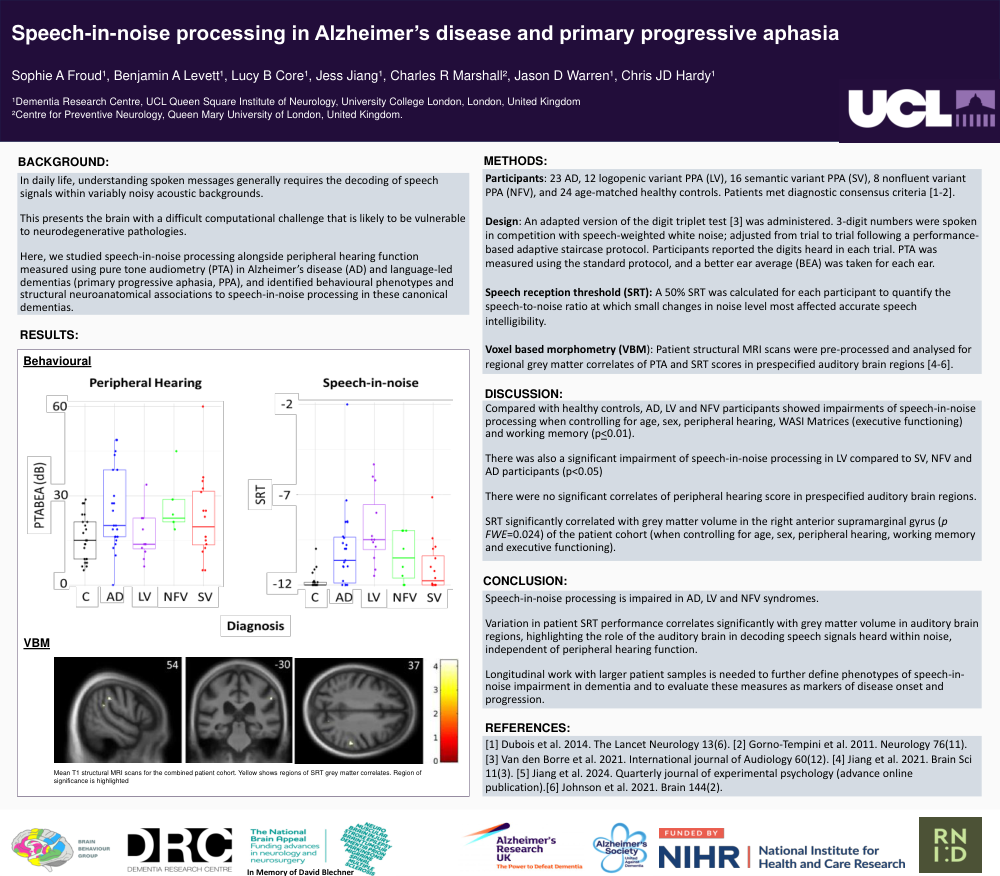
Compared with healthy controls, AD, LV and NFV participants showed impairments of speech-in-noise processing when controlling for age, sex, peripheral hearing, WASI Matrices (executive functioning) and working memory (p<0.01).
There was also a significant impairment of speech-in-noise processing in LV compared to SV, NFV and AD participants (p<0.05)
There were no significant correlates of peripheral hearing score in prespecified auditory brain regions.
SRT significantly correlated with grey matter volume in the right anterior supramarginal gyrus (p FWE=0.024) of the patient cohort (when controlling for age, sex, peripheral hearing, working memory and executive functioning).
Conclusion:
Speech-in-noise processing is impaired in AD, LV and NFV syndromes.
Variation in patient SRT performance correlates significantly with grey matter volume in auditory brain regions, highlighting the role of the auditory brain in decoding speech signals heard within noise, independent of peripheral hearing function.
Longitudinal work with larger patient samples is needed to further define phenotypes of speech-in-noise impairment in dementia and to evaluate these measures as markers of disease onset and progression.
References:
[1] Dubois et al. 2014. The Lancet Neurology 13(6). [2] Gorno-Tempini et al. 2011. Neurology 76(11). [3] Van den Borre et al. 2021. International journal of Audiology 60(12). [4] Jiang et al. 2021. Brain Sci 11(3). [5] Jiang et al. 2024. Quarterly journal of experimental psychology (advance online publication).[6] Johnson et al. 2021. Brain 144(2).
Comments
Email is required but is not shown publicly.
Loading comments...