4,068 posters, 219 videos, 101 topics, 69 sessions, 14,365 authors, 6,128 institutions
ePostersLive by SciGen Technologies S.A. All rights reserved.
Alzheimer's Association International Conference 2026
July 12-15, 2026 | London, United Kingdom, and Online

610
Linguistic Markers In Narrative Discourse For The Differential Diagnosis Of Primary Progressive Aphasia And Alzheimer’S Disease Dementia
Poster Presenter
Part of Topic
ABSTRACT:
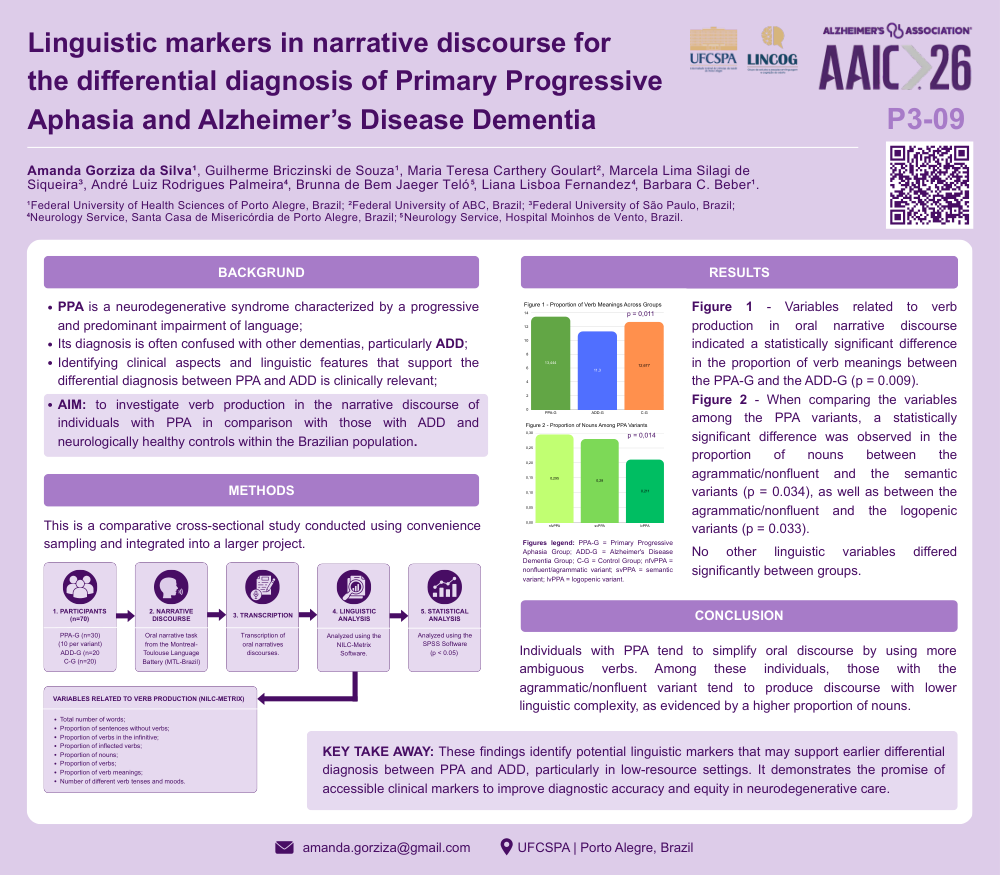
Background: Primary Progressive Aphasia (PPA) is a neurodegenerative syndrome characterized by a progressive and predominant impairment of language. In clinical practice, its diagnosis remains challenging and is often confused with other dementias, particularly Alzheimer’s Disease Dementia (ADD). Therefore, identifying clinical aspects and linguistic features that support the differential diagnosis between PPA and ADD is clinically relevant. Thus, the present study aimed to investigate verb production in the narrative discourse of individuals with PPA in comparison with those with ADD and neurologically healthy controls within the Brazilian population.
Methods: This is a comparative cross-sectional study conducted using convenience sampling and integrated into a larger project. Participants were allocated into three groups: PPA Group (PPA-G), ADD Group (ADD-G), and Control Group (C-G). Narrative discourse was elicited through the oral narrative task from the Montreal-Toulouse Language Battery (MTL-Brazil), transcribed and analyzed using the NILC-Metrix Software. Variables related to verb production are presented in Table 2. Statistical analysis was performed using the Statistical Package for the Social Sciences (SPSS), with appropriate tests for categorical and continuous variables, adopting a significance level of 5%.
Results: The final sample included 30 individuals from the PPA-G, 20 from the ADD-G, and 20 from the C-G (Table 1). Variables related to verb production in oral narrative discourse indicated a statistically significant difference in the proportion of verb meanings between the PPA-G and the ADD-G (p = 0.009) (Table 2). When comparing the variables among the PPA variants, a statistically significant difference was observed in the proportion of nouns between the agrammatic/nonfluent and the semantic variants (p = 0.034), as well as between the agrammatic/nonfluent and the logopenic variants (p = 0.033) (Table 3).
Conclusion: Individuals with PPA tend to simplify oral discourse by using more ambiguous verbs. Among these individuals, those with the agrammatic/nonfluent variant tend to produce discourse with lower linguistic complexity, as evidenced by a higher proportion of nouns. These findings identify potential linguistic markers that may support earlier differential diagnosis between PPA and ADD, particularly in low-resource settings. It demonstrates the promise of accessible clinical markers to improve diagnostic accuracy and equity in neurodegenerative care.
Comments
Email is required but is not shown publicly.
Loading comments...