4,068 posters, 219 videos, 101 topics, 69 sessions, 14,365 authors, 6,128 institutions
ePostersLive by SciGen Technologies S.A. All rights reserved.
Alzheimer's Association International Conference 2026
July 12-15, 2026 | London, United Kingdom, and Online

4869
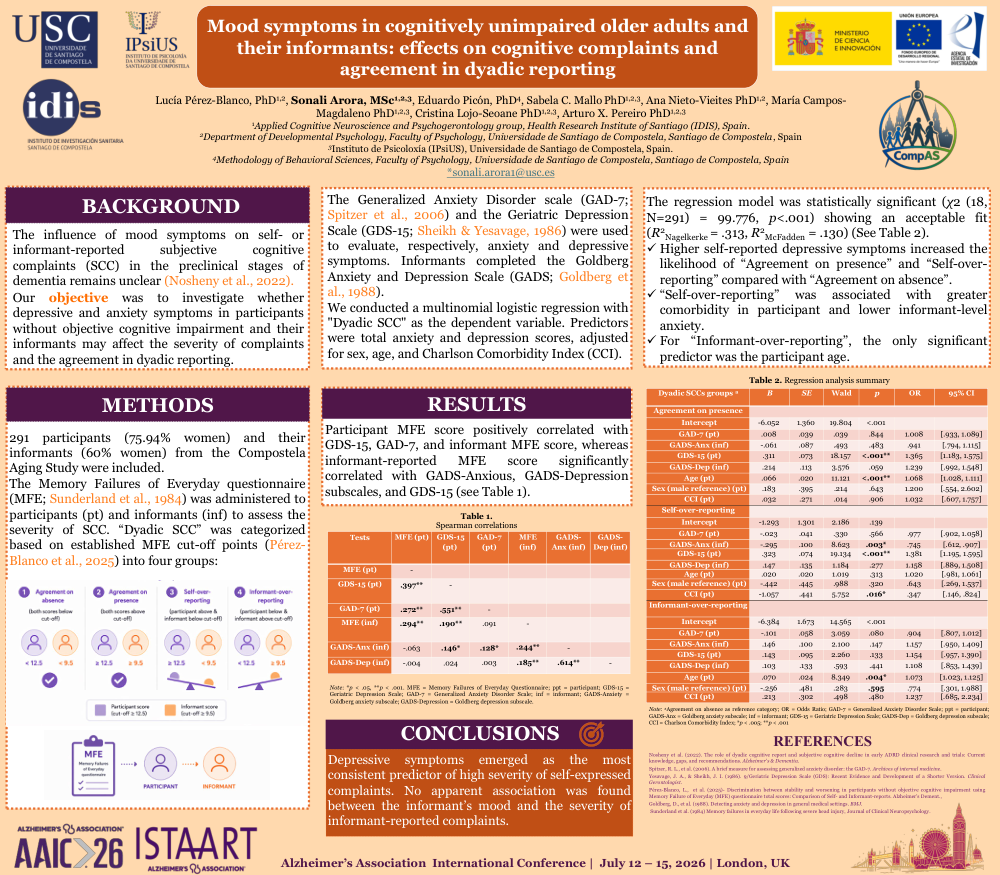
Mood Symptoms In Cognitively Unimpaired Older Adults And Their Informants: Effects On Complaints And Agreement In Dyadic Reporting
Poster Presenter
Authors
Lucía Pérez-Blanco, Sonali Arora, Eduardo Picón, Sabela C. Mallo, Ana Nieto-Vieites, María Campos-Magdaleno, Cristina Lojo-Seoane, Arturo X. Pereiro
Affiliations
¹ Applied Cognitive Neuroscience and Psychogerontology Group, Health Research Institute of Santiago (IDIS), Spain ² Department of Developmental Psychology, Faculty of Psychology, Universidade de Santiago de Compostela, Santiago de Compostela, Spain, ¹ Applied Cognitive Neuroscience and Psychogerontology Group, Health Research Institute of Santiago (IDIS), Spain ² Department of Developmental Psychology, Faculty of Psychology, Universidade de Santiago de Compostela, Santiago de Compostela, Spain ³ Instituto de Psicoloxía (IPsiUS), Universidade de Santiago de Compostela, Spain, ⁴ Methodology of Behavioral Sciences, Faculty of Psychology, Universidade de Santiago de Compostela, Spain
Part of Topic
Mood symptoms in cognitively unimpaired older adults and their informants: effects on cognitive complaints and agreement in dyadic reporting
Lucía Pérez-Blanco, PhD¹,², Sonali Arora, MSc¹,²,³, Eduardo Picón, PhD⁴, Sabela C. Mallo, PhD¹,²,³, Ana Nieto-Vieites, PhD¹,², María Campos-Magdaleno, PhD¹,²,³, Cristina Lojo-Seoane, PhD¹,²,³, Arturo X. Pereiro, PhD¹,²,³
¹ Applied Cognitive Neuroscience and Psychogerontology Group, Health Research Institute of Santiago (IDIS), Spain
² Department of Developmental Psychology, Faculty of Psychology, Universidade de Santiago de Compostela, Santiago de Compostela, Spain
³ Instituto de Psicoloxía (IPsiUS), Universidade de Santiago de Compostela, Spain
⁴ Methodology of Behavioral Sciences, Faculty of Psychology, Universidade de Santiago de Compostela, Spain
Contact: sonali.arora1@usc.es
Alzheimer’s Association International Conference | July 12–15, 2026 | London, UK
BACKGROUND
The influence of mood symptoms on self- or informant-reported subjective cognitive complaints (SCC) in the preclinical stages of dementia remains unclear (Nosheny et al., 2022).
Our objective was to investigate whether depressive and anxiety symptoms in participants without objective cognitive impairment and their informants may affect the severity of complaints and the agreement in dyadic reporting.
METHODS
291 participants, 75.94% women, and their informants, 60% women, from the Compostela Aging Study were included.
The Memory Failures of Everyday questionnaire (MFE; Sunderland et al., 1984) was administered to participants and informants to assess the severity of SCC.
“Dyadic SCC” was categorized based on established MFE cut-off points (Pérez-Blanco et al., 2025) into four groups:
-
Agreement on absence
Both scores low
Participant score < 12.5
Informant score < 9.5 -
Agreement on presence
Both scores above cut-off
Participant score ≥ 12.5
Informant score ≥ 9.5 -
Self-over-reporting
Participant above cut-off and informant below cut-off
Participant score ≥ 12.5
Informant score < 9.5 -
Informant-over-reporting
Participant below cut-off and informant above cut-off
Participant score < 12.5
Informant score ≥ 9.5
The Generalized Anxiety Disorder scale (GAD-7; Spitzer et al., 2006) and the Geriatric Depression Scale (GDS-15; Sheikh & Yesavage, 1986) were used to evaluate anxiety and depressive symptoms, respectively.
Informants completed the Goldberg Anxiety and Depression Scale (GADS; Goldberg et al., 1988).
We conducted a multinomial logistic regression with “Dyadic SCC” as the dependent variable. Predictors were total anxiety and depression scores, adjusted for sex, age, and Charlson Comorbidity Index (CCI).
RESULTS
Participant MFE score positively correlated with GDS-15, GAD-7, and informant MFE score, whereas informant-reported MFE score significantly correlated with GADS-Anxiety, GADS-Depression subscales, and GDS-15.
Table 1. Spearman correlations
MFE participant and GDS-15 participant: .397**
MFE participant and GAD-7 participant: .272**
MFE participant and MFE informant: .294**
MFE participant and GADS-Anxiety informant: -.063
MFE participant and GADS-Depression informant: -.004
GDS-15 participant and GAD-7 participant: .551**
GDS-15 participant and MFE informant: .190**
GDS-15 participant and GADS-Anxiety informant: .146*
GDS-15 participant and GADS-Depression informant: .024
GAD-7 participant and MFE informant: .091
GAD-7 participant and GADS-Anxiety informant: .128*
GAD-7 participant and GADS-Depression informant: .003
MFE informant and GADS-Anxiety informant: .244**
MFE informant and GADS-Depression informant: .185**
GADS-Anxiety informant and GADS-Depression informant: .614**
Note: *p < .05; **p < .001.
MFE = Memory Failures of Everyday Questionnaire; pt = participant; GDS-15 = Geriatric Depression Scale; GAD-7 = Generalized Anxiety Disorder Scale; inf = informant; GADS-Anxiety = Goldberg anxiety subscale; GADS-Depression = Goldberg depression subscale.
Regression analysis
The regression model was statistically significant:
χ²(18, N = 291) = 99.776, p < .001
The model showed an acceptable fit:
Nagelkerke R² = .313
McFadden R² = .130
Table 2. Regression analysis summary
Reference category: Agreement on absence
Agreement on presence
Intercept:
B = -6.052; SE = 1.360; Wald = 19.804; p < .001
GAD-7 participant:
B = .008; SE = .039; Wald = .039; p = .844; OR = 1.008; 95% CI [.933, 1.089]
GADS-Anxiety informant:
B = -.061; SE = .087; Wald = .493; p = .483; OR = .941; 95% CI [.794, 1.115]
GDS-15 participant:
B = .311; SE = .073; Wald = 18.157; p < .001**; OR = 1.365; 95% CI [1.183, 1.575]
GADS-Depression informant:
B = .214; SE = .113; Wald = 3.576; p = .059; OR = 1.239; 95% CI [.992, 1.548]
Age participant:
B = .066; SE = .020; Wald = 11.121; p < .001**; OR = 1.068; 95% CI [1.028, 1.111]
Sex participant, male reference:
B = .183; SE = .395; Wald = .214; p = .643; OR = 1.200; 95% CI [.554, 2.602]
CCI participant:
B = .032; SE = .271; Wald = .014; p = .906; OR = 1.032; 95% CI [.607, 1.757]
Self-over-reporting
Intercept:
B = -1.293; SE = 1.301; Wald = 2.186; p = .139
GAD-7 participant:
B = -.023; SE = .041; Wald = .330; p = .566; OR = .977; 95% CI [.902, 1.058]
GADS-Anxiety informant:
B = -.295; SE = .100; Wald = 8.623; p = .003*; OR = .745; 95% CI [.612, .907]
GDS-15 participant:
B = .323; SE = .074; Wald = 19.134; p < .001**; OR = 1.381; 95% CI [1.195, 1.595]
GADS-Depression informant:
B = .147; SE = .135; Wald = 1.184; p = .277; OR = 1.158; 95% CI [.889, 1.508]
Age participant:
B = .020; SE = .020; Wald = 1.019; p = .313; OR = 1.020; 95% CI [.981, 1.061]
Sex participant, male reference:
B = -.442; SE = .445; Wald = .988; p = .320; OR = .643; 95% CI [.269, 1.537]
CCI participant:
B = -1.057; SE = .441; Wald = 5.752; p = .016*; OR = .347; 95% CI [.146, .824]
Informant-over-reporting
Intercept:
B = -6.384; SE = 1.673; Wald = 14.565; p < .001
GAD-7 participant:
B = -.101; SE = .058; Wald = 3.059; p = .080; OR = .904; 95% CI [.807, 1.012]
GADS-Anxiety informant:
B = .146; SE = .100; Wald = 2.100; p = .147; OR = 1.157; 95% CI [.950, 1.409]
GDS-15 participant:
B = .143; SE = .095; Wald = 2.260; p = .133; OR = 1.154; 95% CI [.957, 1.390]
GADS-Depression informant:
B = .103; SE = .133; Wald = .593; p = .441; OR = 1.108; 95% CI [.853, 1.439]
Age participant:
B = .070; SE = .024; Wald = 8.349; p = .004*; OR = 1.073; 95% CI [1.023, 1.125]
Sex participant, male reference:
B = -.256; SE = .481; Wald = .283; p = .595; OR = .774; 95% CI [.301, 1.988]
CCI participant:
B = .213; SE = .302; Wald = .498; p = .480; OR = 1.237; 95% CI [.685, 2.234]
Note: OR = Odds Ratio; GAD-7 = Generalized Anxiety Disorder Scale; pt = participant; GADS-Anxiety = Goldberg anxiety subscale; inf = informant; GDS-15 = Geriatric Depression Scale; GADS-Depression = Goldberg depression subscale; CCI = Charlson Comorbidity Index.
*p < .005; **p < .001.
MAIN FINDINGS
Higher self-reported depressive symptoms increased the likelihood of “Agreement on presence” and “Self-over-reporting” compared with “Agreement on absence”.
“Self-over-reporting” was associated with greater comorbidity in participants and lower informant-level anxiety.
For “Informant-over-reporting”, the only significant predictor was participant age.
CONCLUSIONS
Depressive symptoms emerged as the most consistent predictor of high severity of self-expressed complaints.
No apparent association was found between the informant’s mood and the severity of informant-reported complaints.
REFERENCES
Nosheny et al. (2022). The role of dyadic cognitive report and subjective cognitive decline in early ADRD clinical research and trials: Current knowledge, gaps, and recommendations. Alzheimer’s & Dementia.
Spitzer, R. L., et al. (2006). A brief measure for assessing generalized anxiety disorder: the GAD-7. Archives of Internal Medicine.
Yesavage, J. A., & Sheikh, J. I. (1986). Geriatric Depression Scale (GDS): Recent evidence and development of a shorter version. Clinical Gerontologist.
Pérez-Blanco, L., et al. (2025). Discrimination between stability and worsening in participants without objective cognitive impairment using Memory Failures of Everyday (MFE) questionnaire total scores: Comparison of self- and informant-reports. Alzheimer’s & Dementia.
Goldberg, D., et al. (1988). Detecting anxiety and depression in general medical settings. BMJ.
Sunderland et al. (1984). Memory failures in everyday life following severe head injury. Journal of Clinical Neuropsychology.
Comments
Email is required but is not shown publicly.
Loading comments...