4,068 posters, 219 videos, 101 topics, 69 sessions, 14,365 authors, 6,128 institutions
ePostersLive by SciGen Technologies S.A. All rights reserved.
Alzheimer's Association International Conference 2026
July 12-15, 2026 | London, United Kingdom, and Online

9789
Correlating Blood-based Biomarkers Of Alzheimer’s Disease With Multiple Motor Assessments: Implications For Disease Specificity
Poster Presenter
Authors
Affiliations
Part of Topic
Introduction
Motor assessments may be sensitive to cognitive and functional impairments associated with Alzheimer’s disease (AD), as well as disease pathology.
A novel functional fine motor test has been linked to AD pathology, but its association with AD biomarkers relative to other motor assessments remains unclear.
Purpose and Hypothesis
Understand the extent to which gait speed, grip strength, and the functional fine motor test are associated with amyloid and tau pathology in asymptomatic older adults.
We hypothesize that the functional fine motor test will have more associations with amyloid and tau pathology than gait speed and grip strength.
Methods
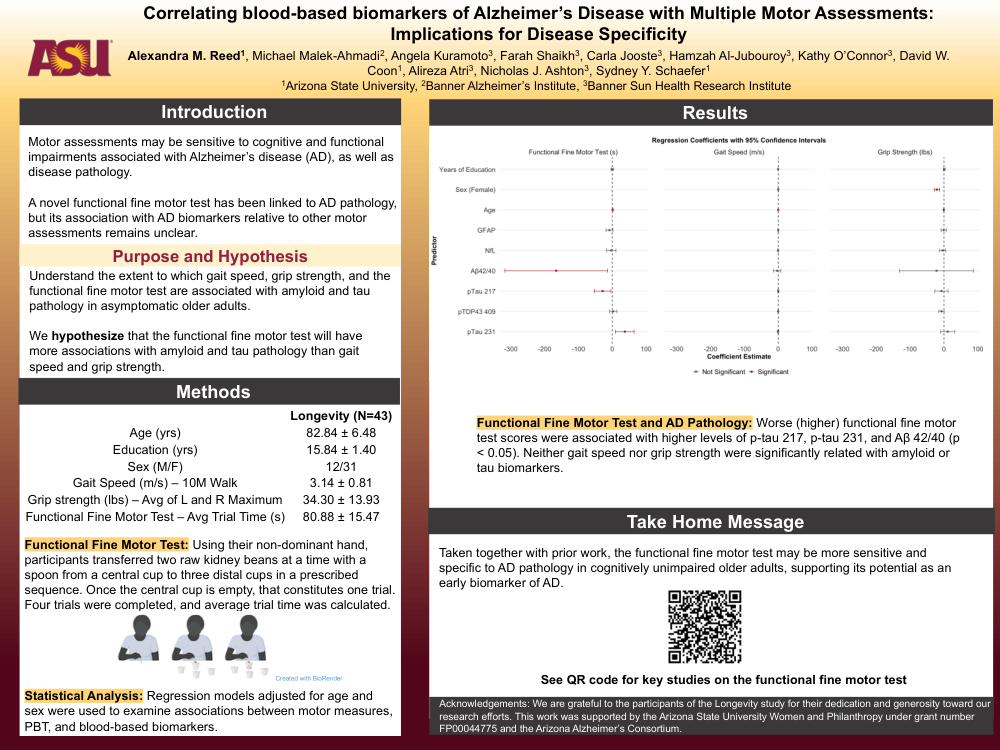
Functional Fine Motor Test: Using their non-dominant hand, participants transferred two raw kidney beans at a time with a spoon from a central cup to three distal cups in a prescribed sequence. Once the central cup is empty, that constitutes one trial. Four trials were completed, and average trial time was calculated.
Statistical Analysis: Regression models adjusted for age and sex were used to examine associations between motor measures, PBT, and blood-based biomarkers.
Results
Worse (higher) functional fine motor test scores were associated with higher levels of p-tau 217, p-tau 231, and Aβ 42/40 (p < 0.05). Neither gait speed nor grip strength were significantly related with amyloid or tau biomarkers.
Take Home Message
Taken together with prior work, the functional fine motor test may be more sensitive and specific to AD pathology in cognitively unimpaired older adults, supporting its potential as an early biomarker of AD.
Comments
Email is required but is not shown publicly.
Loading comments...