4,068 posters, 219 videos, 101 topics, 69 sessions, 14,365 authors, 6,128 institutions
ePostersLive by SciGen Technologies S.A. All rights reserved.
Alzheimer's Association International Conference 2026
July 12-15, 2026 | London, United Kingdom, and Online

352
Grey- And White-matter Brain Resilience To Tau In Relation To Cognition And The Effect Of Sex In Alzheimer’s Disease
Poster Presenter
Authors
Sophie Boutin, Bérengère Houzé, Christophe Bedetti, Alexa Pichet Binette, Simona Maria Brambati
Affiliations
Université de Montréal; Centre de Recherche de l’Institut Universitaire de Gériatrie de Montréal (CRIUGM), Centre de Recherche de l’Institut Universitaire de Gériatrie de Montréal (CRIUGM)
Part of Topic
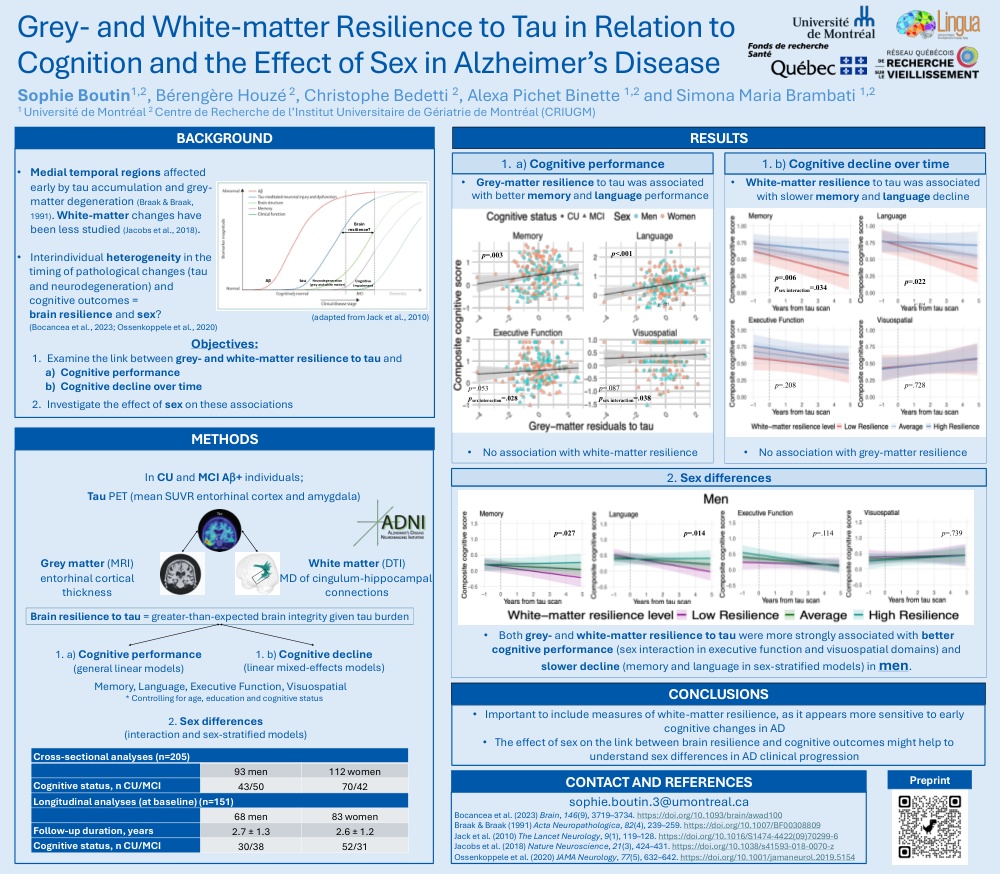
Background: In Alzheimer’s disease (AD), brain resilience reflects better-than-expected brain integrity given pathological burden. Tau is associated with grey- and white-matter degeneration, but these relationships vary across individuals, reflecting differences in brain resilience. Grey-matter resilience may reduce the risk of cognitive decline, whereas the role of white-matter resilience remains less understood. Sex may also influence brain resilience and its relationship with cognition in AD. We examined associations between brain resilience to tau (cortical thickness and white-matter diffusivity), and cognition (cross-sectionally and longitudinally), as well as the effect of sex on such associations.
Methods: We included 115 cognitively unimpaired participants and 92 with mild cognitive impairment (83 and 69, respectively, for longitudinal analyses), all amyloid-positive, from the Alzheimer’s Disease Neuroimaging Initiative. Brain resilience was conceptualized relative to tau and brain integrity in medial temporal regions, the earliest sites of tau accumulation. Grey- and white-matter resilience were quantified as residuals from regressions between medial temporal lobe tau PET and (I) entorhinal cortical thickness (MRI), and (II) mean diffusivity of the cingulum-hippocampal connections (DTI). General linear and linear mixed-effects models examined associations with cognition and cognitive decline across memory, language, executive function, and visuospatial domains. We modeled sex as a moderator and further examined its effect using stratified analyses. Models were adjusted for age, education, and cognitive status.
Results: Greater grey-matter resilience was associated with better memory (p=.004) and language performance (p<.001). Sex interactions indicated a stronger protective effect of grey-matter resilience on memory (p=.027) and executive functioning (p=.034) in men. Greater white-matter resilience was associated with slower decline in memory (p=.016) and language (p=.038) over time. Stratified analyses revealed associations between white-matter resilience and slower language decline in men (p=.026), and between grey-matter resilience and slower executive-function decline in women (p=.024).
Conclusion: White-matter resilience uniquely contributes to cognitive trajectories over time, particularly in memory and language. It may thus be a more sensitive marker of disease spread due to its role in network connectivity, complementing models centered on grey matter. Sex also moderates some associations, with greater sensitivity of cognitive performance to brain resilience in men.
Comments
Email is required but is not shown publicly.
Loading comments...