4,068 posters, 219 videos, 101 topics, 69 sessions, 14,365 authors, 6,128 institutions
ePostersLive by SciGen Technologies S.A. All rights reserved.
Alzheimer's Association International Conference 2026
July 12-15, 2026 | London, United Kingdom, and Online

6684
Factor Structure Of The Harmonized Cognitive Assessment Protocol In Nepal
Poster Presenter
Authors
Part of Topic
Background:
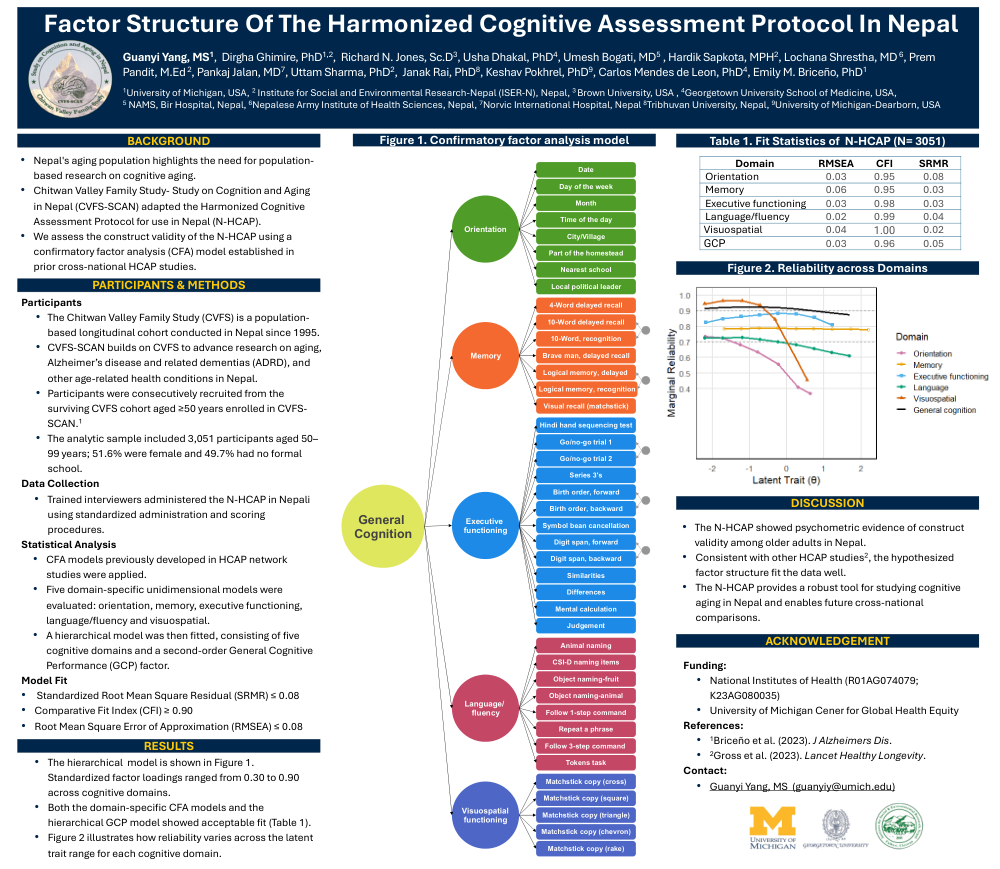
The population in Nepal is aging, with an expected increase in cases of Alzheimer’s disease and related dementias(ADRD). However, no validated cognitive assessment instruments are currently available for ADRD detection in Nepal. To address thisneed, the Chitwan Valley Family Study-Study on Cognition and Aging in Nepal (CVFS-SCAN) adapted the Harmonized CognitiveAssessment Protocol (HCAP) for use in Nepal (N-HCAP). We aimed to evaluate the construct validity of the N-HCAP by applyingconfirmatory factor analysis (CFA) models developed in prior cross-national HCAP studies.
Methods:
Participants were the first consecutively recruited participants from CVFS-SCAN from the surviving CVFS cohort aged ≥ 50years. Trained interviewers administered the N-HCAP in the Nepali language and scored using standardized criteria. Drawing on CFAmodels derived in other HCAP network studies, we applied unidimensional models for each of 5 cognitive domains (orientation, delayed memory, executive functioning, language, and visuospatial). We then applied a hierarchical general cognition modelincluding each of 5 domains and a second-order general cognitive performance (GCP) factor. Model fit was evaluated with thestandardized root mean square residual (SRMR ≤ 0.08), confirmatory fit index (CFI ≥ 0.90), and root mean squared error ofapproximation (RMSEA ≤ 0.08).
Results:
The analytic sample included 3051 participants (age 50-99; 52% female; 49.7% with no formal education). The N-HCAP items included in each domain are shown in Figure 1. Standardized factor loadings were moderate to high across all domains, ranging from0.30 to 0.90. Comparative model fit indices and model complexity across all CFA models are summarized in Table 1. The GCP and unidimensional models demonstrated acceptable fit across indices.
Conclusion:
The N-HCAP captures cognitive functioning through a well-defined factor structure in the Nepali context. The observedfactor structure is consistent with prior studies in the HCAP network, supporting the construct validity of the HCAP adaptation for theNepal context. Together, these findings strengthen the empirical foundation for using the N-HCAP to study cognitive aging in Nepaland will facilitate future harmonization efforts aimed at cross-national comparisons of cognitive aging.
Keywords: Nepal; N-HCAP; HCAP; cognitive aging; confirmatory factor analysis; factor structure; psychometric validity; reliability; General Cognitive Performance.
Comments
Email is required but is not shown publicly.
Loading comments...