4,068 posters, 219 videos, 101 topics, 69 sessions, 14,365 authors, 6,128 institutions
ePostersLive by SciGen Technologies S.A. All rights reserved.
Alzheimer's Association International Conference 2026
July 12-15, 2026 | London, United Kingdom, and Online

7415
BrainTest (electronic Self-administered Gerocognitive Examination (eSAGE)) For Smartphone Use: Equivalency Validation Study
Poster Presenter
Authors
Nicole Vrettos, Haikady Nagaraja, Nicholas Spencer, Douglas Scharre
Affiliations
Part of Topic
AAIC 2026 Abstract
BrainTest (electronic Self-Administered Gerocognitive Examination (eSAGE)) for Smartphone Use: Equivalency Validation Study
Authors: Vrettos N, Nagaraja HN, Spencer N, Scharre DW
Background:
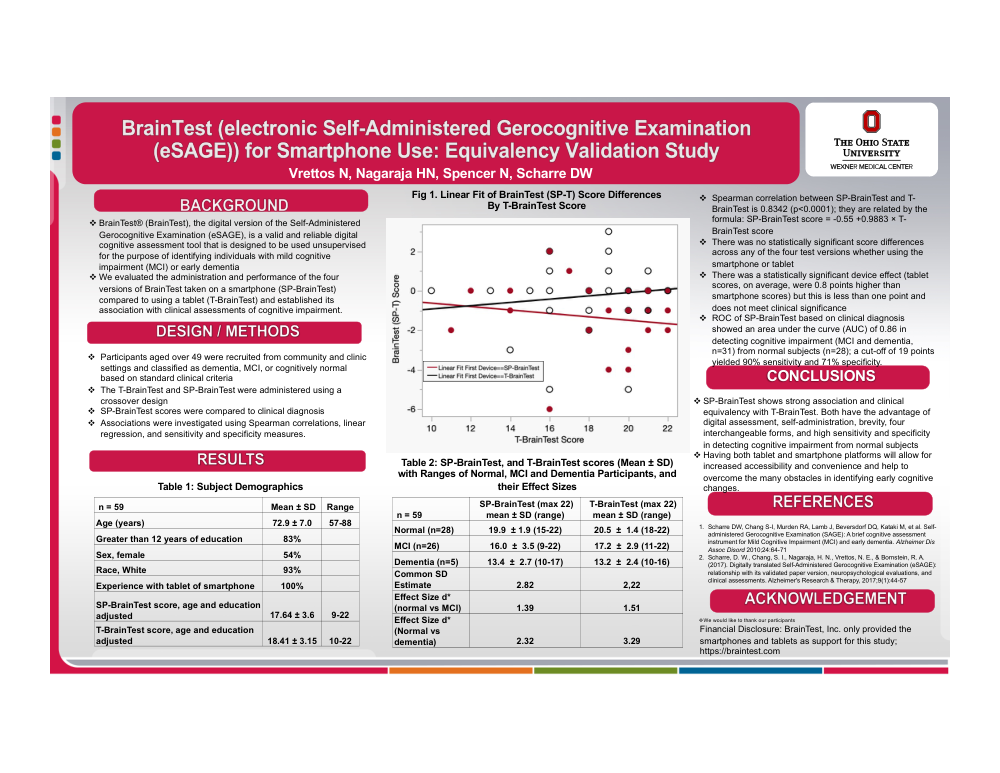
BrainTest® (BrainTest), the digital version of the Self-Administered Gerocognitive Examination (eSAGE), is a valid and reliable digital cognitive assessment tool that is designed to be used unsupervised for the purpose of identifying individuals with mild cognitive impairment (MCI) or early dementia. We evaluated the administration and performance of the four versions of BrainTest taken on a smartphone (SP-eSAGE) compared to using a tablet (T-eSAGE) and established its association with clinical assessments of cognitive impairment.
Methods:
Participants aged over 49 were recruited from community and clinic settings and classified as dementia, MCI, or cognitively normal based on standard clinical criteria. The T-eSAGE and SP-eSAGE were administered using a crossover design. SP-eSAGE scores were compared to clinical diagnosis. Associations were investigated using Spearman correlations, linear regression, and sensitivity and specificity measures.
Results:
The 59 participants were mean age 72.93 ±7.04 (SD) years, 54% female, 7% non-white and 83% over 12 years education. The mean age and education adjusted SP-eSAGE and T-eSAGE were 17.64 ±3.60 (range:9-22) and 18.41 ±3.15 (10-22) respectively. Spearman correlation between SP-eSAGE and T-eSAGE is 0.8342 (p<0.0001); they are related by the formula: SP-eSAGE score = -0.55 +0.9883 × T-eSAGE score. There was no statistically significant score differences across any of the four test versions whether using the smartphone or tablet. There was a statistically significant device effect (tablet scores, on average, were 0.8 points higher than smartphone scores) but this is less than one point and does not meet clinical significance. ROC of SP-eSAGE based on clinical diagnosis showed an area under the curve (AUC) of 0.86 in detecting cognitive impairment (MCI and dementia, n=31) from normal subjects (n=28); a cut-off of 19 points yielded 90% sensitivity and 71% specificity.
Conclusions:
SP-eSAGE shows strong association and clinical equivalency with T-eSAGE. Both have the advantage of digital assessment, self-administration, brevity, four interchangeable forms, and high sensitivity and specificity in detecting cognitive impairment from normal subjects. Having both tablet and smartphone platforms will allow for increased accessibility and convenience and help to overcome the many obstacles in identifying early cognitive changes.
Comments
Email is required but is not shown publicly.
Loading comments...