4,068 posters, 219 videos, 101 topics, 69 sessions, 14,365 authors, 6,128 institutions
ePostersLive by SciGen Technologies S.A. All rights reserved.
Alzheimer's Association International Conference 2026
July 12-15, 2026 | London, United Kingdom, and Online

2961
Sensitive Tests For Early Detection Of Cognitive Impairment: Telemedicine Digidiadem And In-person ALBA And PICNIR
Poster Presenter
Authors
Ales Bartos, Lucie Zajicova, Marie Kompasova, Michaela Zapletalova, Martin Vita, Lubos Smidl
Affiliations
Department of Neurology, Third Faculty of Medicine, Charles University; Memory Clinic, Department of Neurology, University Hospital Královské Vinohrady, Prague, NTIS Research Center, Faculty of Applied Sciences, University of West Bohemia in Pilsen, Pilsen, Memory Clinic, Department of Neurology, University Hospital Královské Vinohrady, Prague; First Faculty of Medicine, Charles University, Prague, Memory Clinic, Department of Neurology, University Hospital Královské Vinohrady, Prague; Institute of Special Education Studies, Faculty of Education, Palacký University in Olomouc, Olomouc, Institute of Physics, the Czech Academy of Sciences, Prague, Department of Cybernetics, Faculty of Applied Sciences, University of West Bohemia in Pilsen, Pilsen
Part of Topic
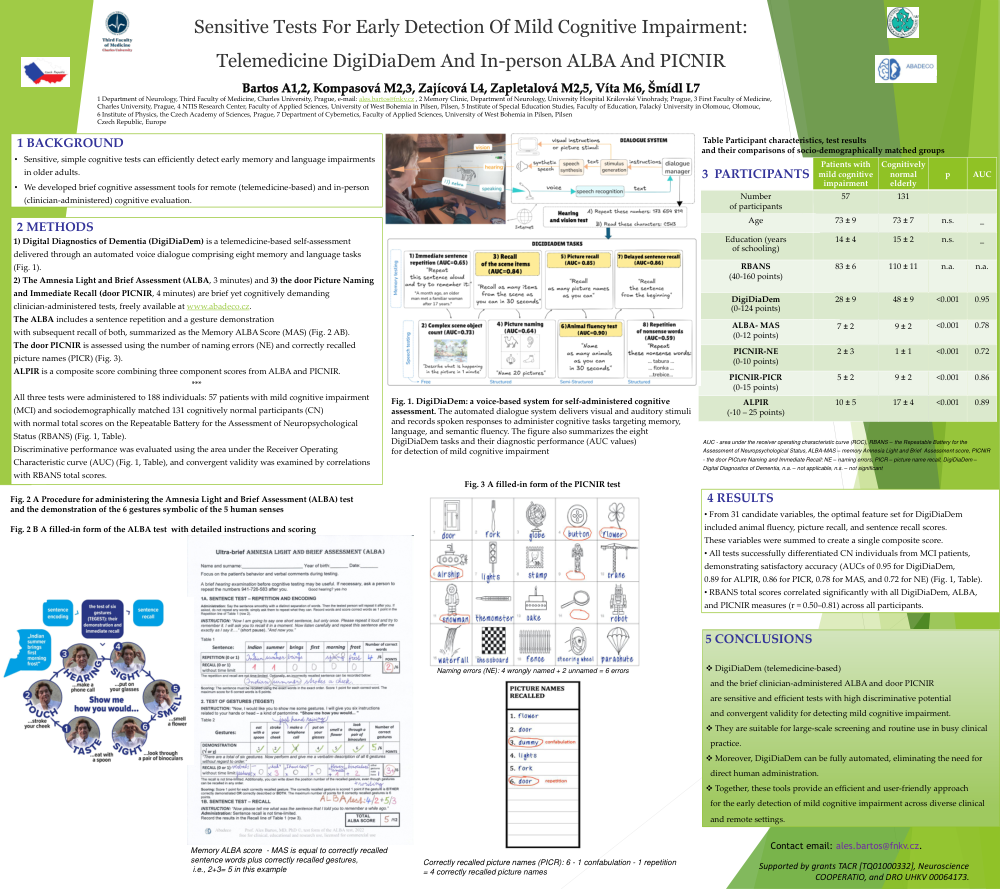
Background: Sensitive, simple cognitive tests can efficiently detect early memory and language impairments in older adults. We developed brief tools for telemedicine-based and in-person assessment of cognitive function.
Methods: 1) Digital Diagnostics of Dementia (DigiDiaDem) is a telemedicine-based self-assessment delivered through an automated voice dialogue comprising eight memory and language tasks (Fig. 1).
2) The Amnesia Light and Brief Assessment (ALBA, 3 minutes) and 3) the door Picture Naming and Immediate Recall (door PICNIR, 4 minutes) are brief yet cognitively demanding
clinician-administered tests, freely available at www.abadeco.cz.
The ALBA includes a sentence repetition and a gesture demonstration
with subsequent recall of both, summarized as the Memory ALBA Score (MAS).
The door PICNIR is assessed using the number of naming errors (NE) and correctly recalled picture names (PICR).
ALPIR is a composite score combining three component scores from ALBA and PICNIR.
All three tests were administered to 188 individuals: 57 patients with mild cognitive impairment (MCI) and sociodemographically matched 131 cognitively normal participants (CN) with normal total scores on the Repeatable Battery for the Assessment of Neuropsychological Status (RBANS).
Discriminative performance was evaluated using the area under the Receiver Operating Characteristic curve (AUC) (Fig. 1, Table), and convergent validity was examined by correlations with RBANS total scores.
Results: From 31 candidate variables, the optimal feature set for DigiDiaDem included animal fluency, picture recall, and sentence recall scores. These variables were summed to create a single composite score. All tests successfully differentiated CN individuals from MCI patients, demonstrating satisfactory accuracy (AUCs of 0.95 for DigiDiaDem, 0.89 for ALPIR, 0.86 for PICR, 0.78 for MAS, and 0.72 for NE). RBANS total scores correlated significantly with all DigiDiaDem, ALBA, and PICNIR measures (r = 0.50–0.81) across all participants.
Conclusions:
DigiDiaDem (telemedicine-based) and the brief clinician-administered ALBA and door PICNIR are sensitive and efficient tests with high discriminative potential and convergent validity for detecting mild cognitive impairment. They are suitable for large-scale screening and routine use in busy clinical practice. Moreover, DigiDiaDem can be fully automated, eliminating the need for direct human administration. These tools provide an efficient and user-friendly approach for the early detection of mild cognitive impairment across diverse clinical and remote settings.
Supported by grants TACR [TQ01000332], Neuroscience COOPERATIO, and DRO UHKV 00064173.
Comments
Email is required but is not shown publicly.
Loading comments...