4,068 posters, 219 videos, 101 topics, 69 sessions, 14,365 authors, 6,128 institutions
ePostersLive by SciGen Technologies S.A. All rights reserved.
Alzheimer's Association International Conference 2026
July 12-15, 2026 | London, United Kingdom, and Online

4812
Personality Traits Predict Cognitive Change In Older Adults With Mild Cognitive Impairment And Subjective Cognitive Decline
Part of Topic
Introduction
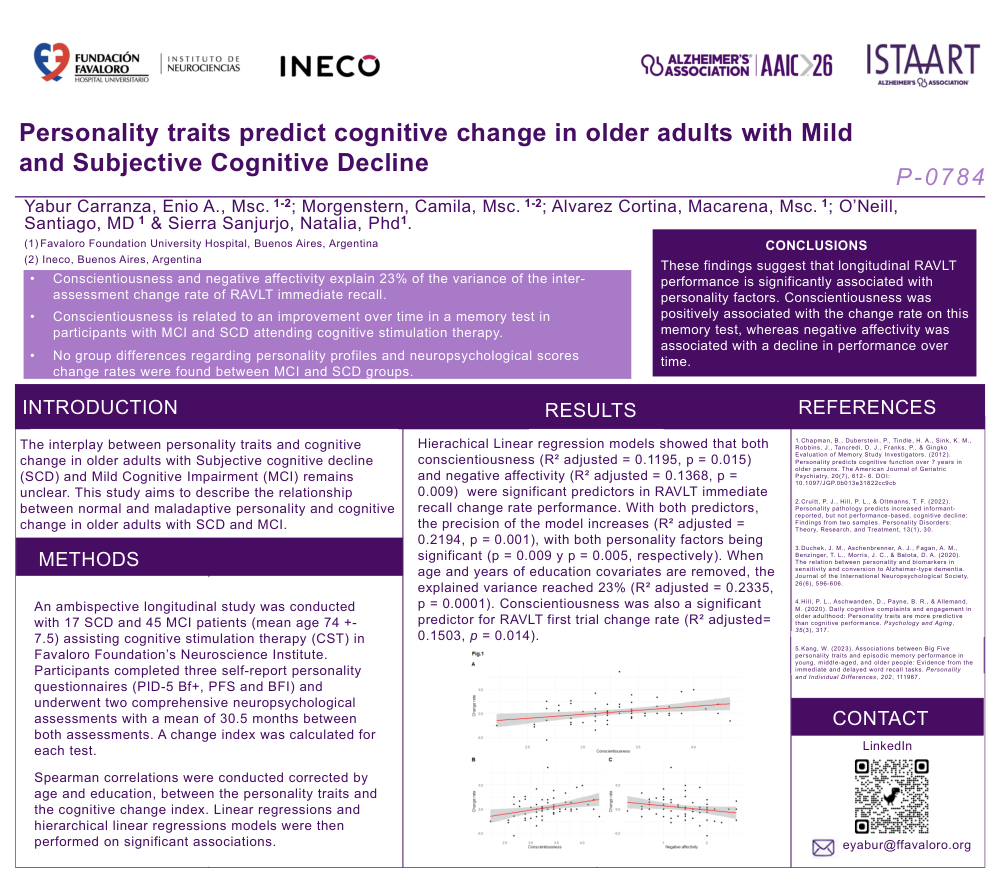
The interplay between personality traits and cognitive change in older adults with Subjective cognitive decline (SCD) and Mild Cognitive Impairment (MCI) remains unclear. This study aims to describe the relationship between normal and maladaptive personality and cognitive change in older adults with SCD and MCI.
Methods
An ambispective longitudinal study was conducted with 17 SCD and 45 MCI patients (mean age 74 +- 7.5) assisting cognitive stimulation therapy (CST) in Favaloro Foundation’s Neuroscience Institute. Participants completed three self-report personality questionnaires (PID-5 Bf+, PFS and BFI) and underwent two comprehensive neuropsychological assessments with a mean of 30.5 months between both assessments. A change index was calculated for each test.
Spearman correlations were conducted corrected by age and education, between the personality traits and the cognitive change index. Linear regressions and hierarchical linear regressions models were then performed on significant associations.
Results
Hierachical Linear regression models showed that both conscientiousness (R² adjusted = 0.1195, p = 0.015) and negative affectivity (R² adjusted = 0.1368, p = 0.009) were significant predictors in RAVLT immediate recall change rate performance. With both predictors, the precision of the model increases (R² adjusted = 0.2194, p = 0.001), with both personality factors being significant (p = 0.009 y p = 0.005, respectively). When age and years of education covariates are removed, the explained variance reached 23% (R² adjusted = 0.2335, p = 0.0001). Conscientiousness was also a significant predictor for RAVLT first trial change rate (R² adjusted= 0.1503, p = 0.014).
Conclusions
These findings suggest that longitudinal RAVLT performance is significantly associated with personality factors. Conscientiousness was positively associated with the change rate on this memory test, whereas negative affectivity was associated with a decline in performance over time.
Comments
Email is required but is not shown publicly.
Loading comments...