4,068 posters, 219 videos, 101 topics, 69 sessions, 14,365 authors, 6,128 institutions
ePostersLive by SciGen Technologies S.A. All rights reserved.
Alzheimer's Association International Conference 2026
July 12-15, 2026 | London, United Kingdom, and Online

4785
Process Evaluation Of A Remote Training Program For Cognitive And Functional Assessment
Poster Presenter
Part of Topic
BACKGROUND
• The growing prevalence of dementia underscores the need for health professionals trained in cognitive and functional assessments.
• Limited availability of trained personnel and geographic barriers challenge standardized in-person training, making remote alternatives necessary. However, evidence on structured remote training processes remains scarce. This study aimed to evaluate a structured remote training process to support standardized administration of cognitive and functional assessments.
METHODS
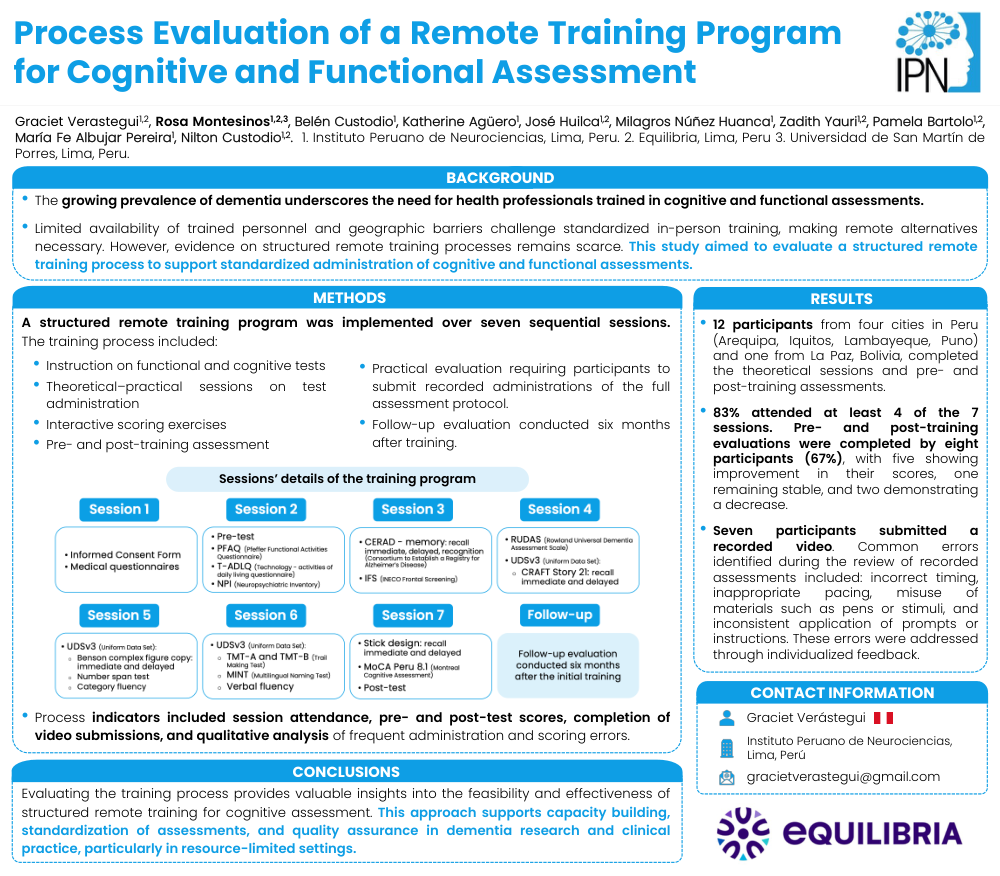
A structured remote training program was implemented over seven sequential sessions. The training process included:
• Instruction on functional and cognitive tests
• Theoretical–practical sessions on test administration
• Interactive scoring exercises
• Pre- and post-training assessment
• Practical evaluation requiring participants to submit recorded administrations of the full assessment protocol.
• Follow-up evaluation conducted six months after training.
Process indicators included session attendance, pre- and post-test scores, completion of video submissions, and qualitative analysis of frequent administration and scoring errors.
RESULTS
• 12 participants from four cities in Peru (Arequipa, Iquitos, Lambayeque, Puno) and one from La Paz, Bolivia, completed the theoretical sessions and pre- and post-training assessments.
• 83% attended at least 4 of the 7 sessions. Pre- and post-training evaluations were completed by eight participants (67%), with five showing improvement in their scores, one remaining stable, and two demonstrating a decrease.
• Seven participants submitted a recorded video. Common errors identified during the review of recorded assessments included: incorrect timing, inappropriate pacing, misuse of materials such as pens or stimuli, and inconsistent application of prompts or instructions. These errors were addressed through individualized feedback.
CONCLUSIONS
Evaluating the training process provides valuable insights into the feasibility and effectiveness of structured remote training for cognitive assessment. This approach supports capacity building, standardization of assessments, and quality assurance in dementia research and clinical practice, particularly in resource-limited settings.
Comments
Email is required but is not shown publicly.
Loading comments...