4,068 posters, 219 videos, 101 topics, 69 sessions, 14,365 authors, 6,128 institutions
ePostersLive by SciGen Technologies S.A. All rights reserved.
Alzheimer's Association International Conference 2026
July 12-15, 2026 | London, United Kingdom, and Online

10048
Remote Administration Of Camcog-ds And Mcrt For Alzheimer’S Disease Screening In Adults With Down Syndrome: A Validation Study
Poster Presenter
Authors
Concepcion Padilla, Bessy Benejam, Laura Videla, María Carmona-Iragui, Isabel Barroeta, Miren Altuna-Azkargorta, Javier Arranz, Susana Fernández, Juan Fortea
Affiliations
Universitat Oberta de Catalunya; Estudis de Ciències de la Salut,Rambla de Catalunya,154-156,08018 Barcelona, Hospital de la Santa Creu i Sant Pau – Instituto de Investigación Biomédica Sant Pau, Barcelona, Center for Research and Memory Clinic, CITA-Alzheimer Foundation, Donostia – San Sebastián, 20009,Spain. / Department of Neurology, Bioaraba Health Research Institute, Araba University Hospital -Txagorritxu,Vitoria-Gasteiz,01009,Spain, Centro Médico Barcelona Down, Fundació Catalana Síndrome de Down,c/Comte Borrell 201-203, entrl,08029, Barcelona
Part of Topic
Abstract:
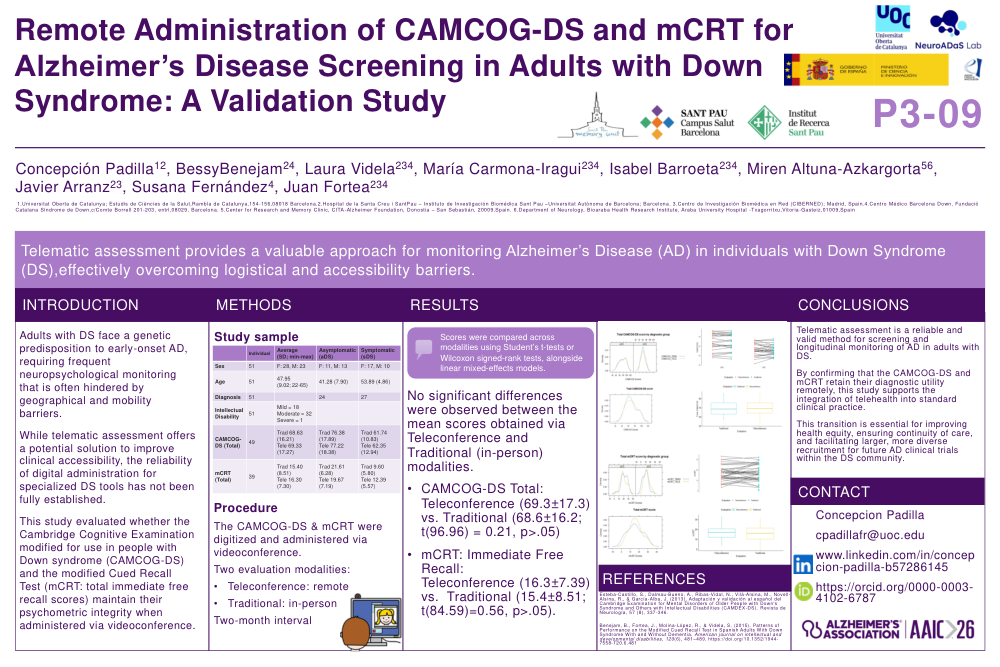
Background: Adults with Down syndrome (DS) face a genetic predisposition to early-onset Alzheimer’s disease (AD), requiring frequent neuropsychological monitoring that is often hindered by geographical and mobility barriers. While remote assessment offers a potential solution to improve clinical accessibility, the reliability of digital administration for specialized DS tools has not been fully established. This study evaluated whether the Cambridge Cognitive Examination modified for use in people with Down syndrome (CAMCOG-DS) and the modified Cued Recall Test (mCRT: total immediate free recall scores) maintain their psychometric integrity when administered via videoconference.
Methods: We enrolled 51 adults with DS (28 females; mean age 49.17 ± 9.02 years) presenting with mild to moderate intellectual disability. Based on clinical evaluation, participants were categorized as asymptomatic (cognitively stable) or symptomatic (prodromal and AD dementia; see Table 1). The CAMCOG-DS and mCRT were digitized for remote application. Using a within-subjects design, participants underwent two neuropsychological evaluations—one in-person and one via a standardized videoconferencing platform—with a two-month interval between sessions to minimize practice effects. Total CAMCOG-DS and total immediate free recall mCRT scores from both modalities were compared using paired-sample t and Wilconson tests, and linear-mixed models to determine inter-modal reliability.
Results: Statistical analysis revealed no significant differences between the scores obtained in the remote and face-to-face modalities (see Figures 1 and 2). Specifically, the mean scores for the remote CAMCOG-DS (69.3 ± 17.3) were highly consistent with in-person results (68.6 ± 16.2; t(96.96) = 0.21, p > .05). Similarly, the mCRT showed no significant variance between remote (16.3 ± 7.39) and in-person (15.4 ± 8.51; t(84.59) = 0.56, p > .05) administrations. These findings demonstrate that cognitive performance remains stable across delivery formats in this population.
Conclusion: Tele-neuropsychology is a reliable and valid method for screening and longitudinal monitoring of AD in adults with DS. By confirming that the CAMCOG-DS and mCRT retain their diagnostic utility remotely, this study supports the integration of telehealth into standard clinical practice. This transition is essential for improving health equity, ensuring continuity of care, and facilitating larger, more diverse recruitment for future AD clinical trials within the DS community.
Comments
Email is required but is not shown publicly.
Loading comments...