4,068 posters, 219 videos, 101 topics, 69 sessions, 14,365 authors, 6,128 institutions
ePostersLive by SciGen Technologies S.A. All rights reserved.
Alzheimer's Association International Conference 2026
July 12-15, 2026 | London, United Kingdom, and Online

9705
Depressive Symptoms And Olfactory Impairment In Later Life: Evidence From Two Population-based Cohorts
Poster Presenter
Authors
Henry Bode, Linnea Sjöberg, Warre Linseele, Federico Triolo, Steven Nordin, Erika J Laukka, Maria Josefsson, Ingrid Ekström
Affiliations
Aging Research Center, Department of Neurobiology, Care Sciences and Society, Karolinska Institutet and Stockholm University, Stockholm, Sweden, Department of Psychology, Umeå University, Umeå, Sweden, Umeå School of Business, Economics and Statistics, Umeå University, Umeå, Sweden
Part of Topic
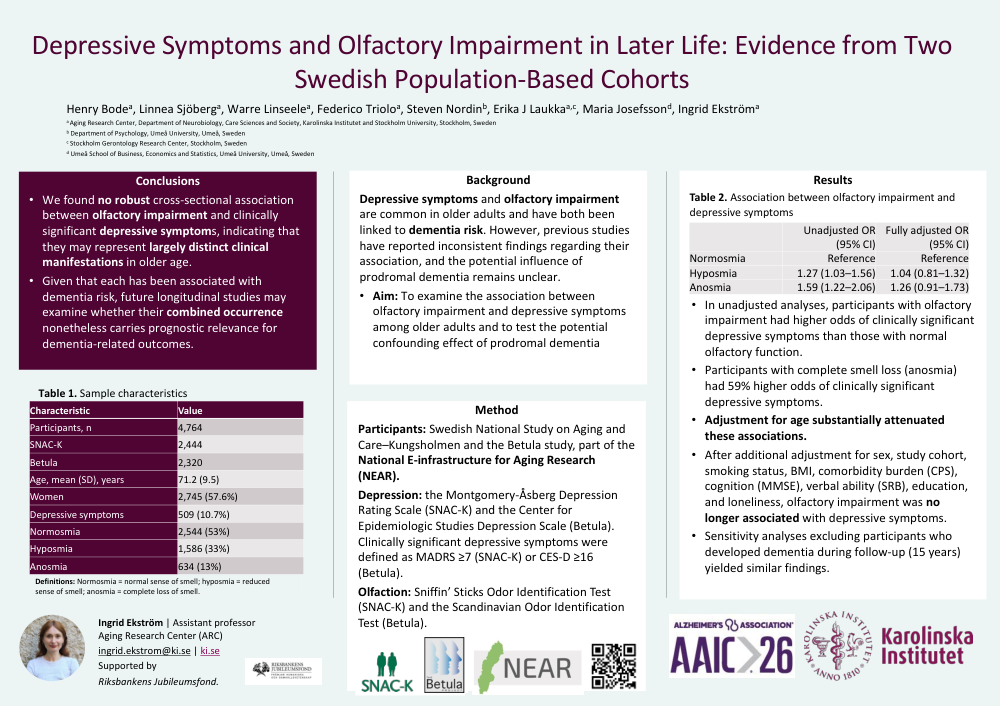
Background: Depressive symptoms and olfactory impairment are common in older adults and have both been linked to dementia risk. However, previous studies have reported inconsistent findings regarding their association, and the potential confounding effect of prodromal dementia remains unclear.
Aim: To examine the association between olfactory impairment and depressive symptoms among older adults and to test the potential confounding effect of prodromal dementia.
Methods: Participants were drawn from the Swedish National Study on Aging and Care–Kungsholmen (SNAC-K) and the Betula study, part of the National E-infrastructure for Aging Research (NEAR). Clinically significant depressive symptoms were defined as MADRS ≥7 (SNAC-K) or CES-D ≥16 (Betula). Olfactory function was assessed using the Sniffin' Sticks Odor Identification Test (SNAC-K) and the Scandinavian Odor Identification Test (Betula). Logistic regression models adjusted for demographic, lifestyle, health, cognitive, and psychosocial factors.
Results: In unadjusted analyses, participants with olfactory impairment had 36% higher odds of clinically significant depressive symptoms than those with normal olfactory function. Participants with complete smell loss (anosmia) had 59% higher odds of clinically significant depressive symptoms. Adjustment for age substantially attenuated these associations. After additional adjustment for sex, study cohort, smoking status, BMI, comorbidity burden, cognitive screening, verbal ability, education, and loneliness, olfactory impairment was no longer independently associated with clinically significant depressive symptoms. Sensitivity analyses excluding participants who developed dementia during 16 years of follow-up yielded similar findings.
Conclusions: No robust cross-sectional association was observed between olfactory impairment and clinically significant depressive symptoms. The findings suggest that previously reported associations may largely reflect shared neurodegenerative processes rather than a direct relationship. Future longitudinal studies should examine whether the combined presence of olfactory impairment and depressive symptoms improves identification of individuals at increased risk of dementia.
Comments
Email is required but is not shown publicly.
Loading comments...