4,068 posters, 219 videos, 101 topics, 69 sessions, 14,365 authors, 6,128 institutions
ePostersLive by SciGen Technologies S.A. All rights reserved.
Alzheimer's Association International Conference 2026
July 12-15, 2026 | London, United Kingdom, and Online

4876
Neuropsychological Model For The Classification Of Predementia Stages Using Artificial Intelligence: Validation Based On CompAS Study
Poster Presenter
Authors
Xana Cid-Mejías, Sonia Valladares-Rodríguez, Alba Felpete, Fátima Fernández-Feijoo, Ingri K. Sandoval-García, Jose M. Aldrey, Marta Saavedra-Piñeiro, Arturo X. Pereiro
Affiliations
Department of Developmental Psychology, Faculty of Psychology, Universidade de Santiago de Compostela, Santiago de Compostela, A Coruña, Spain, Department of Electronics and Computing, Higher Polytechnic Engineering School, Universidade de Santiago de Compostela, Lugo, Spain, Instituto de Psicoloxía (IPsiUS), Universidade de Santiago de Compostela, Santiago de Compostela, A Coruña, Spain, Health Research Institute of Santiago (IDIS), Santiago de Compostela, A Coruña, Spain, Galicia Sur Health Research Institute (IISGS), Vigo, Pontevedra, Spain
Part of Topic
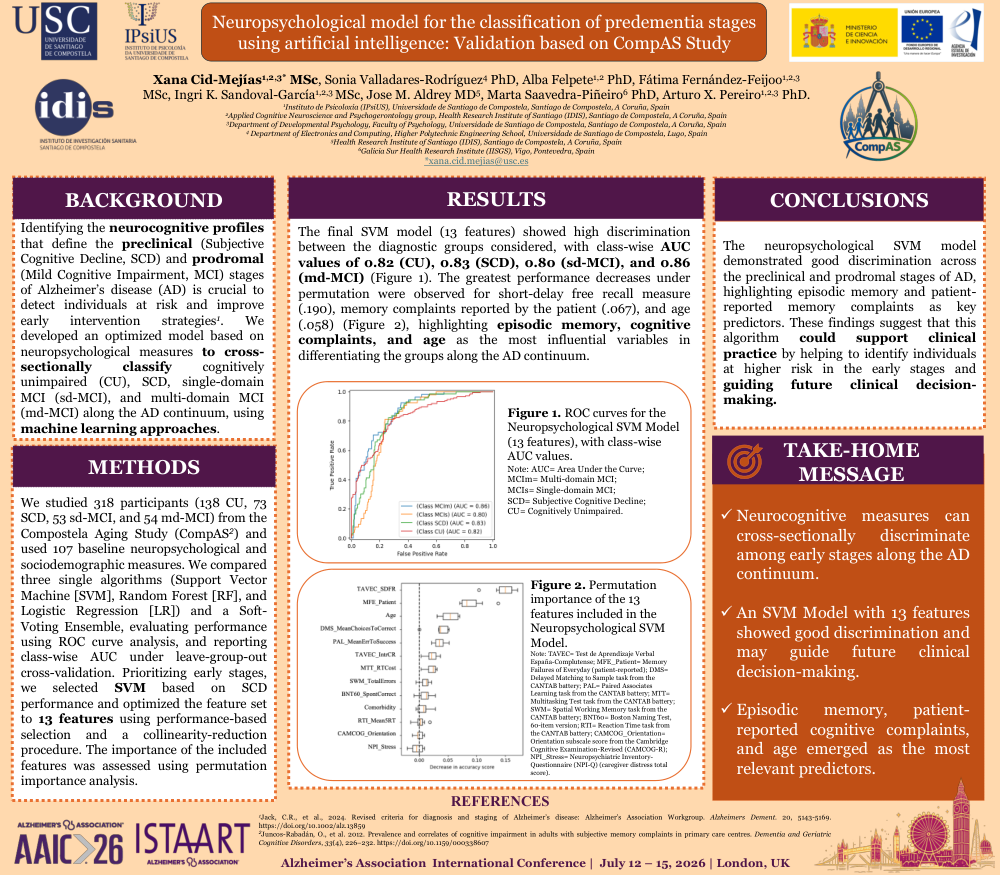
Background: Identifying the neurocognitive profiles that define the preclinical (Subjective Cognitive Decline, SCD) and prodromal (Mild Cognitive Impairment, MCI) stages of Alzheimer´s disease (AD) is crucial to detect individuals at risk and improve early intervention strategies (Jack et al., 2024). We developed an optimized model based on neuropsychological measures to classify cognitively unimpaired (CU), SCD, single-domain MCI (sd-MCI), and multi-domain MCI (md-MCI) along the AD continuum, using machine learning approaches.
Method: We studied 318 participants (138 CU, 73 SCD, 53 sd-MCI, and 54 md-MCI) from the Compostela Aging Study (CompAS) and used 107 baseline neuropsychological and sociodemographic measures (Juncos-Rabadán et al., 2012). We compared three single algorithms (Support Vector Machine [SVM], Random Forest [RF], and Logistic Regression [LR]) and a Soft-Voting Ensemble, evaluating performance using ROC curve analysis, and reporting class-wise AUC under leave-group-out cross-validation. Prioritizing early stages, we selected SVM based on SCD performance and optimized the feature set to 13 features using performance-based selection and a collinearity-reduction procedure. The importance of the included features was assessed using permutation importance analysis.
Results: The final SVM model (13 features) showed high cross-sectional discrimination between the diagnostic groups considered, with class-wise AUC values of 0.82 (CU), 0.83 (SCD), 0.80 (sd-MCI), and 0.86 (md-MCI) (Figure 1). The greatest performance decreases under permutation were observed for short-delay free recall measure (TAVEC_SDFR; 0.190), memory complaints reported by the patient (MFE_Patient; 0.067), and age (0.058) (Figure 2), highlighting episodic memory, cognitive complaints, and age as the most influential variables in differentiating the groups along the AD continuum.
Conclusion: The neuropsychological SVM model demonstrated good discrimination across the preclinical and prodromal stages of AD, highlighting episodic memory and patient-reported memory complaints as key predictors. These findings suggest that this algorithm could support clinical practice by helping to identify individuals at higher risk in the early stages and guiding future clinical decision-making.
Comments
Email is required but is not shown publicly.
Loading comments...