4,068 posters, 219 videos, 101 topics, 69 sessions, 14,365 authors, 6,128 institutions
ePostersLive by SciGen Technologies S.A. All rights reserved.
Alzheimer's Association International Conference 2026
July 12-15, 2026 | London, United Kingdom, and Online

2690
Stratifying Preclinical Alzheimer's Stage 2 Criteria Predicts Biomarker Burden In Cognitively Normal, Amyloid Positive Individuals
Poster Presenter
Authors
Affiliations
Part of Topic
Introduction
Recent research classifies preclinical AD into two stages:1
These staging criteria have predicted decline in prior studies.2
It has not yet been addressed how Stage 2 risk might differ based on the number of criteria met, nor how sex differences may impact staging.
We hypothesize that individuals who meet multiple criteria exhibit greater risk as a group. Specifically, higher levels of plasma p-tau 217 (p-tau) and brain amyloid (SUVR). We also predict a significant sex effect for p-tau 217.4
Methods
This analysis included 545 cognitively normal, amyloid positive participants from the Anti-Amyloid Treatment in Asymptomatic Alzheimer's Disease study (A4).3
Individuals were categorized into three groups based on number of symptom criteria present.
Stage 2 was stratified into two groups
Group and sex effects on biomarker burden at baseline were assessed using ANOVA.
Results
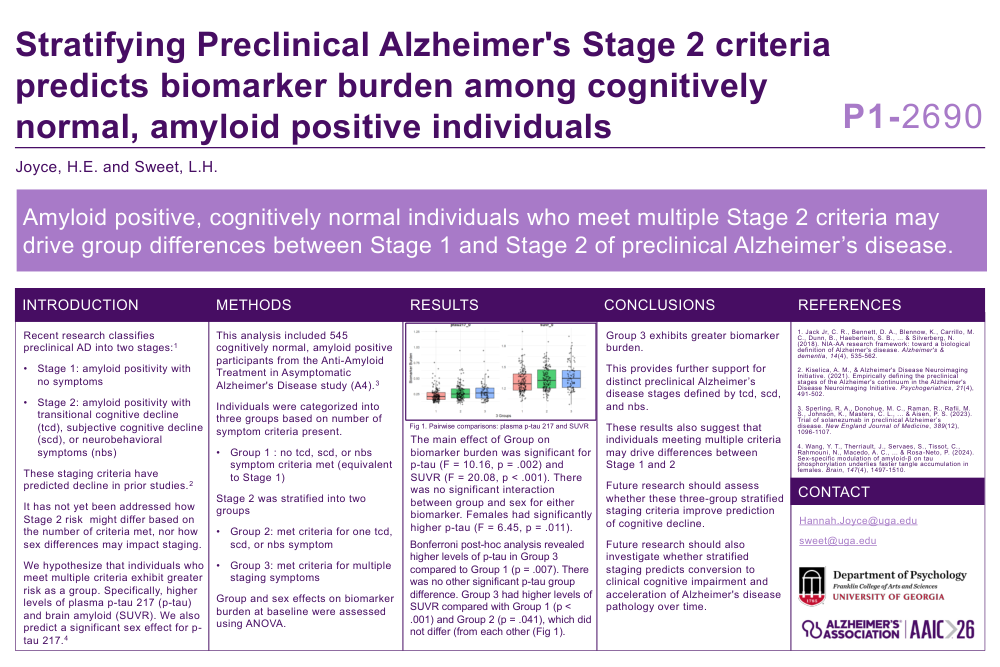
The main effect of Group on biomarker burden was significant for p-tau (F = 10.16, p = .002) and SUVR (F = 20.08, p < .001). There was no significant interaction between group and sex for either biomarker. Females had significantly higher p-tau (F = 6.45, p = .011).
Bonferroni post-hoc analysis revealed higher levels of p-tau in Group 3 compared to Group 1 (p = .007). There was no other significant p-tau group difference. Group 3 had higher levels of SUVR compared with Group 1 (p < .001) and Group 2 (p = .041), which did not differ (from each other (Fig 1).
Conclusions
Group 3 exhibits greater biomarker burden.
This provides further support for distinct preclinical Alzheimer’s disease stages defined by tcd, scd, and nbs.
These results also suggest that individuals meeting multiple criteria may drive differences between Stage 1 and 2
Future research should assess whether these three-group stratified staging criteria improve prediction of cognitive decline.
Future research should also investigate whether stratified staging predicts conversion to clinical cognitive impairment and acceleration of Alzheimer's disease pathology over time.
References
1. Jack Jr, C. R., Bennett, D. A., Blennow, K., Carrillo, M. C., Dunn, B., Haeberlein, S. B., ... & Silverberg, N. (2018). NIA‐AA research framework: toward a biological definition of Alzheimer's disease. Alzheimer's & dementia, 14(4), 535-562.
2. Kiselica, A. M., & Alzheimer's Disease Neuroimaging Initiative. (2021). Empirically defining the preclinical stages of the Alzheimer's continuum in the Alzheimer's Disease Neuroimaging Initiative. Psychogeriatrics, 21(4), 491-502.
3. Sperling, R. A., Donohue, M. C., Raman, R., Rafii, M. S., Johnson, K., Masters, C. L., ... & Aisen, P. S. (2023). Trial of solanezumab in preclinical Alzheimer’s disease. New England Journal of Medicine, 389(12), 1096-1107.
4. Wang, Y. T., Therriault, J., Servaes, S., Tissot, C., Rahmouni, N., Macedo, A. C., ... & Rosa-Neto, P. (2024). Sex-specific modulation of amyloid-β on tau phosphorylation underlies faster tangle accumulation in females. Brain, 147(4), 1497-1510.
Comments
Email is required but is not shown publicly.
Loading comments...