4,068 posters, 219 videos, 101 topics, 69 sessions, 14,365 authors, 6,128 institutions
ePostersLive by SciGen Technologies S.A. All rights reserved.
Alzheimer's Association International Conference 2026
July 12-15, 2026 | London, United Kingdom, and Online

3584
Impact Of Heterogeneity On MRI-based Alzheimer’s Disease Classification Accuracy
Poster Presenter
Part of Topic
Impact Of Heterogeneity On MRI-based Alzheimer’s Disease Classification Accuracy
Lucia Li, University of Cambridge
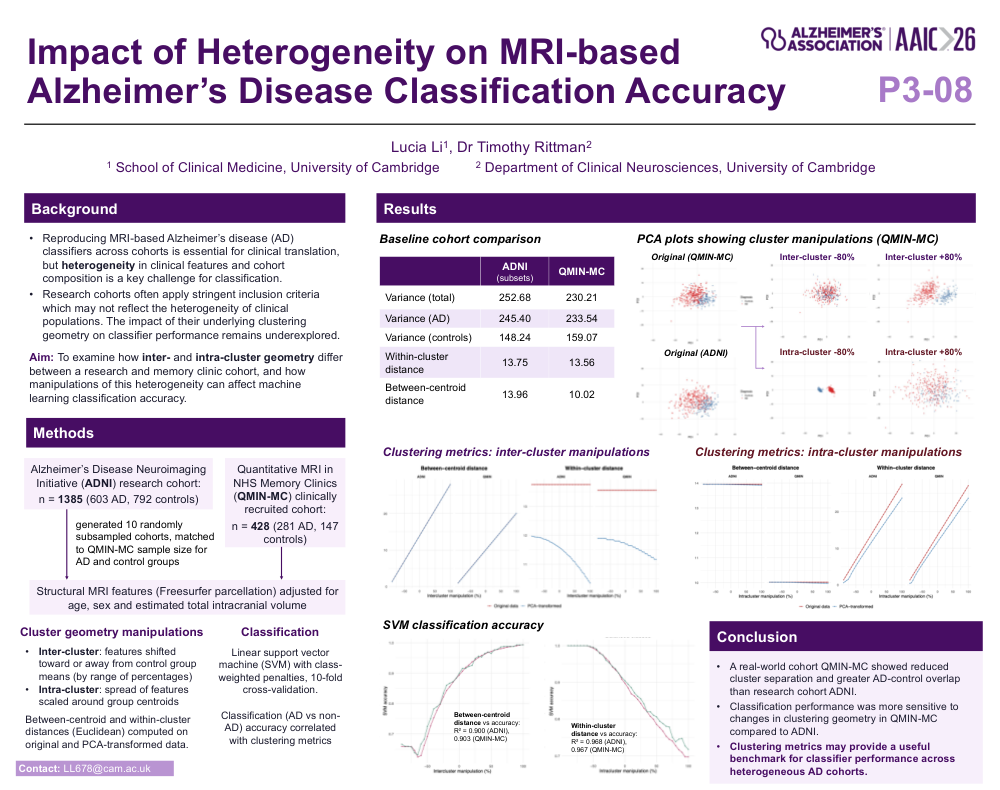
Background: Reproducing findings across cohorts is a key step in validating MRI and other biomarker classifiers for Alzheimer’s disease (AD). Heterogeneity in clinical features and cohort composition poses a challenge for classification, yet the impact of underlying clustering geometry on machine learning performance remains underexplored. This study examined how differences between AD cohort heterogeneity, and manipulations of that heterogeneity, influence the accuracy of machine learning classification to distinguish AD from cognitively unimpaired controls.
Methods: Structural MRI features were derived from the ADNI research cohort (n = 1385) and QMIN-MC memory clinic cohort (n = 428), which differ in recruitment protocols and patient characteristics. Inter-cluster and intra-cluster cohesion were systematically manipulated across a range of percentages, and clustering metrics and cross-validated linear SVM performance were computed and compared across both datasets.
Results: After adjustment for sample size and composition, the QMIN-MC cohort showed higher control-group variance and lower between-centroid distance compared to ADNI, suggesting clinically recruited controls were more similar to AD patients thereby reducing cluster separation. Higher SVM classification accuracy was seen with greater inter‑cluster separation and reduced intra‑cluster dispersion, but performance was more locally variable in QMIN‑MC, indicating greater sensitivity to small changes in clustering geometry. Across both datasets, between-centroid and within-cluster distances were well-correlated with SVM accuracy when inter- and intra-cluster structure were manipulated, respectively.
Conclusion: Clustering metrics may offer an interpretable and computationally efficient proxy for predicting and benchmarking AI classifier performance across heterogeneous AD cohorts, supporting model development and cross-site validation.
Comments
Email is required but is not shown publicly.
Loading comments...