4,068 posters, 219 videos, 101 topics, 69 sessions, 14,365 authors, 6,128 institutions
ePostersLive by SciGen Technologies S.A. All rights reserved.
Alzheimer's Association International Conference 2026
July 12-15, 2026 | London, United Kingdom, and Online

2945
When Cognitive Age And Brain Age Diverge: Distinct Neuropsychiatric Symptom Networks In Older Adults
Poster Presenter
Authors
Jing Li, Zhaohua Huo, Ngo Wang Leung, Cuichan Lin, Xuechen Xiong, Benjamin HK Yip, Allen TC Lee, Linda CW Lam
Affiliations
Department of Psychiatry, The Chinese University of Hong Kong, The Jockey Club School of Public Health and Primary Care, The Chinese University of Hong Kong, Hong Kong SAR, China
Part of Topic
Abstract
Introduction: Cognitive ageing and brain ageing do not always progress in parallel in older adults. Such discrepancies may reflect heterogeneous neurobiological and psychological profiles, yet their associations with patterns of neuropsychiatric symptoms remain poorly understood.
Objective: This study aimed to investigate whether older adults with mismatched cognitive and brain ageing process, exhibit distinct neuropsychiatric symptom networks, and to identify core neuropsychiatric symptoms associated with different ageing discrepancy profiles.
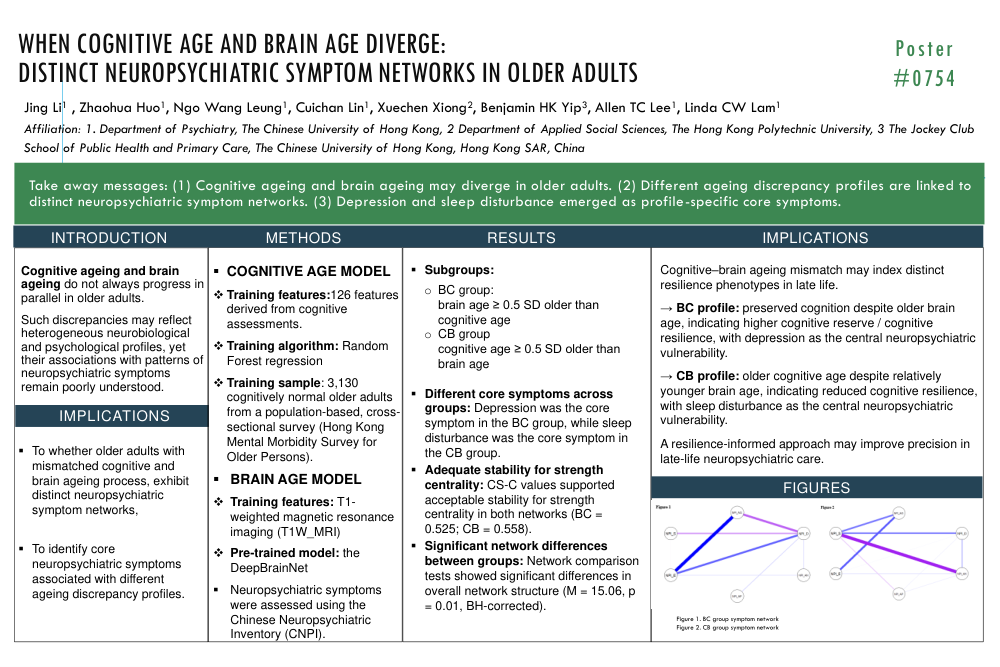
Method: A cognitive age estimation model was developed using 126 features derived from cognitive assessments. The model was trained with a Random Forest regression algorithm in 3,130 cognitively normal older adults (age range: 60–96 years) recruited from the population-based Hong Kong Morbidity Survey for Older People (HKMMSOP). The pre-trained model was applied to an independent community-based sample of 279 older adults (age range: 60–88 years) in Hong Kong. Brain age was estimated for the same individuals using T1-weighted magnetic resonance imaging (T1W_MRI) and the DeepBrainNet model. Based on the discrepancy between cognitive age and brain age, participants were classified into two subgroups: BC group (brain age ≥ 0.5 SD older than cognitive age) and CB group (cognitive age ≥ 0.5 SD older than brain age). Neuropsychiatric symptoms were assessed using the Chinese Neuropsychiatric Inventory (CNPI). Symptom network analysis was conducted separately in the BC and CB groups to identify core neuropsychiatric symptoms.
Results: In the BC network, depression (DEP) exhibited the highest node strength and was identified as the core symptom. The correlation stability coefficients (CS-C) for centrality indices were 0.525 for strength, 0.391 for closeness, and 0.460 for betweenness. In the CB network, sleep disturbance (SLE) showed the highest node strength and emerged as the core symptom; the CS-C values were 0.558 for strength, 0.119 for closeness, and 0.008 for betweenness. Network comparison tests revealed significant differences between the two neuropsychiatric symptom networks after Benjamini–Hochberg correction. Specifically, the network structure invariance test indicated a significant difference in overall network topology between the BC and CB groups (M = 15.06, p = 0.01).
Conclusion: These findings suggest that targeted interventions may be warranted for neuropsychiatric symptom management in older adults with mismatched cognitive and brain ageing.
Keywords: Cognitive age, brain age, neuropsychiatric symptom, depression, sleep disturbance.
Comments
Email is required but is not shown publicly.
Loading comments...