4,068 posters, 219 videos, 101 topics, 69 sessions, 14,365 authors, 6,128 institutions
ePostersLive by SciGen Technologies S.A. All rights reserved.
Alzheimer's Association International Conference 2026
July 12-15, 2026 | London, United Kingdom, and Online

9535
Determinants Of Adherence To An Online Dementia Risk-factor Management Program: A Secondary Analysis Of The Betterbrains Trial
Poster Presenter
Authors
Catherine Robb, Emily Rosenich, Darshini Ayton, Stephanie Pirotta, Hannah Cummins, Samantha De Araugo, Amelia Bevins, Paul Maruff, Yen Ying Lim
Affiliations
Turner Institute for Brain and Mental Health, School of Psychological Sciences, Monash University, Australia; Industrial Transformation Training Centre for Optimal Ageing, Monash University, Australia; School of Public Health and Preventive Medicine, Monash University, Australia, Turner Institute for Brain and Mental Health, School of Psychological Sciences, Monash University, Australia; Industrial Transformation Training Centre for Optimal Ageing, Monash University, Australia, School of Public Health and Preventive Medicine, Monash University, Australia, Turner Institute for Brain and Mental Health, School of Psychological Sciences, Monash University, Australia, Industrial Transformation Training Centre for Optimal Ageing, Monash University, Australia; Cogstate Ltd, Melbourne, Australia
Part of Topic
Determinants of Adherence to an Online Risk Factor Management Program to Prevent Cognitive Decline
A Secondary Analysis of the BetterBrains Trial
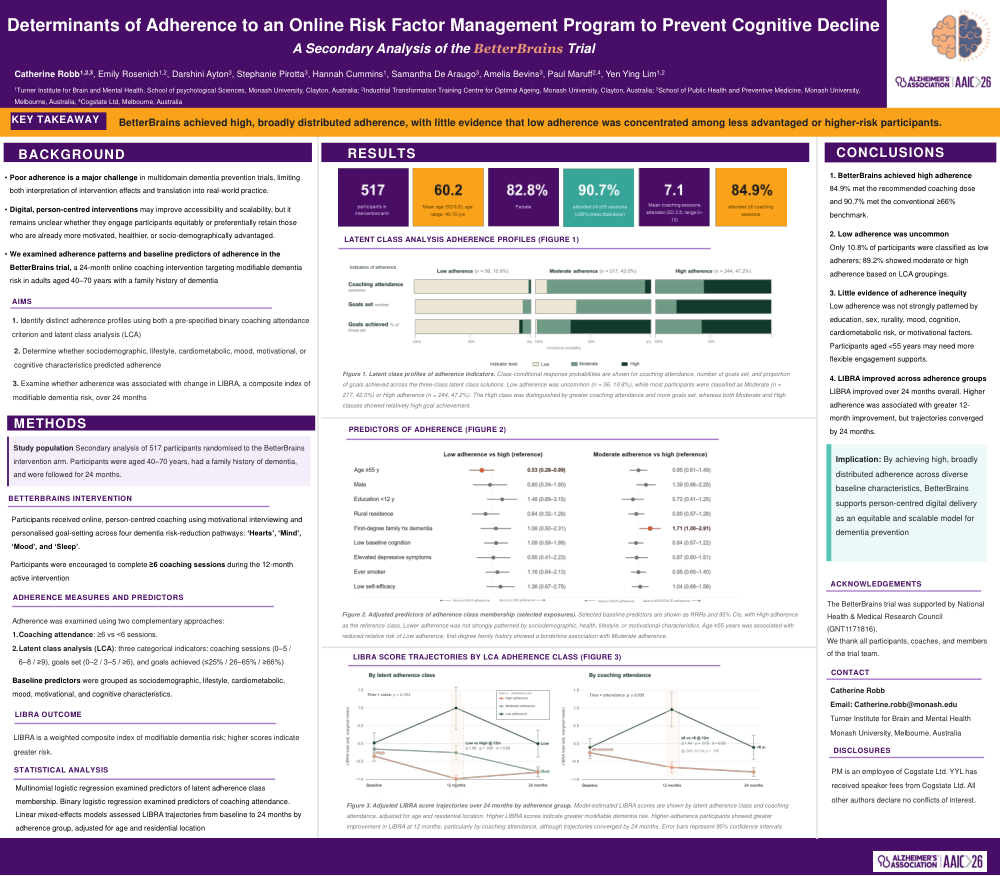
Key Takeaway: BetterBrains achieved high, broadly distributed adherence, with little evidence that low adherence was concentrated among less advantaged or higher-risk participants
Background:
1. Identify distinct adherence profiles using both a pre-specified binary coaching attendance criterion and latent class analysis (LCA)
2. Determine whether sociodemographic, lifestyle, cardiometabolic, mood, motivational, or cognitive characteristics predicted adherence
3. Examine whether adherence was associated with change in LIBRA, a composite index of modifiable dementia risk, over 24 months
Methods:
Study population Secondary analysis of 517 participants randomised to the BetterBrains intervention arm. Participants were aged 40–70 years, had a family history of dementia, and were followed for 24 months.
Betterbrains intervention:
Participants received online, person-centred coaching using motivational interviewing and personalised goal-setting across four dementia risk-reduction pathways: ‘Hearts’, ‘Mind’, ‘Mood’, and ‘Sleep’.
Participants were encouraged to complete ≥6 coaching sessions during the 12-month active intervention.
Adherence measures and predictors
Adherence was examined using two complementary approaches:
Baseline predictors were grouped as sociodemographic, lifestyle, cardiometabolic, mood, motivational, and cognitive characteristics.
Libra outcome
LIBRA is a weighted composite index of modifiable dementia risk; higher scores indicate greater risk.
Statistical analysis:
Multinomial logistic regression examined predictors of latent adherence class membership. Binary logistic regression examined predictors of coaching attendance. Linear mixed-effects models assessed LIBRA trajectories from baseline to 24 months by adherence group, adjusted for age and residential location
conclusions
1. BetterBrains achieved high adherence
84.9% met the recommended coaching dose and 90.7% met the conventional ≥66% benchmark.
2. Low adherence was uncommon
Only 10.8% of participants were classified as low adherers; 89.2% showed moderate or high adherence based on LCA groupings.
3. Little evidence of adherence inequity
Low adherence was not strongly patterned by education, sex, rurality, mood, cognition, cardiometabolic risk, or motivational factors. Participants aged <55 years may need more flexible engagement supports.
4. LIBRA improved across adherence groups
LIBRA improved over 24 months overall. Higher adherence was associated with greater 12-month improvement, but trajectories converged by 24 months.
Implication: By achieving high, broadly distributed adherence across diverse baseline characteristics, BetterBrains supports person-centred digital delivery as an equitable and scalable model for dementia prevention
Comments
Email is required but is not shown publicly.
Loading comments...