4,068 posters, 219 videos, 101 topics, 69 sessions, 14,365 authors, 6,128 institutions
ePostersLive by SciGen Technologies S.A. All rights reserved.
Alzheimer's Association International Conference 2026
July 12-15, 2026 | London, United Kingdom, and Online

4556
28-year Depressive Symptom Trajectories And Plasma Phosphorylated Tau-217
Poster Presenter
Authors
Toni T. Saari, Anni Varjonen, Teemu Palviainen, Sanna-Kaisa Herukka, Tarja Kokkola, Sari Kärkkäinen, - FinnGen, Aarno Palotie, Juha O. Rinne, Heiko Runz, Valtteri Julkunen, Jaakko Kaprio, Eero Vuoksimaa
Affiliations
, University of Helsinki, Helsinki, Finland, University of Eastern Finland, Kuopio, Finland, University of Turku, Turku, Finland, Insitro Inc., San Francisco, CA, USA
Part of Topic
Background
Depressive symptom trajectories spanning over decades have been linked to increased risk of dementia. As Alzheimer’s disease is the most common cause of dementia, depressive symptom trajectories could be associated with Alzheimer’s disease biomarkers. This study estimates 28-year-depressive symptom trajectories and examines whether any trajectory is associated with increased levels of plasma phosphorylated tau-217 (p-tau217).
Methods
The participants (n=554) are from the older Finnish Twin Cohort study with up to three waves of depressive symptom assessments in 1990, 2011-2017 and 2023. Exclusion criteria for the study were a history of major neurological diseases (including dementia) or psychiatric disorders assessed in 2023. Plasma p-tau217 was quantified with the ALZpath Simoa pTau-217 v2 Assay Kit in January 2024. Depressive symptoms had right-skewed distributions and were assessed with different rating scales: Beck Depression Inventory in 1990, and 20- and 8-item versions of the Center for Epidemiological Studies-Depression scale in 2011-217 and 2023, respectively. Therefore, depression sum scores were Yeo-Johnson-transformed and standardized for each study visit. Trajectories were estimated with the lcmm package using R. Associations of latent classes with p-tau217 were investigated after adjusting for covariates measured at the time of blood draw for p-tau217 (age, sex, APOE ε4 carriership, body mass index, smoking and antidepressant use) using linear regression. Regression analyses were weighted by each participant’s likelihood of belonging to each latent class and cluster-robust standard errors were used to account for data clustering (twins within families).
Results
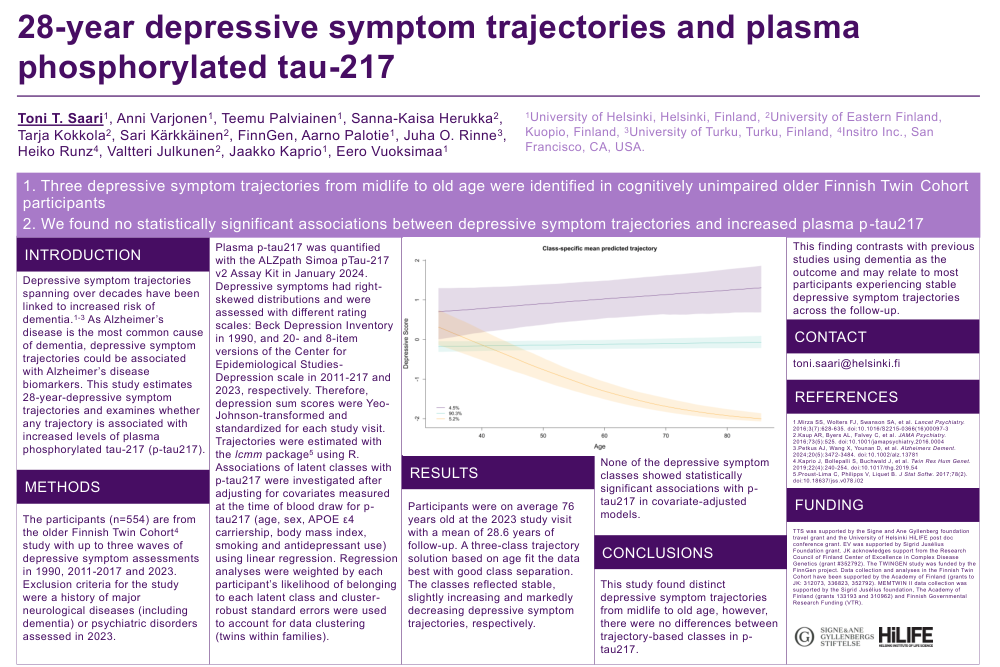
Participants were on average 76 years old at the 2023 study visit with a mean of 28.6 years of follow-up. A three-class trajectory solution based on age fit the data best with good class separation. The classes reflected stable, slightly increasing and markedly decreasing depressive symptom trajectories, respectively. None of the depressive symptom classes showed statistically significant associations with p-tau217 in covariate-adjusted models.
Conclusions
This study found distinct depressive symptom trajectories from midlife to old age, however, there were no differences between trajectory-based classes in p-tau217. This finding contrasts with previous studies using dementia as the outcome and may relate to most participants experiencing stable depressive symptom trajectories across the follow-up.
Comments
Email is required but is not shown publicly.
Loading comments...