4,068 posters, 219 videos, 101 topics, 69 sessions, 14,365 authors, 6,128 institutions
ePostersLive by SciGen Technologies S.A. All rights reserved.
Alzheimer's Association International Conference 2026
July 12-15, 2026 | London, United Kingdom, and Online

10174
LLM-Derived Metrics Of Surprisal In Alzheimer’s Spectrum Disorders
Poster Presenter
Authors
Annette Glotfelty, Rene L. Utianski, Leland R. Barnard, Joseph R. Duffy, John L. Stricker, Jonathan Graff-Radford, Stuart J. McCarter, Gregory S. Day, Neill R. Graff-Radford, Bradley F. Boeve, David T. Jones, Prashanthi Vemuri, Val Lowe, Clifford R. Jack, David S. Knopman, Ronald C. Petersen, Vijay K. Ramanan, Hugo Botha
Affiliations
Part of Topic
LLM-Derived Metrics of Surprisal in Alzheimer’s Spectrum Disorders
Annette Glotfelty1, Rene L. Utianski1, Leland R. Barnard1, Joseph R. Duffy1, John L. Stricker1, Jonathan Graff-Radford1,
Stuart J. McCarter1, Gregory S. Day2, Neill R. Graff-Radford2, Bradley F. Boeve1, David T. Jones1, Prashanthi Vemuri1, Val
Lowe1, Clifford R. Jack1, David S. Knopman1, Ronald C. Petersen1, Vijay K. Ramanan1, Hugo Botha1
1Mayo Clinic, Rochester, MN 2Mayo Clinic, Jacksonville, FL
BACKGROUND
LANGUAGE CHANGES IN AD
Language deficits – such as anomia,
circumlocution, perseveration, and
tangential language – are well
documented in patients with AD
DISCOURSE SAMPLES
Open-ended connected speech
production involves ongoing interactions
among diverse cognitive processes –
including working memory, executive
function, and semantic retrieval
Picture description tasks enable quick
collection of rich data that represent
these overlapping cognitive processes,
with minimal burden on patients (1)
AUTOMATED ANALYSES
LLMs provide an opportunity to
automate the formerly onerous process
of transcription and linguistic feature
extraction from open-ended speech
SURPRISAL
Surprisal tracks the overall
unexpectedness of a word choice in the
context of the full utterance. Surprising
words can arise from unexpected
choices at multiple linguistic levels –
semantic, syntactic, or pragmatic
SURPRISAL IN APHASIA
One study of patients with aphasia –
neurogenic language disorder – found
higher surprisal values when speech is
structurally deficient or “agrammatic” (2)
Another study on agrammatic aphasia
found that surprisal values were
attenuated by the process of lexical
condensation – using richer words to
compensate for impoverished sentence
structure (3)
RESEARCH QUESTION
Can LLM-derived surprisal values in an
open-ended picture description task
distinguish different severities of
cognitive impairment due to AD?
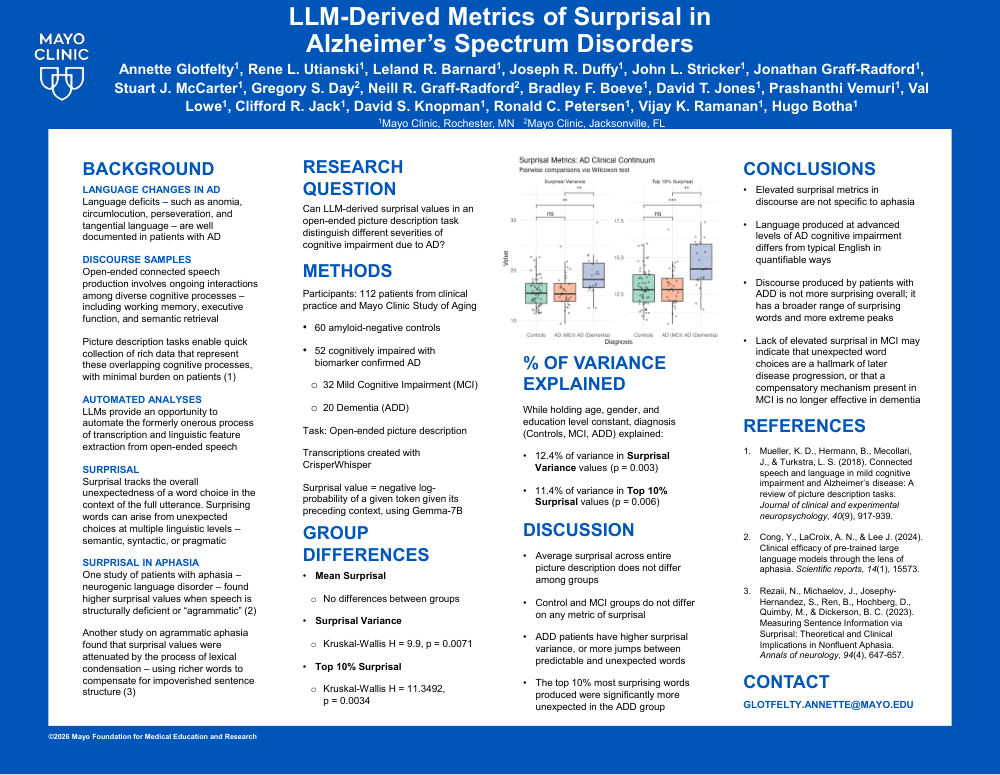
GROUP DIFFERENCES
• Mean Surprisal
o No differences between groups
• Surprisal Variance
o Kruskal-Wallis H = 9.9, p = 0.0071
• Top 10% Surprisal
o Kruskal-Wallis H = 11.3492,
p = 0.0034
METHODS
Participants: 112 patients from clinical
practice and Mayo Clinic Study of Aging
• 60 amyloid-negative controls
• 52 cognitively impaired with
biomarker confirmed AD
o 32 Mild Cognitive Impairment (MCI)
o 20 Dementia (ADD)
Task: Open-ended picture description
Transcriptions created with
CrisperWhisper
Surprisal value = negative logprobability
of a given token given its
preceding context, using Gemma-7B
% OF VARIANCE EXPLAINED
While holding age, gender, and
education level constant, diagnosis
(Controls, MCI, ADD) explained:
• 12.4% of variance in Surprisal
Variance values (p = 0.003)
• 11.4% of variance in Top 10%
Surprisal values (p = 0.006)
DISCUSSION
• Average surprisal across entire
picture description does not differ
among groups
• Control and MCI groups do not differ
on any metric of surprisal
• ADD patients have higher surprisal
variance, or more jumps between
predictable and unexpected words
• The top 10% most surprising words
produced were significantly more
unexpected in the ADD group
CONCLUSIONS
Elevated surprisal metrics in
discourse are not specific to aphasia
• Language produced at advanced
levels of AD cognitive impairment
differs from typical English in
quantifiable ways
• Discourse produced by patients with
ADD is not more surprising overall; it
has a broader range of surprising
words and more extreme peaks
• Lack of elevated surprisal in MCI may
indicate that unexpected word
choices are a hallmark of later
disease progression, or that a
compensatory mechanism present in
MCI is no longer effective in dementia
REFERENCES
1. Mueller, K. D., Hermann, B., Mecollari,
J., & Turkstra, L. S. (2018). Connected
speech and language in mild cognitive
impairment and Alzheimer’s disease: A
review of picture description tasks.
Journal of clinical and experimental
neuropsychology, 40(9), 917-939.
2. Cong, Y., LaCroix, A. N., & Lee J. (2024).
Clinical efficacy of pre-trained large
language models through the lens of
aphasia. Scientific reports, 14(1), 15573.
3. Rezaii, N., Michaelov, J., Josephy-
Hernandez, S., Ren, B., Hochberg, D.,
Quimby, M., & Dickerson, B. C. (2023).
Measuring Sentence Information via
Surprisal: Theoretical and Clinical
Implications in Nonfluent Aphasia.
Annals of neurology, 94(4), 647-657.
CONTACT
Glotfelty.Annette@mayo.edu
Comments
Email is required but is not shown publicly.
Loading comments...