4,068 posters, 219 videos, 101 topics, 69 sessions, 14,365 authors, 6,128 institutions
ePostersLive by SciGen Technologies S.A. All rights reserved.
Alzheimer's Association International Conference 2026
July 12-15, 2026 | London, United Kingdom, and Online

1102
Hierarchical MRI-EHR Framework For Alzheimer’s And Mixed AD/ Vascular Dementia Subtyping
Part of Topic
Background: Distinguishing Alzheimer’s disease (AD) from mixed or vascular cognitive
syndromes is challenging in routine memory-clinic practice. This distinction is increasingly
important because of knowledge of modifiable vascular risk factors and emerging disease
modifying AD therapies require accurate case selection, while vascular burden may influence
treatment safety and remains clinically actionable.
Methods: We used structural magnetic resonance imaging (MRI) volumetrics, white
matter hyperintensities (WMH) segmentation, radiology-report-derived features, demographic
variables, Mini-Mental State Examination (MMSE) scores and clinical comorbidities from
a cohort drawn from South London and Maudsley memory services to classify diagnoses
into AD, Mixed and Non-AD groups. We compared four XGBoost-based models: a direct
three-class model without WMH, a direct three-class model with WMH, a hierarchical model
without WMH and a hierarchical model with WMH. The main analysis used one available
baseline MRI per participant, XGBoost internal missing-value handling, and participant
grouped nested cross-validation with 5 outer folds and 10 inner folds. Model interpretability
was assessed using gain-based feature importance and supplementary SHAP-style dependence
plots.
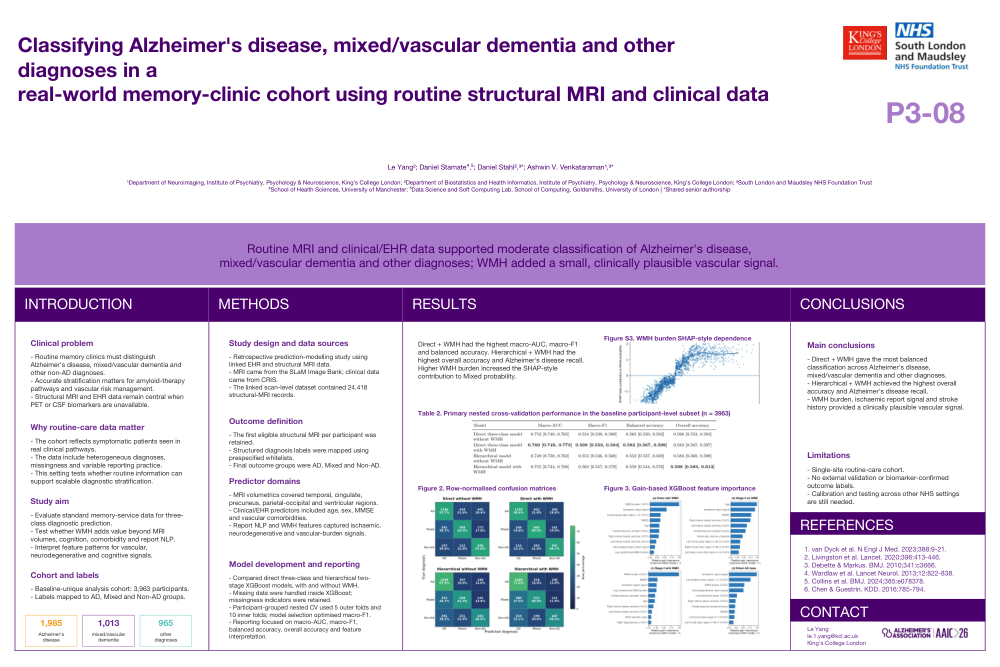
Results: The baseline participant-level cohort included 3,963 participants. The direct
three-class model with WMH had the highest point estimates for macro-AUC (0.760, 95%
CI 0.749–0.773), macro-F1 (0.569, 95% CI 0.553–0.584), and balanced accuracy (0.582, 95%
CI 0.567–0.599). The hierarchical model with WMH had the highest point estimate for
overall accuracy (0.598, 95% CI 0.583–0.613). Adding WMH produced consistent but modest
improvements across both modelling strategies.
Conclusions: In this real-world memory-clinic cohort, the direct three-class model
with WMH had the strongest point estimates for class-balanced performance, whereas the
hierarchical model with WMH had the highest point estimate for overall accuracy and retained
a clinically interpretable two-stage structure. Explainability analyses highlighted clinically
plausible vascular, neurodegenerative and cognitive signals, with WMH and ischaemic report
features particularly relevant to Mixed classification. WMH added modest but consistent
1information, supporting further validation of vascular-burden-aware models as decision
support tools in routine dementia assessment.
Keywords: Alzheimer’s disease; mixed dementia; vascular dementia; memory clinic;
magnetic resonance imaging; white matter hyperintensities; machine learning
Comments
Email is required but is not shown publicly.
Loading comments...