4,068 posters, 219 videos, 101 topics, 69 sessions, 14,365 authors, 6,128 institutions
ePostersLive by SciGen Technologies S.A. All rights reserved.
Alzheimer's Association International Conference 2026
July 12-15, 2026 | London, United Kingdom, and Online

3828
Characteristics Of Infusion-related Reactions To Lecanemab In Early AD: A Multicenter Real-world Study In Northwestern China
Poster Presenter
Authors
Part of Topic
Characteristics of infusion-related reactions to lecanemab in early Alzheimer’s disease: a multicenter real-world study in Northwestern China
Peijie Liu1*, Jie Liu1*, Ying Du2, Zhirong Liu3, Hong Zhang4, Aiqin Zhu5, Gejuan Zhang6, Xinling Meng7, Chunmei Zhao8, Weiping Zhang9, Liangjun Dang1, Wei Zhang2+, Jin Wang1+, Qiumin Qu1+, Yan Qu1+
1Department of Neurology, The First Affiliated Hospital of Xi’an Jiaotong University, Xi’an, China
2Department of Neurology, Tangdu Hospital, Air Force Medical University, Xi’an, China
3Department of Neurology, Xijing Hospital, Air Force Medical University, Xi’an, China
4Department of Neurology, Shaanxi Provincial People’s Hospital, Xi’an, China
5Department of Geriatrics, Qinghai Provincial People’s Hospital, Xining, China
6Department of Neurology, The Affiliated Hospital of Northwest University, Xi’an No.3 Hospital, Xi’an, China
7Encephalopathy Department I, The Fourth Affiliated Hospital of Xinjiang Medical University (Xinjiang Hospital of Traditional Chinese Medicine), Urumqi, China
8Department of Neurology, General Hospital of Ningxia Medical University, Yinchuan, China.
9Department of Neurology, Xi’an Central Hospital, Xi’an, China
Abstract
INTRODUCTION
Lecanemab is the first drug approved by the FDA for the treatment of early Alzheimer’s disease (AD). Infusion-related reactions (IRRs) represent the most common adverse events associated with Lecanemab. However, real-world data on IRR characteristics and risk factors in Asian populations, particularly Chinese, remain scarce.
METHODS
In a multicenter prospective registry, 139 patients with early Alzheimer’s disease (AD) receiving lecanemab were included. IRRs were physician-confirmed. Multivariable logistic regression identified independent predictors.
RESULTS
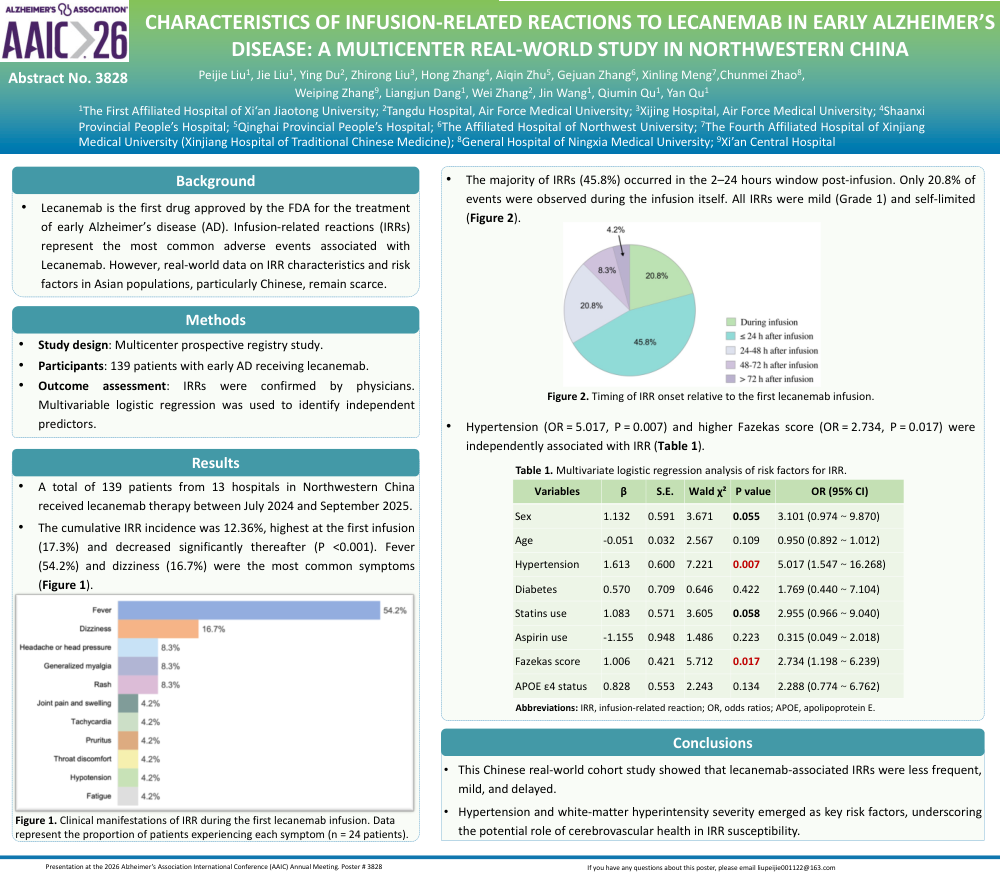
A total of 139 patients from 13 hospitals in Northwestern China received lecanemab therapy between July 2024 and September 2025. The cumulative IRR incidence was 12.36%, highest at the first infusion (17.3%) and decreased significantly thereafter (P < 0.001). Fever (54.2%) and dizziness (16.7%) were the most common symptoms. 45.8% of IRRs occurred 2-24 hours after infusion. All IRRs were mild (Grade 1) and self-limited. Hypertension (OR = 5.017, P = 0.007) and higher Fazekas score (OR = 2.734, P = 0.017) were independently associated with IRR.
DISCUSSION
In this Chinese real‑world cohort, lecanemab‑associated IRRs were less frequent, mild, and delayed. Hypertension and white‑matter hyperintensity severity emerged as key risk factors, underscoring the potential role of cerebrovascular health in IRR susceptibility.
HIGHLIGHTS
•Lower incidence, mild severity, and delayed onset characterize lecanemab‑associated IRRs in the Northwestern Chinese cohort.
•The IRR incidence was highest at the first lecanemab infusion and decreased significantly thereafter.
•Hypertension and white matter hyperintensity burden (higher Fazekas scores) are independent risk factors of IRRs.
KEYWORDS
Alzheimer’s disease, lecanemab, infusion-related reaction, risk factors, real-world study
Comments
Email is required but is not shown publicly.
Loading comments...