Loading...

4,068 posters, 219 videos, 101 topics, 69 sessions, 14,365 authors, 6,128 institutions

ePostersLive by SciGen Technologies S.A. All rights reserved.

Alzheimer's Association International Conference 2026

July 12-15, 2026 | London, United Kingdom, and Online

Alzheimer's Association International Conference 2026 banner

10506

Recruitment And Adherence Relative To The Covid-19 Pandemic In The PAAD-2 Exercise Trial For Midlife Adults At Risk Of Alzheimer’s Disease
Part of Topic

Recruitment and adherence relative to the COVID-19 pandemic in the PAAD-2 exercise trial for midlife adults at risk of Alzheimer’s disease

 Jennifer L. Etnier1, Brittany D. Armstrong1, William B. Karper1, Kyoung Shin Park1,2, Alexis Slutsky-Ganesh1,3, Jeffrey D. Labban1,4, Emily Mcgeehan1,5,

Jarod C. Vance1,6, Samuel W. Kibildis1,7, Samantha L. DuBois1,8, Hadassah Som-Pimpong1,9, Laurie Wideman1

1University of North Carolina at Greensboro, NC; 2Emory University, Atlanta, GA; 3 North Carolina Agricultural and Technical State University, NC, 4University of Tennessee, Knoxville, TN;

5Moses Cone Hospital, Greensboro, NC; 6Longwood University, VA; 7Athens-Clark County Unified Government, GA; 8Appalachian State University, NC; 9Meharry Medical College, Nashville, TN

INTRODUCTION

•In prospective studies, greater physical activity (PA) has been shown to predict better cognitive performance and a decreased risk of dementia (OR=0.55-0.72).1,2
•Experimental studies show that increasing PA improves cognitive performance in cognitively normal adults.3
•Given these findings and the absence of a cure for Alzheimer’s disease (AD), it is important to further our understanding of how PA might be used to prevent or delay AD.
•In the Physical Activity and Alzheimer’s Disease 2 study (PAAD-2; NIH R01AG058919), we examined the effects of a one-year exercise intervention on cognition, brain health, and blood-based biomarkers in cognitively unimpaired (MoCA ≥ 26), community-dwelling middle-aged (40-65 years) adults with a family history of AD (FH+).4
•Here, we report on recruitment strategies and efficacy and on adherence to the one-year exercise program.
 
METHODS
•Cognitively unimpaired (MoCA=27.92±1.69) adults (N=180, Age=56.4±6.42 years) who had a FH+ and did not meet current PA guidelines (i.e., <90 min moderate/vigorous PA/week) were randomized to an exercise intervention (group strength training + moderate-intensity walking 3x/week) or usual care control group.
•Effectiveness and costs of recruitment was tracked across seven distinct categories: Social Media, Search Engines, Traditional Media, Word of Mouth, Email Campaigns, Printed Materials, and Community Events,.
•Exercise adherence was assessed in the 98 participants assigned to the exercise condition. Group exercise sessions were face-to-face from August 2019 to March 2020 and then pivoted to a fully virtual format in response to COVID-19 pandemic restrictions.
•Attendance at strength training sessions was reported by the group exercise leader and performance of walking was tracked weekly via self-report in REDCap.
•Retention (percent remaining active), dropout rate (percent not completing post-test), and adherence (percent sessions attended by those who completed post-test) of the exercise group are presented.
 
RESULTS

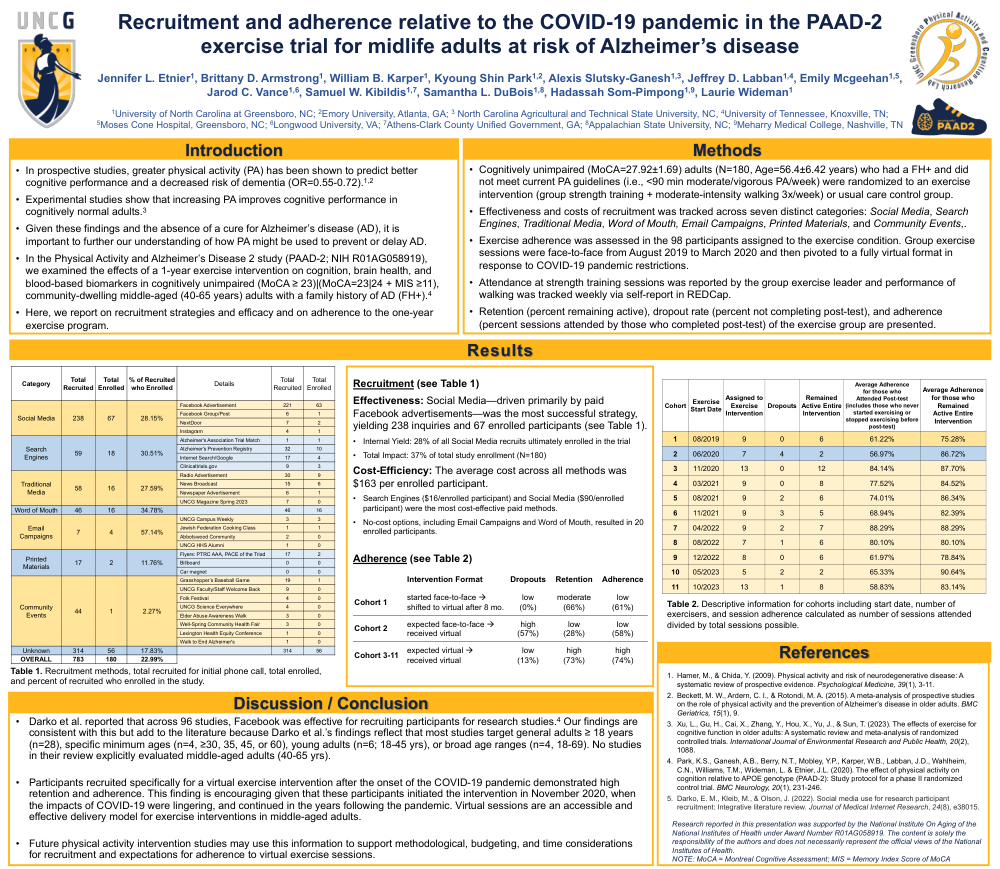
Recruitment (see Table 1)

Effectiveness: Social Media—driven primarily by paid Facebook advertisements—was the most successful strategy, yielding 238 inquiries and 67 enrolled participants (see Table 1).

•Internal Yield: 28% of all Social Media recruits ultimately enrolled in the trial
•Total Impact: 37% of total study enrollment (N=180)

Cost-Efficiency: The average cost across all methods was $163 per enrolled participant.

•Search Engines ($16/enrolled participant) and Social Media ($90/enrolled participant) were the most cost-effective paid methods.
•No-cost options, including Email Campaigns and Word of Mouth, resulted in 20 enrolled participants.

Adherence (see Table 2)

DISCUSSION/CONCLUSIONS

•Darko et al. reported that across 96 studies, Facebook was effective for recruiting participants for research studies.4 Our findings are consistent with this but add to the literature because Darko et al.’s findings reflect that most studies target general adults ≥ 18 years (n=28), specific minimum ages (n=4, ≥30, 35, 45, or 60), young adults (n=6; 18-45 yrs), or broad age ranges (n=4, 18-69). No studies in their review explicitly evaluated middle-aged adults (40-65 yrs).
•
•Participants recruited specifically for a virtual exercise intervention after the onset of the COVID-19 pandemic demonstrated high retention and adherence. This finding is encouraging given that these participants initiated the intervention in November 2020, when the impacts of COVID-19 were lingering, and continued in the years following the pandemic. Virtual sessions are an accessible and effective delivery model for exercise interventions in middle-aged adults.
•
•Future physical activity intervention studies may use this information to support methodological, budgeting, and time considerations for recruitment and expectations for adherence to virtual exercise sessions.
 
REFERENCES
1.Hamer, M., & Chida, Y. (2009). Physical activity and risk of neurodegenerative disease: A systematic review of prospective evidence. Psychological Medicine, 39(1), 3-11.
2.Beckett, M. W., Ardern, C. I., & Rotondi, M. A. (2015). A meta-analysis of prospective studies on the role of physical activity and the prevention of Alzheimer’s disease in older adults. BMC Geriatrics, 15(1), 9.
3.Xu, L., Gu, H., Cai, X., Zhang, Y., Hou, X., Yu, J., & Sun, T. (2023). The effects of exercise for cognitive function in older adults: A systematic review and meta-analysis of randomized controlled trials. International Journal of Environmental Research and Public Health, 20(2), 1088.
4.Park, K.S., Ganesh, A.B., Berry, N.T., Mobley, Y.P., Karper, W.B., Labban, J.D., Wahlheim, C.N., Williams, T.M., Wideman, L. & Etnier, J.L. (2020). The effect of physical activity on cognition relative to APOE genotype (PAAD-2): Study protocol for a phase II randomized control trial. BMC Neurology, 20(1), 231-246.
5.Darko, E. M., Kleib, M., & Olson, J. (2022). Social media use for research participant recruitment: Integrative literature review. Journal of Medical Internet Research, 24(8), e38015.

 Research reported in this presentation was supported by the National Institute On Aging of the National Institutes of Health under Award Number R01AG058919. The content is solely the responsibility of the authors and does not necessarily represent the official views of the National Institutes of Health.

Comments

Email is required but is not shown publicly.

Loading comments...

aaic2026 banner
Copyright © 2015-2026, ePostersLive® SciGen is a registered trademark of SciGen Technologies S.A. Patent pending.

This website and third-party tools we use rely on cookies for the best user experience. By selecting "I agree", you agree to cookie usage as described in our Privacy Policy.