Loading...

4,068 posters, 219 videos, 101 topics, 69 sessions, 14,365 authors, 6,128 institutions

ePostersLive by SciGen Technologies S.A. All rights reserved.

Alzheimer's Association International Conference 2026

July 12-15, 2026 | London, United Kingdom, and Online

Alzheimer's Association International Conference 2026 banner

680

Post-delirium Cognitive Impairment 6 Months After Hospitalisation Among Older Ghanaians
Part of Topic

Background

Delirium is a potentially modifiable risk factor for dementia1. However, post-delirium cognition has hardly been studied in Africa, where the burden of both disorders is rising disproportionately2.

This pilot study estimated the incidence of new-onset cognitive impairment (NCI)among hospitalized older Ghanaians, 6-months after hospitalization with non-stroke delirium


Methods

Design & Population

Prospective observational study assessing cognitive functioning of 60 older adults 6 months after medical hospitalization with prevalent delirium (presumably present on admission).

§Inclusion criteria: age ≥60 yrs; prevalent delirium; during medical admission via A&E
§Exclusion criteria: stroke; ICSOL; confirmed or probable dementia (Short Form  of the Informant Questionnaire for Cognitive Decline in the Elderly,  short IQCODE score >3.31);  terminal diagnoses, inability to speak English or Twi, interfering medical/mental illness or intervention; or inability to attend follow up visits

Data Collection

§Delirium: Confusion Assessment Method:

(confirmation) + CAM-S (severity) within

24-72 hours of admission, twice weekly

until discharge, and at each follow-up

visit (6w, 3m & 6m).

§Global Cognitive Assessment:  IDEA

Study Cognitive Screening tool (0-15)3

Outcomes

§Primary: NCI= IDEA <8 + CAM-negative @6 months
§Secondary: Attrition (mortality & loss-to follow-up/withdrawal)

Data Analysis

§Calculated cumulative incidence factor (CIF) for NCI with competing mortality risk and right censoring due to dropout. Attrition-presented as %
§Fitted Cox regression models and estimated unadjusted hazard ratios of mortality with 95% confidence intervals (95%CI) to identify drivers of mortality in sample.


Results

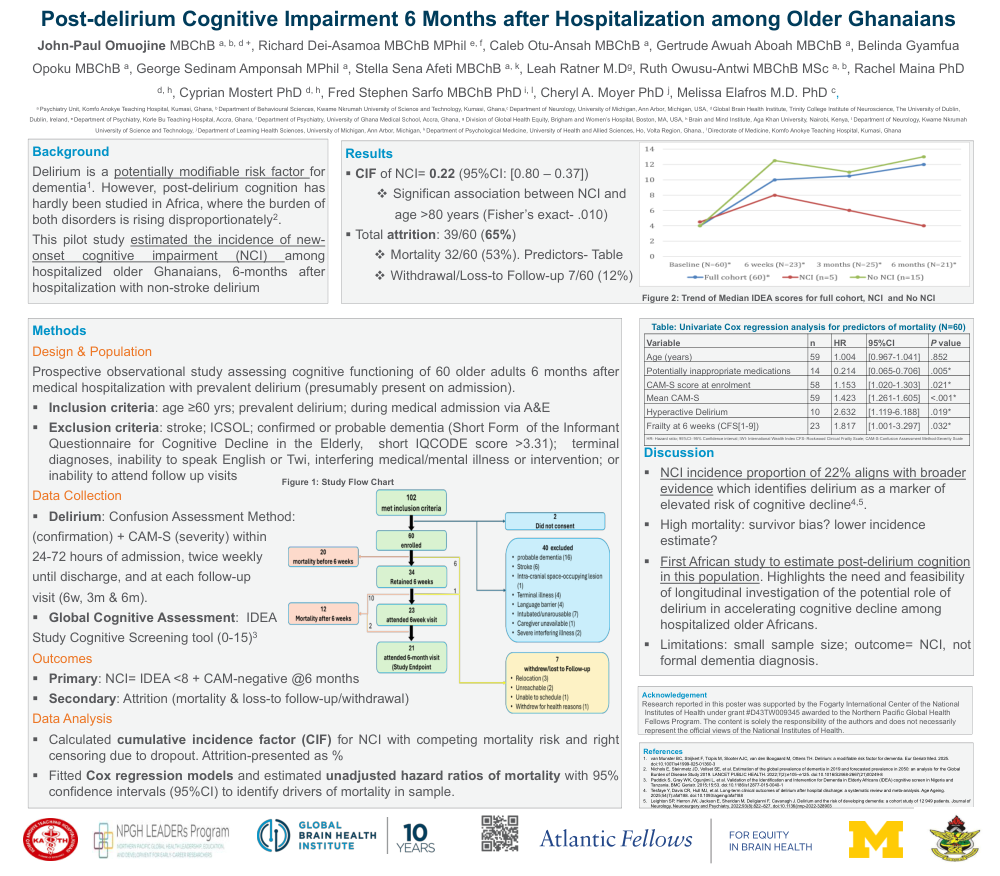
§CIF of NCI= 0.22 (95%CI: [0.80 – 0.37])
vSignifican association between NCI and

     age >80 years (Fisher’s exact- .010)

§Total attrition: 39/60 (65%)
vMortality 32/60 (53%). Predictors- Table
vWithdrawal/Loss-to Follow-up 7/60 (12%)  


Discussion

§NCI incidence proportion of 22% aligns with broader evidence which identifies delirium as a marker of elevated risk of cognitive decline4,5.
§High mortality: survivor bias? lower incidence estimate?
§First African study to estimate post-delirium cognition in this population. Highlights the need and feasibility of longitudinal investigation of the potential role of delirium in accelerating cognitive decline among hospitalized older Africans.
§Limitations: small sample size; outcome= NCI, not formal dementia diagnosis.
 

Acknowledgement

Research reported in this poster was supported by the Fogarty International Center of the National Institutes of Health under grant #D43TW009345 awarded to the Northern Pacific Global Health Fellows Program. The content is solely the responsibility of the authors and does not necessarily represent the official views of the National Institutes of Health.


References

1.van Munster BC, Strijkert F, Trzpis M, Slooter AJC, van den Boogaard M, Ottens TH. Delirium: a modifiable risk factor for dementia. Eur Geriatr Med. 2025. doi:10.1007/s41999-025-01360-3
2.Nichols E, Steinmetz JD, Vollset SE, et al. Estimation of the global prevalence of dementia in 2019 and forecasted prevalence in 2050: an analysis for the Global Burden of Disease Study 2019. LANCET PUBLIC HEALTH. 2022;7(2):e105–e125. doi:10.1016/S2468-2667(21)00249-8
3.Paddick S, Gray WK, Ogunjimi L, et al. Validation of the Identification and Intervention for Dementia in Elderly Africans (IDEA) cognitive screen in Nigeria and Tanzania. BMC Geriatr. 2015;15:53. doi:10.1186/s12877-015-0040-1
4.Tesfaye Y, Davis CR, Hull MJ, et al. Long-term clinical outcomes of delirium after hospital discharge: a systematic review and meta-analysis. Age Ageing. 2025;54(7):afaf188. doi:10.1093/ageing/afaf188
5.Leighton SP, Herron JW, Jackson E, Sheridan M, Deligianni F, Cavanagh J. Delirium and the risk of developing dementia: a cohort study of 12 949 patients. Journal of Neurology, Neurosurgery and Psychiatry. 2022;93(8):822–827. doi:10.1136/jnnp-2022-328903

Comments

Email is required but is not shown publicly.

Loading comments...

aaic2026 banner
Copyright © 2015-2026, ePostersLive® SciGen is a registered trademark of SciGen Technologies S.A. Patent pending.

This website and third-party tools we use rely on cookies for the best user experience. By selecting "I agree", you agree to cookie usage as described in our Privacy Policy.