4,068 posters, 219 videos, 101 topics, 69 sessions, 14,365 authors, 6,128 institutions
ePostersLive by SciGen Technologies S.A. All rights reserved.
Alzheimer's Association International Conference 2026
July 12-15, 2026 | London, United Kingdom, and Online

3723
Explainable AI Reveals Hidden Treatment-Responsive Subgroups In The A4 Solanezumab Trial
Part of Topic
Explainable AI Reveals Hidden Treatment-Responsive Subgroups in the A4 Solanezumab
Trial
Authorship:
Joseph Geraci 1,2,3 ; Jan Sedway 1 , Bessi Qorri 1 , Mike Tsay 1 , Christian Cumbaa 1 , Paul Leonchyk 1 ,
Larry Alphs 1 , LucaPani 4,5
1 NetraMark, Toronto, Canada, 2 Department of Pathology and Molecular Medicine, Queen's
University, Kingston, Canada, 3 Centre for Biotechnology and Genomic Medicine, Medical
College of Georgia, Augusta, GA, United States of America, 4 Department of Psychiatry and
Behavioral Sciences, Leonard M. Miller School of Medicine, University of Miami, Coral Gables,
FL, United States of America, 5 Department of Biomedical, Metabolic and Neural Sciences,
University of Modena and Reggio Emilia, Modena, Italy,
Background
Identifying differential subpopulation treatment response is critical for addressing heterogeneity
in MCI/AD. Although negative trials contain potential insights, they are rarely leveraged for
effective exploration of treatment effect heterogeneity due to low power, multiplicity, and difficulty
modeling higher-order interactions. The objective of this study is to identify clinically
interpretable subpopulations within the Anti-Amyloid Treatment in Asymptomatic Alzheimer’s
Disease (A4) Study that may exhibit differential response to solanezumab using an explainable
AI-based approach that uniquely allows for the discovery of synergistic variables, overcoming
the challenges of traditional methods.
Methods
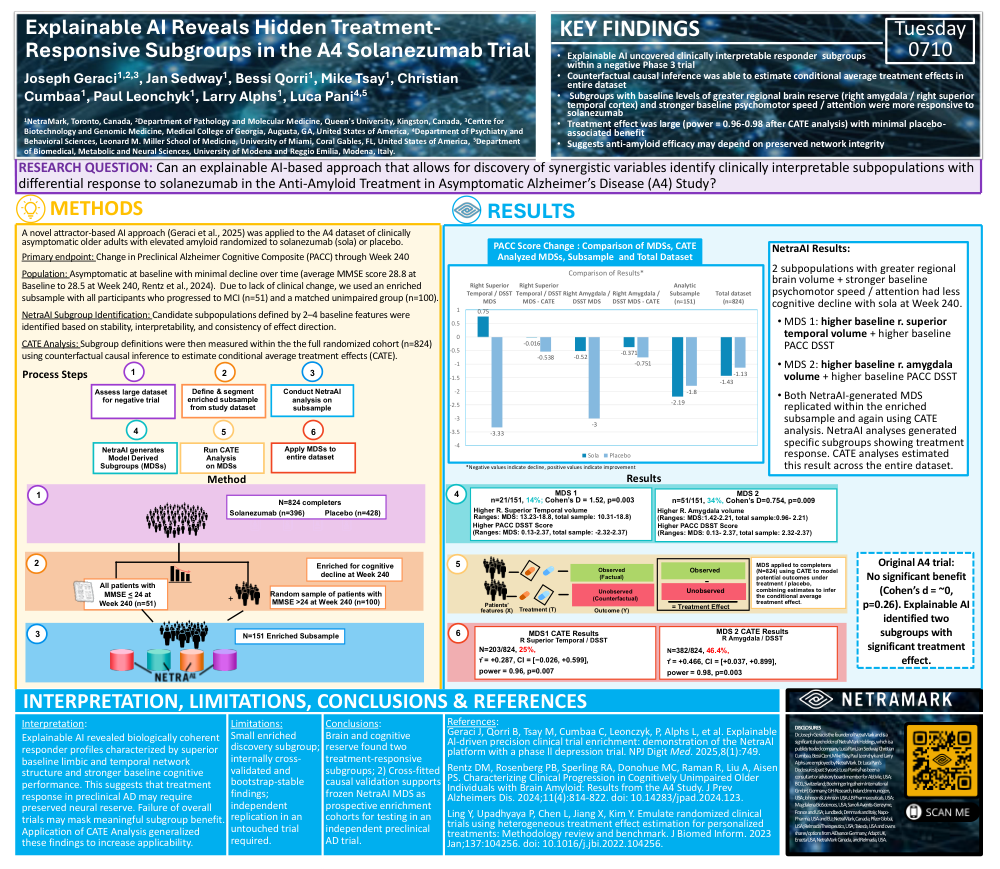
A novel attractor-based AI approach was applied to the A4 dataset of clinically asymptomatic
older adults with elevated amyloid randomized to solanezumab or placebo. The primary
endpoint was change in Preclinical Alzheimer Cognitive Composite (PACC) through Week 240.
To increase sensitivity to treatment heterogeneity, an enriched subsample was constructed
including participants who progressed to MCI (n=51) and a matched unimpaired group (n=100).
Candidate subpopulations defined by 2–4 baseline features were identified based on stability,
interpretability, and consistency of effect direction.
Identified subpopulation profiles were then evaluated in the full randomized cohort (n=824)
using counterfactual causal inference to estimate conditional average treatment effects (CATE).
Results
Two treatment-responsive subpopulations were identified in the enriched sample (n=151) and
reproduced in the full cohort.
One subgroup (382/824; 46.4%), characterized by higher baseline right amygdala volume and
Digit Symbol Substitution Test (DSST) performance, showed attenuated cognitive decline with
solanezumab versus placebo (τ̂ = 0.287; 95% CI: −0.026 to 0.599; p=0.007).
A second subgroup (203/824; 25.0%), characterized by higher baseline right superior temporal
volume and DSST performance, demonstrated treatment separation (τ̂ = 0.466; 95% CI: 0.037
to 0.899; p=0.003) with minimal decline in PACC at Week 240 in the solanezumab group.
Conclusions
A novel attractor-based AI learning framework identified biologically and clinically interpretable
subpopulations with potential differential treatment response despite the overall negative A4
study outcome. Preserved regional brain volume and stronger baseline psychomotor
speed/attention may characterize individuals more likely to benefit from solanezumab. These
findings require independent replication and correction for multiple testing but suggest utility for
precision enrichment in future trials.
Comments
Email is required but is not shown publicly.
Loading comments...